
My paternal grandparents, Sara and Chilik Mauer, were raised in a small Jewish community about an hour’s drive from Krakow. Of the approximately 4,400 Jews living in Jędrzejów before the Shoah, my grandparents were among the 80 who survived. Like most Holocaust survivors, they had no home to return to. Their non-Jewish neighbors had claimed their property as their own, and that was, for the most part, where that story ended. After the war, they settled in Germany and attempted to regain a sense of normalcy. Despite their modest success in Germany, they could not contemplate bearing Jewish children in a country that had staked its national pride on the eradication of Jewish life.
Shortly after Israel concluded its war of independence, the two made aliyah. The aspiration of “complete equality of social and political rights to all its inhabitants irrespective of religion, race or sex” envisioned in the country’s declaration of independence appeared a cosmic corrective to their dehumanization. In their neighborhood in Ramat Gan, then a small enclave of Polish Jewry, elderly individuals were nowhere to be found. My grandmother, a woman with a third-grade education and a desire to display a cosmopolitan upbringing, enjoyed describing how she furnished her home. The first piece of furniture to enter was a piano they shipped from Germany. My grandmother viewed the piano as both a symbolic and embodied gateway towards a holistic education. Although they themselves had no musical training or competence, they insisted their children undertake piano lessons. Steering them towards educational pursuits honored the memory of my great-grandmother, Esther. When my grandmother spoke about her, she focused on the values Esther instilled in her children. As their neighborhood was converted into a Nazi ghetto, Esther promised my grandmother, “Even if I have to sell the ring on my finger, you will be educated.”
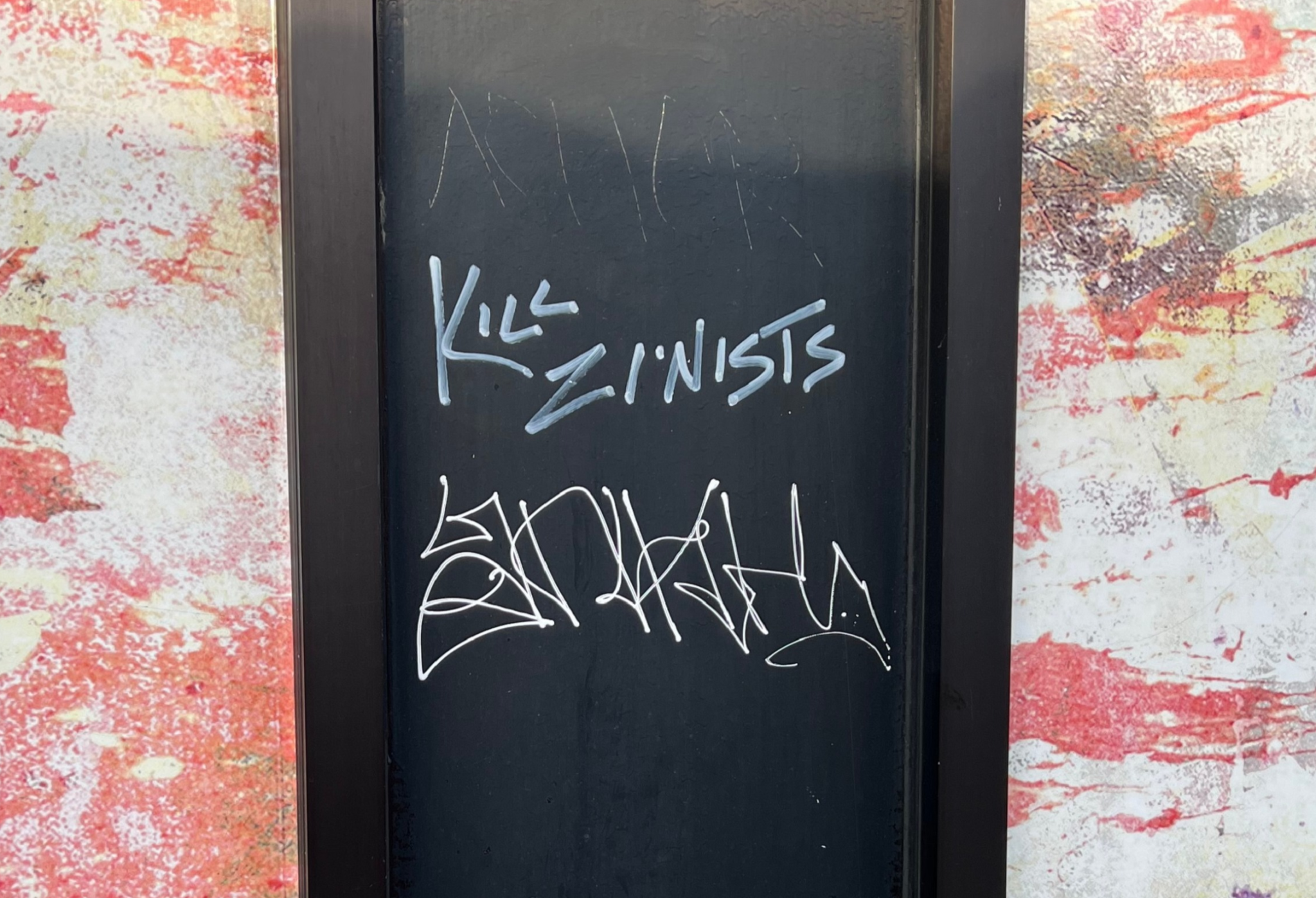
Anti-Zionist Graffiti in Lincoln Park, Chicago, that I came across in December 2024.
Contemporary antisemitism often feels like it echoes the bigotry of the past. One of the more shocking proclamations by masked protestors post-October 7th has been the not infrequent refrain of “Go back to Poland,” documented by reputable legacy media outlets such as The New York Times and the L.A. Times. I often wonder what my grandparents would have thought had they been alive today to witness accounts of this and other comparably bigoted slogans at student protests. Part of me is grateful they are not around to hear about any of it. I suspect they would have felt similarly about a student at Columbia University urging supporters to “Kill Zionists” as they would have about a man in a ski mask shouting “Go back to Poland.” Why do political coalitions engaged in this discourse seem so acutely attentive to the sensitivities of nearly every other minority but clearly care little about Zionism’s prominence within modern Jewish life?
The stigmatization of Zionists post-October 7th in literary circles, academia, healthcare, and popular dating platforms eerily evokes the treatment of Polish Jews after the Six Day War. After Warsaw Pact governments witnessed the defeat of their Middle Eastern allies, they attempted to salvage their humiliation by turning “Zionist” into a word synonymous with fifth-columnist and using this canard to scapegoat local Jewish populations. Starting in March of 1968, a wave of 13,000 Jews fled Poland with one-way travel documents provided by the Polish government. I am grateful my grandparents were spared at least this dark part of Polish history.
Recognizing that post-October 7th calls to exclude or kill Zionists have often been antisemitic in impact, if not in intent, is to acknowledge how this hate has been felt by its recipients. Christian Zionists have not bore the brunt of this harassment like Israelis and diasporic Jews. Over the past two years, Jewish homes, Jewish cultural institutions, Jewish cemeteries, and numerous members of our community have been uniquely targeted by individuals claiming they are simply speaking out against Zionism. Zionism itself – a complex and extensive series of movements envisioning Jewish national liberation in the Near East – is often reduced by these same individuals to any and all actions of the Israeli government, real or perceived. To point out such behavior is not an exercise in adjudicating the ethics of anti-Zionism, but simply to shine a light on actions that should be objectionable to anyone who values basic human decency.
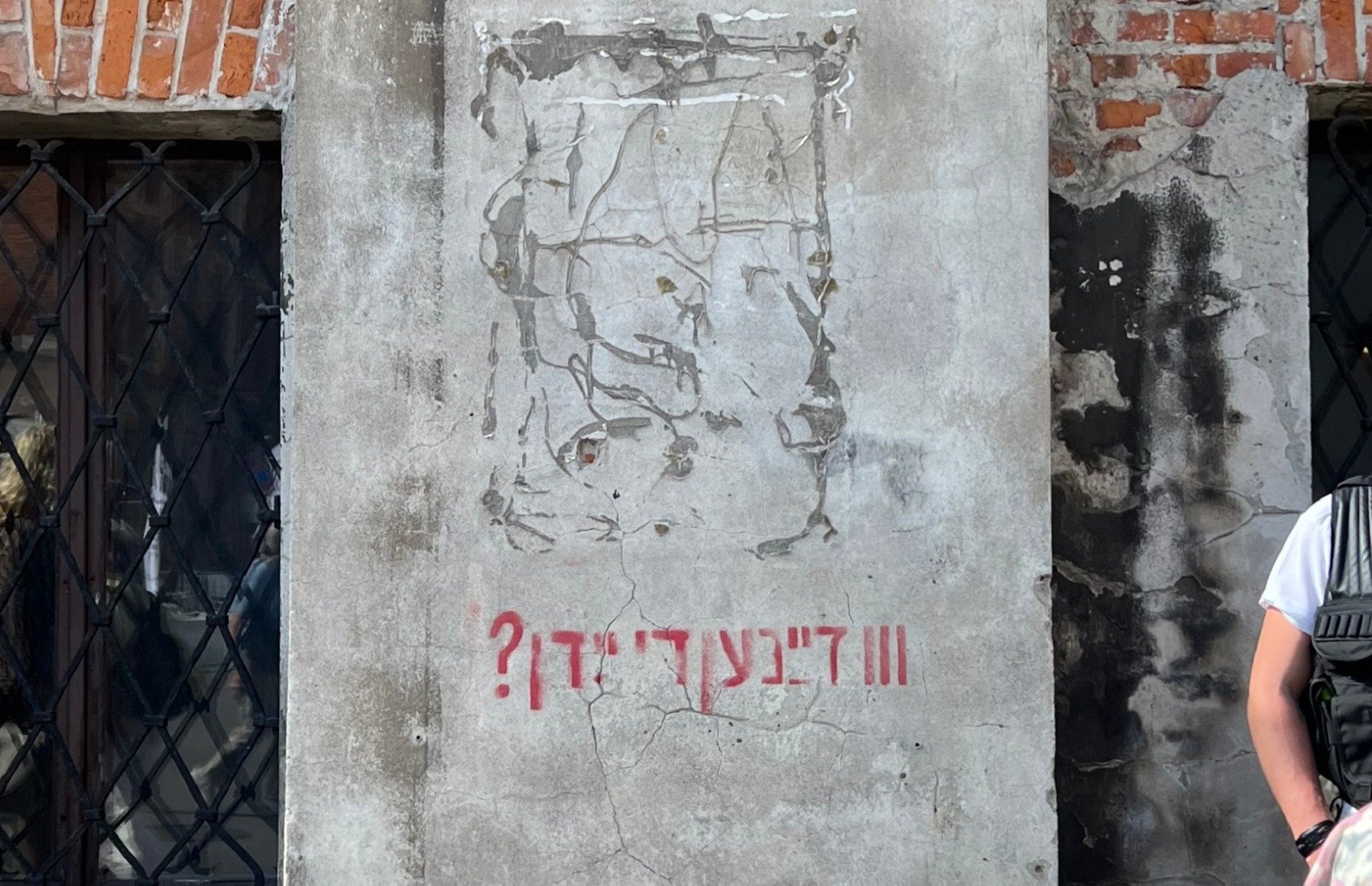
Yiddish graffiti in Krakow’s historic Jewish quarter we observed in June, 2025.
Before stopping in Jędrzejów, we spent a day in Krakow. Among our first destinations was the city’s historic Jewish quarter. Once a bustling center of Jewish life, today the district functions primarily as a commercial center selling patrons a depiction of Ashkenazi-Polish culture from the interwar period. Most striking is the contrast between the number of shops looking to sell a flavor of this idealized Yiddishkeit to tourists and the dearth of homes in the area displaying mezuzahs. After we returned home, I discussed this phenomenon further with my brother. The tourism business surrounding the history of the Jews in Krakow does not come off as ill-intentioned or exploitative, but as descendants of Ashkenazi-Polish survivors, it hardly feels like the actualization of some sort of archetypal redemption arc. This disconnect between what was and what is was exemplified most plainly in graffiti we came across as we walked towards a collection of kosher restaurants: “Vu zaynen di yidn?” the graffiti said. Translated into English, it read, “Where are the Jews?”
Our next major destination was Oskar Schindler’s factory, today famously memorialized thanks to the tremendous work of Steven Spielberg in his 1993 magnum opus Schindler’s List. The stories depicted in Schindler’s List, and by extension the museum, also hold a place in our own family’s heritage, albeit not because of any direct connection, but because of the striking similarities between my grandmother’s story and the survivors in the film. My grandmother, in a similar vein to the Jews Schindler saved, survived the middle of the war under the care of her uncle, who convinced the Nazis she was essential to his work assembling fur coats for Nazi personnel. When she went to the cinema to experience such a poignant homage to her people’s story 50 years later, she found the film too reminiscent of her own experience. Feeling herself reliving the war, she ran out of the theater within the first hour.
As we walked through the halls of the factory museum, the reminder of Jewish civilization and its proverbial absence kept returning. At one point in the tour, my brother thought he heard a young boy point to a picture of the factory workers and ask his parents in German if “all of those people are Jews”, the way someone might marvel at a distinct species depicted in its natural habitat. It was a completely benign question phrased awkwardly by a child likely too young to read any of the accompanying text. Whatever his intention, at that moment, my brother felt more like a dinosaur walking through a natural history museum than a Jew touring a display meant to highlight a high-water mark of non-Jewish magnanimity during one of the darkest moments in our people’s history.
Our visit to Jędrzejów occurred at the tail end of our time in Poland. My father had embarked on a similar trip with his parents 46 years ago. Whatever feelings of triumph my father and grandfather may have felt at the time, they were not shared by my grandmother. As they drove through my grandparents’ childhood neighborhood, my grandmother immediately burst into tears at the sight of her home. Instead of stopping for photographs, my grandfather drove swiftly away to their next destination. They did, however, manage to linger at the sites of both my grandfather’s and great-great-grandmother’s homes. Despite my father’s acute visual memory, the passage of time made our summer trip together significantly more difficult to properly navigate.
Heading towards Jędrzejów by car, my father’s goal was twofold: To revisit the town through the eyes of a father and to place us into the city of his ancestors so that we too could establish a direct connection to our heritage. My brothers and I hoped to reshape our connection with the town from something rooted in inherited stories of violence and destruction into a story of our own making in which our physical presence in Jędrzejów honored the lives of our grandparents. For my mother, the most literary among us and our anchor to Jewish customs, her goal was to support our family on a journey at times difficult to describe.
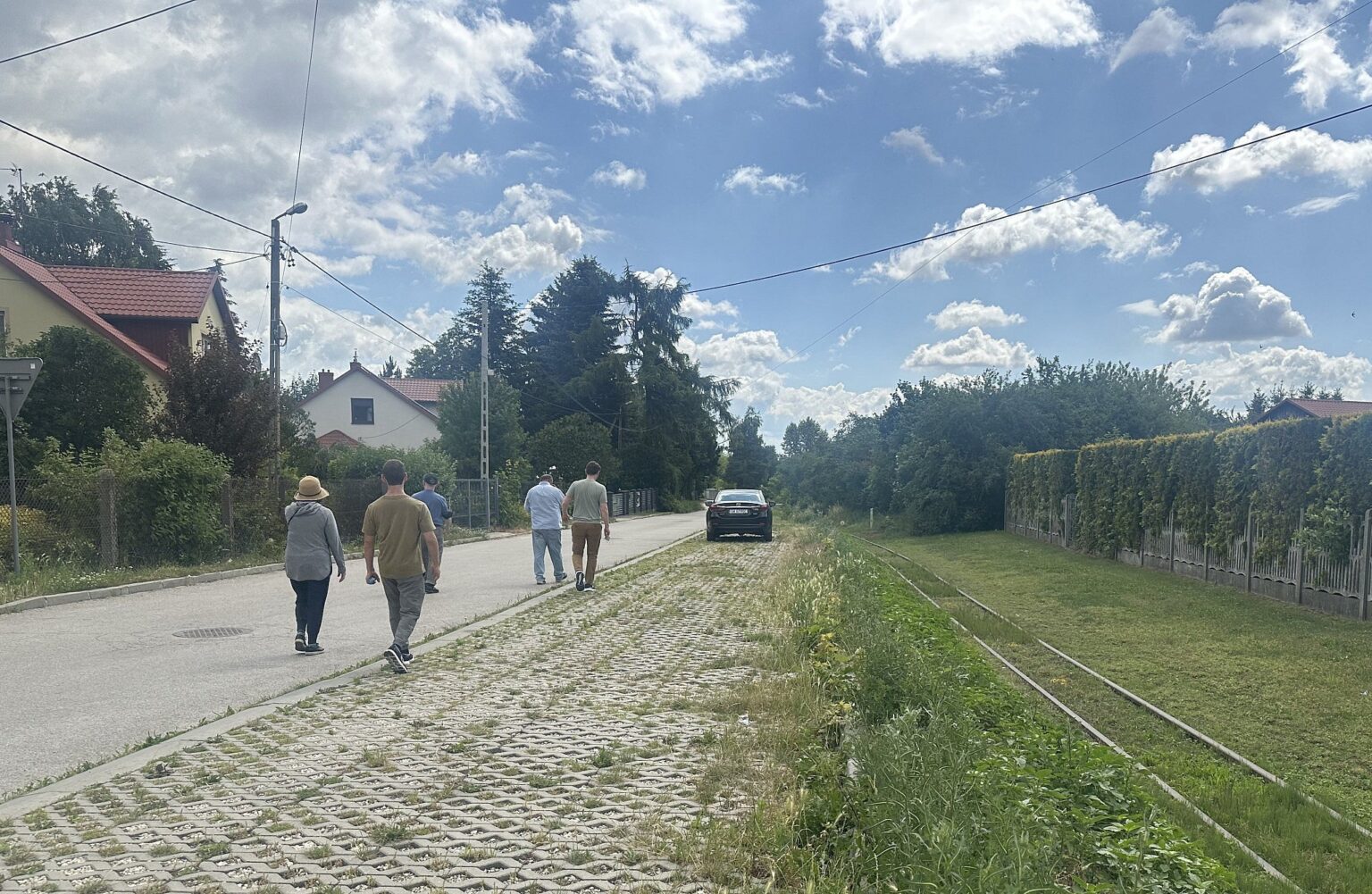
My great-great-grandmother’s home, if it indeed was the same structure, was the easiest to spot; in the town center, we found a small, rusty shack sitting atop an empty plot of land. After walking around the site for a few minutes to take in the moment, we began searching for my grandfather’s home, utilizing landmarks my father remembered from his first trip. In pursuit of a route unreachable by car, we found ourselves walking along a narrow-gauge railway. Its potential function during the early 1940s was not lost on any of us. Eventually, we spotted the town hospital where my grandmother had been treated for appendicitis in September of 1942. When it became clear she would need surgery, her mother used what little money she had left to smuggle her out of the ghetto to undergo the procedure there. My grandmother discovered the Nazis had liquidated her ghetto only days after her appendectomy, when her nurse told her to look out the window. “Those are the trains that took all the Jews away,” her nurse explained.
In defiance of history, my father leisurely walked into the hospital to use the restroom before proceeding with us back towards the center of town. By midafternoon, we managed to find a building matching the description of my grandmother’s childhood home. We got out of the car to take a few photographs and noted a “for sale” sign on the window. My father joked briefly about contacting the owners, and afterwards we said goodbye to Jędrzejów. Before returning to Krakow, we stopped at the site of the nearby Jewish cemetery just outside the town. What we saw showed no markers of a former burial ground; only wheatgrass growing on top of an area we Jews once called our own.
While we drove away, I thought about the lyrics of the famous Israeli folk song Hachita Tzomachat Shuv written to commemorate kibbutzniks massacred during the Yom Kippur War. The song was featured in Professor Noah Efron’s Promised Podcast weeks earlier and had been stuck in my head ever since. The final stanza roughly translates as the following:
“… Indeed this is the same home,
And yet you are unable to return,
And how has it happened, and how has it happened, and how does it still happen,
That the wheat grows again?”
Alec is a student at Tel Aviv University pursuing an MA in Security and Diplomacy Studies. He is interested in exploring the relationship between Israeli policy and diasporic identity. As an undergraduate, Alec studied writing and rhetoric. He was born and raised in Chicago.