
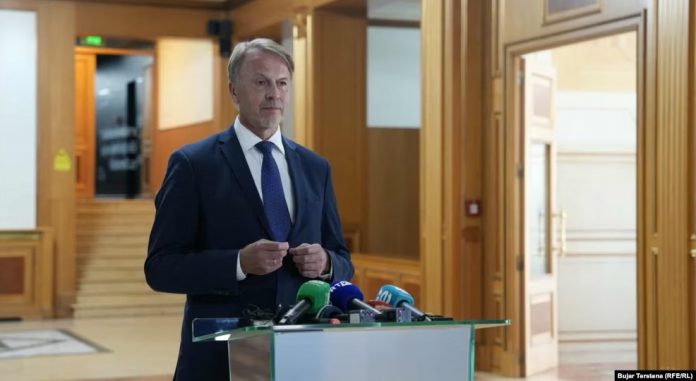
EU Ambassador to Kosovo, Aivo Orav, said he hopes Kosovo will soon form a new government. This would allow authorities to implement the 2025 Progress Report recommendations.
Orav delivered the report to acting Prime Minister Albin Kurti. However, he noted that political deadlock caused Kosovo to lose a year.
“We need partners to make progress in European integration. Specifically, we need a government with a parliamentary majority to advance fundamental freedoms and serve the people. Without it, Kosovo loses opportunities,” Orav said.
He recalled that last year Kosovo led reforms and approached the first EU Western Balkans Growth Plan funds. Moreover, Kosovo made progress in multiple areas.
Orav urged Kosovo’s political elite to unite beyond political and ethnic divisions. In addition, he stressed forming a strong parliamentary majority to ratify the Growth Plan and advance obligations in the dialogue with Serbia.
The report notes Kosovo advanced in six areas: judiciary function, market resilience, employment policies, food policies, and foreign relations. Nevertheless, reforms remain incomplete. Orav said Kosovo must do more to fight corruption, ensure a competitive market, and maintain an effective administration.
He called for improved freedom of expression. Kosovo needs new laws for the Independent Media Commission and public broadcaster funding. Furthermore, the anti-corruption strategy must align with EU standards.
Orav also mentioned gradual lifting of EU sanctions from 2023. Yet, this requires transferring local authority in the north after elections and reducing tensions.
Kurti said the acting government successfully fulfilled its duties. “This year, we progressed in 36 areas, with delays in only three. Overall, we advanced from limited to substantial progress,” he said.
The report highlights political deadlock. Since February 9 elections, Kosovo has not formed a new executive. Consequently, this blocked ratification of EU Growth Plan agreements worth €6 billion, with Kosovo set to receive around €900 million.
The report urges Kosovo to strengthen anti-corruption measures, improve high-level investigations, and boost cooperation between the Special Investigation Unit and the Special Prosecution. Kosovo also made progress in combating organized crime.
Judiciary and media reforms need attention. Kosovo improved case delays and digitalization, but the Judicial and Prosecutorial Councils lack full membership. Additionally, fundamental rights require stronger protection. Media freedom fell to its lowest in 15 years, ranking 99th of 180 countries.
Public administration reforms must continue. The report recommends merit-based hiring, performance evaluation, gender equality measures, reducing vacant posts, finalizing job classifications, and implementing the new salary system. Also, increasing e-services can reduce administrative burdens.
The report covers September 1, 2024, to September 1, 2025. It draws on data from Kosovo’s government, EU member states, the European Parliament, and international and local NGOs.
/a.c/