
This study further employed the ordinary least squares (OLS) method to statistically evaluate the impact of bird, insect, and plant species diversity on the Perceptual Restorability Scale (PRS) in visual (G1) and the audiovisual group (G2) (Fig. 10; Table 12). The PRS comprises four dimensions: fascination, distance, compatibility, and extent. The results indicate that multisensory biodiversity perception significantly positively affects PRS (Fig. 11).
In the visual group (G1), plant species diversity had the most significant impact on “fascination” (β = 0.603, F = 49.165, P < 0.001), “being away from” (β = 0.529, F = 33.37, P < 0.001), and “compatibility” (β = 0.531, F = 33.683, P < 0.001). Additionally, the analysis revealed that bird species diversity had the greatest impact on “extent” (β = 0.321, F = 9.891, P < 0.01). In the audiovisual group (G2), plant species diversity also showed the most significant impact across all dimensions, particularly on “compatibility” (β = 0.648, F = 62.35, P < 0.001) and “Extent” (β = 0.57, F = 41.459, P < 0.001).
In both groups, the impact of plant species diversity on PRS was generally more significant than that of bird and insect species. Additionally, the β values for compatibility and extent were higher in the audiovisual group (G2) relative to the visual group (G1), indicating that the audiovisual experience potentially amplifies the effect of species diversity on PRS. Furthermore, the audiovisual experience has the potential to amplify this effect. It is noteworthy that the role of plant species diversity in promoting perceived restorativeness is prominent.
The findings of this study are consistent with previous research. Joel Methorst (2021) obtained socioeconomic data from European citizens and macro-level species diversity across 26 countries or regions in Europe, demonstrating a positive correlation between bird species richness and life satisfaction42. Li Yaocheng (2021) conducted a correlation study using 16 plant diversity indicators with citizens’ mental recovery values, analyzing whether the quality of environmental restorativeness was influenced by plant diversity. The results indicated that perceived plant diversity had a stronger correlation with participants’ mental recovery43.
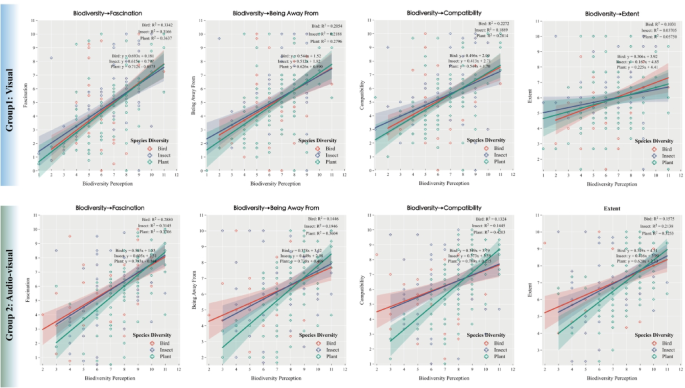
The impact of multisensory biodiversity perception on PRS based on OLS. The top four images represent the visual group, the bottom four images represent the audiovisual group, the x-axis represents biodiversity perception (the three different line colors represent bird, insect, and plant species diversity), and the y-axis represents four dimensions on PRS, including fascination, being away from, compatibility, and extent.
Effects of multisensory biodiversity perception on emotional evaluation
On the other hand, perceived biodiversity significantly impacted the two dimensions of emotional evaluation, “unpleasure-pleasure” and “calm-nervous,” in both the visual group (G1) and the audiovisual group (G2) (Fig. 12; Table 13). In the “visual group (G1) × pressure stage (S1),” plant species diversity had the most pronounced effect on the “unpleasure-pleasure” emotional dimension (β = 0.498, F = 28.349, P < 0.001). In the “visual group (G1) × recovery stage (S2),” the path effect remained significant (β = 0.354, F = 12.317, P < 0.001), but the impact was relatively reduced compared to the pressure stage (S1).
In the “audiovisual group (G2) × pressure stage (S1),” the effects on the “unpleasure-pleasure” emotional dimension were significantly positive for bird species diversity (β = 0.49, F = 27.164, P < 0.000), insect diversity (β = 0.32, F = 9.816, P < 0.002), and plant species diversity (β = 0.38, F = 9.027, P < 0.003). These effects further intensified during the recovery stage (S2), particularly for plant species diversity (β = 0.578, F = 43.038, P < 0.000). Regarding the “calm-nervous” dimension, the impact of plant species diversity was the most significant (β = -0.385, F = 14.947, P < 0.000). Thus, plant species diversity plays a crucial role in enhancing positive emotions and reducing nervous emotions. The audiovisual experience has been shown to amplify this effect.
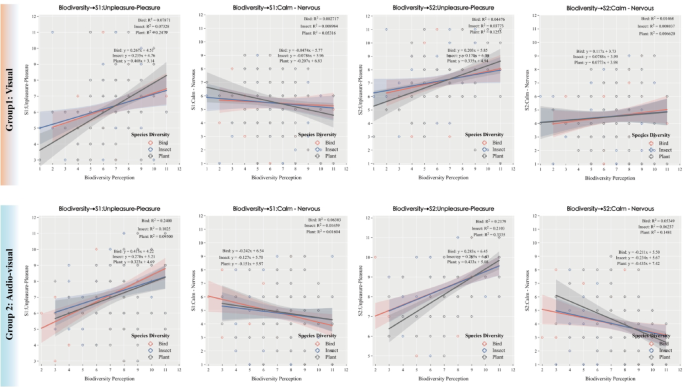
The impact of multisensory biodiversity perception on two emotional evaluation dimensions, “unpleasure-pleasure” and “calm-nervous,” using the OLS method. The first four images are the visual group; the following four are the audiovisual group. The x-axis represents biodiversity perception (the three different line colors represent bird, insect, and plant species diversity), and the y-axis represents emotional evaluation, including S1: pressure stage and S2: recovery stage.
Are social and demographic factors related to biophilic perception?
This study applied econometric models to analyze the correlation and variability between participants’ social and demographic factors and their biophilic perception. Certain sociocultural variables were found to be significantly correlated with participants’ perceived restorativeness, emotional evaluation, and biodiversity perception (Table 14). These sociocultural variables include gender, age, education level, household registration status, political affiliation, marital status, self-rated health, annual household income, and frequency of natural environment contact.
This study further employed the analysis of variance (ANOVA) to statistically analyze the impact of various sociocultural backgrounds. The results indicated (Table 15) that there was a significant difference in the perception of bird species diversity among the participants. Specifically, the data show that females (M = 7.329) perceive a higher level of bird species diversity than males (M = 6.568, F = 5.456, P < 0.05**). This finding aligns with Helen Hoyle’s research in 2019, which suggested that perceived naturalness is associated with participants’ gender and connections to nature, and female participants with more natural connections perceive significantly higher levels of naturalness44.
Moreover, a notable disparity emerged in the perception of insect species diversity regarding self-rated health and annual household income. Self-rated health assessment exhibited a positive “U”-shaped trend (F = 3.386, P = 0.011**), with individuals who rated their health as either “extremely poor” or “very healthy” demonstrating a higher perception of insect species diversity. A correlation was observed between lower annual household income and a higher perception of insect species diversity (F = 2.254, P = 0.065*). Finally, the perception of plant species diversity also followed a positive “U”-shaped pattern concerning self-rated health, with those who rated their health as “extremely poor” or “very healthy” showing a greater perception of plant species diversity (F = 2.986, P < 0.021**).
How can the bio-friendly design of urban green spaces better exert perceptual restoration effect?Bird diversity’s role in perceived and sensory dimensions (PSDs)
Bird diversity has significant positive effects on perceived and sensory dimensions (PSDs). This study demonstrated a positive correlation between the perception of bird species diversity and human psychological health and physiological arousal. Bird sounds can reduce stress and annoyance, as well as improve mood and cognitive performance26. Landscape designers can create suitable bird habitats in parks by installing features such as birdbaths, nest boxes, and diverse habitats. These features can attract birds to stay and increase their diversity17. Moreover, the visual impact of birds has been demonstrated to exert a positive influence on human emotional states45. For instance, the establishment of designated bird-watching areas within parks can serve as a distinctive zone, allowing visitors to observe and appreciate birds in close proximity. This initiative has the potential to provide a relaxing and enjoyable experience. The strategic incorporation of low-impact visitor footpaths within the design of green spaces to create an educational corridor. Consequently, the biodiversity of birds ensures the stability of park ecosystems and provides visitors an efficacious method of stress relief.
Insect diversity’s role in PSDs
Insects play a significant role in the design of park soundscape. Cicadas, crickets, bees, and butterflies are key indicator species of insect diversity in parks. As recorded in this study, the cicada species commonly found in southern China’s parks include Hyalessa maculaticollis, Pomponia linearis, Meimuna opalifera, Platypleura kaempferi, Cryptotympana atrata, Meimuna mongolica, and Mogannia hebes. Research has demonstrated that insect sounds can provide psychological restorative effects19. The ecological design of specific insect habitats, such as butterfly gardens, insect hotels, and insectariums, can enhance insect diversity and enliven parks with their activities and sounds. Thus, biophilic design helps conserve biodiversity and provides visitors with a more tranquil and restorative environment.
Plant diversity’s role in PSDs
This study confirmed that plant species diversity plays a particularly prominent role in promoting PRS, exerting a substantial impact on the enhancement of positive emotions and the alleviation of tension. Forest landscapes in particular have been found to attract heightened attention from participants in the study of natural soundscapes. Concurrently, research has demonstrated that exposure to nature can awaken sensory experiences, such as visual, olfactory, and tactile senses, contributing to stress reduction and immune system enhancement and further improving overall health and wellbeing46,47. This study capitalized on the superior natural environment, distinctive landscape features, and unique biodiversity of the Foshan area. Local species and ecological environments were incorporated into soundscape design to increase park uniqueness and appeal. The design should take into consideration the acoustic characteristics of different plants, including the natural sounds of insects and birds attracted to them. This will serve to enrich the soundscape27. The provision of green spaces and the colors of flowers has been demonstrated to have a significant effect on people’s emotions and psychological states43. For instance, the visual impact of green and white leaves, as well as yellow or white flowers, has been demonstrated to significantly reduces stress48. Moreover, the scents of plants such as lavender and pine have been proven to possess anti-anxiety and stress-reducing properties. Thus, future research on the multisensory restorative effects of green spaces can be expanded by incorporating color and olfactory perceptions7.
How to build a biodiversity-friendly CityChina’s actions in biodiversity conservation
China has made significant progress in the realm of biodiversity protection, as evidenced by the release of the China Biodiversity Conservation Strategy and Action Plan (2023–2030)49, which clarifies the goals and pathways for biodiversity conservation in the ensuing decade. China has also established a national-scale biodiversity monitoring network, such as Sino BON, providing vital information services and decision support for biodiversity conservation. The optimization of the spatial layout of conservation is a fundamental component of this plan. The strategy is predicated on the provision of high-level protection, with the objective to enhancing the diversity, stability, and sustainability of key ecological spaces, including nature reserves, ecological red lines, and critical ecological corridors, thereby achieving high-quality biodiversity conservation.
First, China has initiated pilot programs for a national park system and has constructed a natural protected area system with national parks as the mainstay. This system includes nature reserves, scenic spots, geological parks, wetland parks, marine parks, and desert parks. These protected areas compass a wide range of ecosystem types and serve as the primary habitats of various species of wild flora and fauna species that are of national importance and are protected under law. These protected areas have achieved the United Nations Convention on Biological Diversity’s Aichi Target of reaching 17% by 2020, a goal that was met well in advance of the target date. Secondly, China has designated priority areas for biodiversity conservation, encompassing significant natural ecosystems and biological resources and ensuring effective protection of ecosystems, species, and habitats. Furthermore, China has instituted a national spatial planning system and has been the first nation to propose and implement the ecological red line system on an international level. This initiative signifies a substantial institutional innovation within China’s national spatial planning and ecological environment system mechanism reform.
Bio-friendly design strategy of urban green spaces in Southern China
Foshan City, located in the Guangdong Province, has demonstrated a proactive stance on biodiversity conservation, aligning with the strategies and actions outlined in the relevant plan. In accordance with the Guangdong Biodiversity Conservation Strategy and Action Plan (2023–2030)42, the Guangdong Province has established explicit objectives for biodiversity conservation and implemented specific action plans, with the overarching goal of enhancing the governance level of biodiversity in a comprehensive manner. Foshan City has issued the Foshan Territorial Spatial Ecological Restoration Plan (2021–2035)43, which aims to maintain the overall pattern of ecological security. The plan focuses on three major spaces: ecological areas, urban areas, and agriculture areas. It also implements differentiated ecological protection and restoration strategies.
According to the Foshan Special Plan for the Construction of Natural Ecological Civilization in 2018 44, the natural ecological pattern of “three screens, six wedges, two veins, and a blue-green network” has been proposed. The Lei Gang Park in this study located within the confines of urban thousand-acre city park ring. In contrast, the Hanlin Lake Agricultural Park is situated within the confines of a ten-thousand-acre suburban wilderness forest ring. The “two-ring ecological circle” plan of Foshan City is part of the city’s special plan for constructing a natural ecological civilization, aspires to establish an eco-friendly and biodiverse urban environment. This initiative is designed to improve the quality of life for city residents and to establish a robust foundation for sustainable development.
Foshan City has demonstrated notable advancements in the realm of biodiversity conservation. The municipality has initiated eight significant initiatives to advance the ecological construction of a green and beautiful city. These initiatives are designed to continuously optimize the “Forest Chief +” coordination mechanism and to promote comprehensive transformation from the “Forest Chief System” to “Forest Chief Governance.” The efficacy of these measures is evident in the enhancement of forest stands and the improvement of forest quality. This enhancement is achieved through various strategies, including forest tending and enhancement, the improvement of forest appearance, and the enhancement of forest ecosystems’ stability and carbon sequestration capacity. It has been observed that the region has been able to leverage its geographical advantages and natural resource endowments. Efforts have been made to create national wetland parks and national forest parks, and the construction of comprehensive parks, thematic parks, and ribbon parks has been vigorously promoted. It has been demonstrated to advance the planning and construction of the Foshan section of the Thousand-Mile Greenway at a high level, build a “three-ring” system with a total length of nearly 512 km, focuse on constructing the “six ribbons” with a length of about 508 km, and create ecological corridors.
Application of modern ecological theory and biophilic design
Modern ecology has evolved rapidly, giving rise to two branches: landscape ecology, which focuses on landscapes, and global ecology, which addresses the biosphere. However, ecological research and planning have long been disconnected from practice. They lack paradigms and operability, which makes it challenging to guide implementation50. The biophilic design practice method, consists of three steps: field research, experimental design, and optimization adjustments. It integrates research and practice to optimize ecological design and enhance the potential for resilience in novel ecosystems51.
This study further approached the biodiversity conservation strategies of Foshan City using the biophilic design method, aiming to create conditions for the reintroduction and healthy development of regional biodiversity to the greatest extent possible. Biophilic design is the intentional integration of natural elements andstructures to achieve specific goals. The design of ecosystems is the consequence of active management and intervention in novel ecosystems28. From the perspective of human society’s subjective needs, objective environmental conditions, and existing technological levels, designed ecosystems cannot maintain the state of original natural ecosystems. Therefore, human influence should be regarded as an endogenous factor that provides optimized ecosystem services within the natural-human hybrid ecosystem, rather than reverting to the original natural ecosystem state.
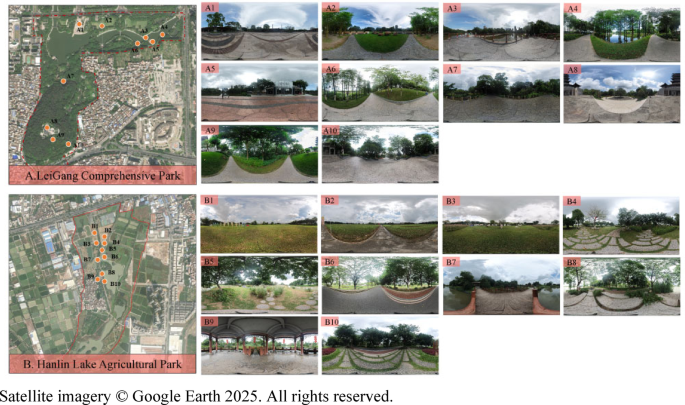
This study designed habitat scenarios (Fig. 13) based on the ecological knowledge provided by the Foshan Park Biodiversity Conservation Plan and the knowledge about forest birds, water birds, insects, and wildlife habits obtained from the Foshan Planning Institute. These scenarios include the establishment of flexible water edges, the creation of small and micro wetland clusters, and the establishment of bird habitats. The study’s implementation of biophilic design entailded the execution of multiple experimental schemes, the regulation of the scale of individual experiments, and the regular monitoring and adjustment of practices. On the other hand, the implementation of strategies aimed at enhancing avian and entomological biodiversity in the region was undertaken. These strategies encompassed the creation of bird and insect habitats, the integration of low-maintenance yet resilient water systems, and the implementation of water purification systems within wetland ecosystems. Additionally, the study encompassed the expansion of the tidal channel beneath the trees canopy, with the objective to enhance the flood storage capacity of wetlands. The efficacy of these measures was evidenced by their ability to meet the foraging needs of forest birds, provide adequate habitation for water birds, and ensure the survival and safety of insects52.
Additionally, this study utilized the plant survey results of the Pearl River Delta region in southern China as a foundational template. A Consideration of the avian and entomological habitats, as well as the foraging needs of birds and insects, the effects of the landscape on plant communities, and the routine maintenance costs, suggests that plant communities are suitable for a variety of animal habitats. The implementation of nesting forests, as outlined in this study, has led to a notable augmentation in the number and density of tree species that are conductive to the nesting of large birds. These species possess several characteristics that are conducive to avian habitation, including dense foliage, robust support structure, non-toxicity, and a low propensity to attract natural enemies of birds and insects. This study considered the construction of bird habitat in four layers from the vertical structure: (1) the tree layer should select species such as Ficus concinna, Pterocarya stenoptera, and Cinnamomum camphora to provide them with suitable habitats and foraging sites; (2) the shrub layer can be planted with Ligustrum quihoui Carr and Nandina domestica; (3) the herbaceous layer can consider Axonopus compressus and Cynodon dactylon; and (4) aquatic plants can be Neyraudia reynaudiana and Phragmites australis. In the construction of insect habitat plant communities, the selection of species such as Aristolochia kaempferi Willd and Alyxia sinensis Champ as habitats is recommended, while Centaurea cyanus Linn and Tagetes erecta can serve as foraging sites. The construction of such plant communities fulfills the ecological requirements of animals and creates aesthetic natural landscapes that are straightforward to maintain and manage.
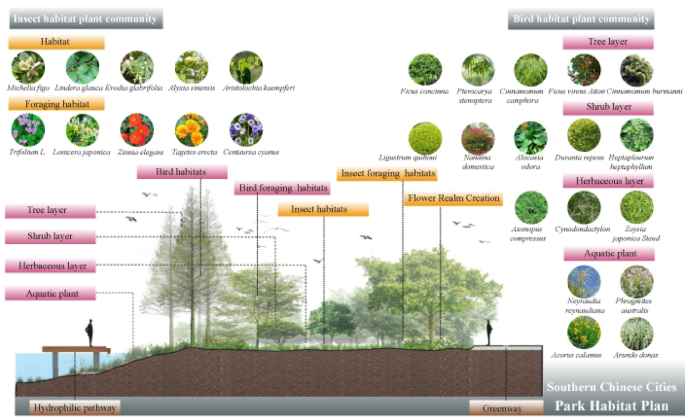
Schematic diagram of plant allocation for insect and bird habitat communities in urban parks of southern China.
During the construction and optimization of the park ecosystem, it is essential to focus on the monitoring and management of invasive species53, including Mikania micrantha, Bidens pilos, and Ipomoea cairica. These species have been observed to invade habitats, such as forests, farmlands, and urban green spaces. These highly vigorous invasive species have been shown to strangle other plants by entwining them and releasing chemical substances that have a negative impact on their surroundings. Additionally, invasive species such as Pomacea canaliculate and Lissachatina fulica exhibit strong growth and reproductive capabilities, causing significant damage to vegetation, competition for space with other organisms, and the transmission of numerous pathogens. These species rapidly proliferate, consuming crops and vegetation after infestation, thereby exacerbating the damage to native ecosystems. On the other hand, the conservation of veteran fruit trees is crucial for maintaining ecological food webs, as these trees provide essential fruits and nectar for pollinators, birds, and mammals. This study further advocates introducing diverse tree species that offer fruits and nectar year-round to attract omnivorous songbirds that feed on plant fruits, seeds, and insects, such as Pycnonotus jocosus, Zosterops japonicus, Pycnonotus aurigaster, Lanius schach, Phoenicurus auroreus, Parus major, Egretta garzetta, and Phalacrocorax carbo. This design has the potential to provide ecosystem services, including pollination, soil amelioration, and biological control, which are essential for maintaining ecosystem functionality and promoting human wellbeing.