
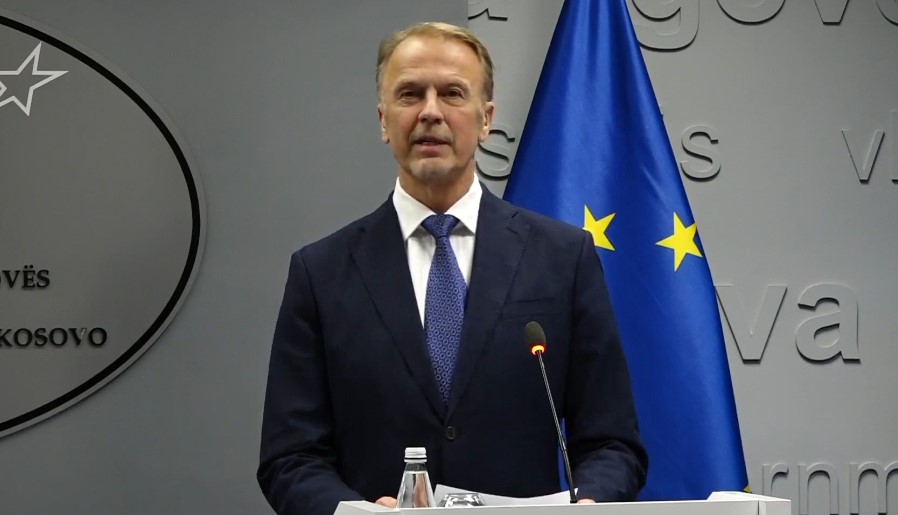
The European Union Ambassador, Aivo Orav, said he hopes that Kosovo will soon have a new government so that work can begin on implementing the recommendations of this year’s European Commission Progress Report.
During a press conference, after handing over the Progress Report to Kosovo’s acting Prime Minister Albin Kurti, Orav stated that due to the political deadlock, Kosovo has lost a year.
“Let me be clear: in order to help you make progress toward European integration, we need partners. We need a government with which we can cooperate—one that has a majority in the Assembly and the capacity to advance fundamental freedoms for the benefit of the people of Kosovo. In this regard, unfortunately, this has been a lost year,” he said.
He recalled that last year, Kosovo was at the forefront of the reform agenda, close to receiving the first tranche of funds from the EU Growth Plan for the Western Balkans, and had made progress in many areas.
“I want to emphasize that the political elite in Kosovo should unite beyond political and ethnic divisions and form a strong majority in the Assembly to ensure the ratification of the Growth Plan and to advance obligations stemming from the Kosovo–Serbia dialogue. Without this, more opportunities will be lost,” Orav stated.
Speaking about the Report, Orav said that Kosovo had made progress in six areas:
the functioning of the judiciary, capacity to withstand market pressures, developments in employment policies, food policies, and external relations.
However, he said there are still areas where reforms remain unfinished. According to him, more needs to be done in the fight against corruption, in establishing a competitive market, and building a functional administration.
Freedom of expression also needs improvement, Orav said, noting that new laws are needed for the Independent Media Commission and for the public broadcaster’s budget, as well as an urgent need to adopt the anti-corruption strategy in line with EU standards.
Speaking about the sanctions imposed by the EU in 2023, Orav said they began to be lifted gradually in May of this year. However, he noted that for their complete removal, local power transfer in the north must occur following local elections and a reduction in tensions.
Kurti: We Fulfilled Our Duties Successfully
Acting Prime Minister Albin Kurti said that even though the government has been in caretaker status, the Report confirmed that Kosovo had “successfully fulfilled its duties.”
“This year’s report is positive in almost all fields and provides clear recommendations where there are shortcomings. There has been no backsliding in any area this year. There has been progress in 36 areas and stagnation in only three. Our progress ranges from limited to advanced,” Kurti said.
Key Findings for Kosovo in the European Commission’s Progress Report
The European Commission published on Tuesday the 2024–2025 Progress Report for Kosovo, stating that the country has made progress—albeit limited—in several areas, while highlighting the impact of the political stalemate on Kosovo’s European path.
The EU compiles these reports for countries aspiring to join the bloc.
“The reporting period was affected by divisive internal politics and a pre-election campaign ahead of the 9 February 2025 general elections, followed by a post-election political stalemate due to the inability and lack of political will among parties to form institutions. The government has been in caretaker status since 23 March 2025 and has limited executive powers to conduct daily operations,” the report said.
The EU, according to the Report, has since May 2025 taken steps toward the gradual lifting of sanctions imposed in 2023 over the tense situation in northern Kosovo, predominantly inhabited by Serbs.
The Report notes that Kosovo has not ratified the agreements that would have enabled it to benefit from the EU’s €6 billion Western Balkans Growth Plan, due to the ongoing political deadlock.
Of this package, Kosovo is entitled to around €900 million, making it the largest per capita beneficiary among Western Balkan countries.
Political Stalemate and the EU Agenda
Regarding the February 9 elections, the Report said they were conducted freely and democratically, though the campaign was competitive and often marked by harsh rhetoric, misuse of public resources, and socio-political pressure in Serb-majority areas.
As for governance, the Report notes that challenges between local and central institutions persist.
“On 5 December 2024, the Government adopted several laws through an accelerated procedure, raising concerns about democratic principles. The opposition, critical of this practice, challenged a number of these laws before the Constitutional Court,” it said.
While Kosovo continues to publicly reaffirm its commitment to the EU agenda, the Report highlights that divisive domestic politics and a lack of prioritization have hindered effective implementation.
In regard to the Assembly, the Report states that the last parliamentary term was marked by a lack of political consensus, procedural violations, boycotts, frequent extraordinary sessions, and fast-tracked legislation.
Despite isolated improvements—such as the introduction of electronic voting and the publication of individual votes by MPs—parliamentary performance declined overall.
The document also points out the failure of MPs to constitute the Assembly after the February elections, seriously undermining the functioning of key democratic institutions.
The Assembly was finally constituted at the end of August, after several failed attempts and Constitutional Court rulings.
Fight Against Corruption
Kosovo has made limited progress in fighting corruption, according to the Report’s key findings.
“Kosovo has made further progress in prosecuting high-level corruption cases, resulting in a higher number of final court decisions and convictions. However, the overall number of low-level corruption investigations and convictions has decreased,” the Report said.
The European Commission (EC) stated that Kosovo still lacks a strategic framework for the fight against corruption.
Despite political declarations of commitment, there is no coherent approach.
To ensure an effective anti-corruption fight at all levels, Kosovo must better enforce existing anti-corruption laws, including the Law on Confiscation, and use preventive tools such as asset declarations and institutional integrity plans more effectively.
The EC recommends that Kosovo further strengthen the Anti-Corruption Agency’s capacity, both in staffing and expertise, implement existing legislation, and adopt a National Anti-Corruption Strategy and Action Plan for 2025–2027 aligned with EU best practices.
Kosovo is also advised to improve the quality of investigations into high-level corruption cases and increase the capacity of the Special Investigation Unit within the Police to better cooperate with the Special Prosecutor’s Office.
The Report also noted progress in the fight against organized crime.
Judiciary and Freedom of Expression
Kosovo has made limited progress in improving the functioning of the judiciary, the EC said, noting improvements in addressing case backlogs and measures toward digitalization.
The country has consulted with the Venice Commission on a package of judicial laws, taking steps toward alignment with European standards. However, the Judicial Council and Prosecutorial Council continue to operate without full membership.
“Due to the current political blockade, delays in drafting judicial reforms have negatively affected efforts to strengthen accountability and efficiency mechanisms within the judiciary and prosecution. Inappropriate internal and external influence remains present,” the Report stated.
Regarding fundamental human rights, Kosovo must make greater efforts to promote, protect, and implement them.
Progress was noted in the verification of diplomas from the University of North Mitrovica and the extension of the verification commission’s mandate.
However, implementation of laws protecting the rights of non-majority communities, including language rights, needs strengthening.
Some recent government measures have further restricted access to basic services for these groups.
The Civil Code and amendments to the Law on Freedom of Religion remain pending.
On freedom of expression, the Report notes that the Constitutional Court annulled the Law on the Independent Media Commission, providing clear guidance for drafting a new law.
“While the media landscape is pluralistic, it faces challenges concerning ownership transparency and financial sustainability. The environment in northern Kosovo remains restrictive, encouraging self-censorship among the public, media, and civil society,” it stated.
According to the Reporters Without Borders Index, Kosovo recorded the sharpest decline in media freedom in the past 15 years, ranking 99th out of 180 countries.
Public Administration Reform
The Report calls on Kosovo to fully address the EU’s recommendations regarding the Law on Public Officials and the Constitutional Court’s ruling on the Law on Public Sector Salaries.
It recommends that Kosovo:
- increase the capacity of the civil service through merit-based recruitment,
- introduce performance evaluations,
- take measures to ensure gender equality,
- reduce the number of vacant and acting positions,
- finalize job classification and systematization, and
- ensure the new pay system functions properly.
The EC also recommends increasing the number of e-services to reduce the administrative burden.
The reporting period for this document covers September 1, 2024 – September 1, 2025.
The Report is compiled using data from multiple sources, including the Government of Kosovo, EU member states, European Parliament reports, and international and local NGOs.
(Source: Radio Free Europe/REL)