
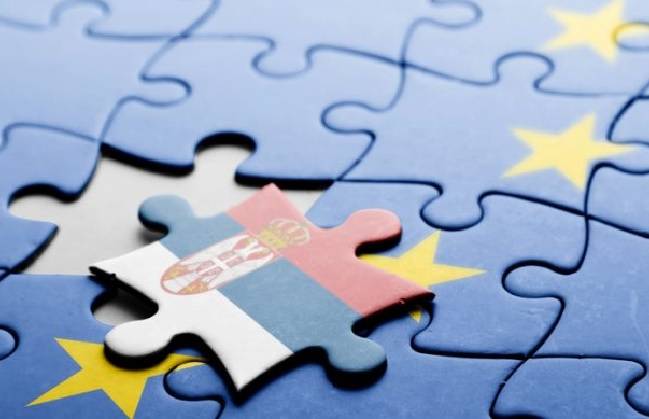
In its annual report on the progress of Serbia and other candidate countries, the European Commission assessed that there has been stagnation and regression in the area of the rule of law in Serbia.
The Commission maintained its previous assessment, first made in 2021, that Serbia meets the technical criteria for opening Cluster 3, while urging Belgrade to make greater efforts towards gradual alignment with Brussels’ foreign and security policy.
The European Commissioner for Enlargement, Marta Kos, emphasised that Serbia needs to progressively and more strongly align itself with the EU’s Common Foreign and Security Policy.
She also underlined the need for more proactive and objective communication about the EU accession process and the avoidance of anti-EU rhetoric. The Commission noted that polarisation in Serbian society has deepened in the context of the protests that have been taking place across the country over the past year.
“All countries in the region are fully aligned with the EU, while Serbia’s level of alignment, although better than before, currently stands at 62 per cent. We expect Serbia to overcome the stagnation in the judiciary and fundamental rights, urgently reverse the setbacks in freedom of expression and the erosion of academic freedoms, and improve its electoral legislation. This is also what the citizens of Serbia are demanding,” said Kos.
Report presented to the Speaker of the National Assembly of Serbia
The European Union Ambassador to Serbia, Andreas von Beckerath, presented the European Report to the Speaker of the National Assembly, Ana Brnabić, and emphasised that Serbia’s commitment to the European Union must be demonstrated through actions – decisive reforms and public communication that will bring tangible benefits to the people of Serbia.
“Serbia needs credible and measurable reforms in various sectors, above all in the rule of law, the functioning of democratic institutions, freedom of expression, media freedom, and respect for human rights. These are what we call the fundamentals of the accession process,” said Beckerath.
The Speaker of the National Assembly, Ana Brnabić, stated that the report serves as a guide both for the executive branch, meaning the government, and for the legislative branch, meaning the parliament. What matters more than the events of the reporting period, she added, are the recommendations on what can be done to accelerate Serbia’s European path.
“For me, as Speaker of the National Assembly, the most relevant part of the report is that, for the fifth consecutive year, the European Commission has called on EU member states to open Cluster 3 in negotiations with Serbia. That is our most important goal at this moment,” said Brnabić.
Taking into account some recent developments, such as the relaunch of the process to elect a new Council of the Regulatory Authority for Electronic Media and progress in the legislative process concerning the Law on the Unified Electoral Register, the Commission concluded that more needs to be done and reaffirmed that it sees Serbia’s future within the European Union.
(Euronews, 04.11.2025)
https://www.euronews.rs/srbija/politika/195197/srbija-suocava-sa-izazovima-na-putu-ka-eu/vest