
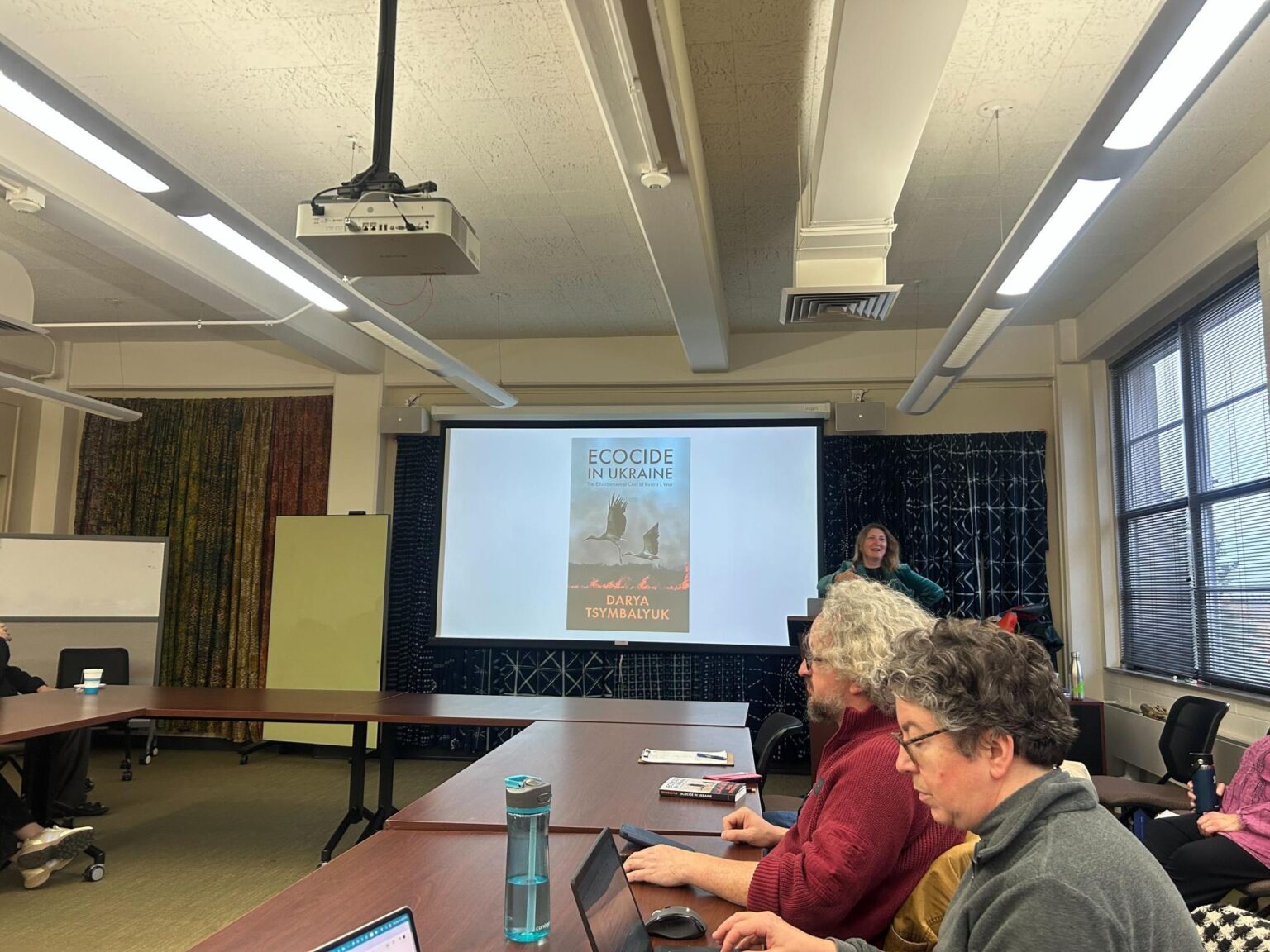
The Center for Russia, East Europe and Central Asia at University of Wisconsin hosted University of Chicago assistant professor of Slavic language and literatures and member of the Committee on Environment, Geography and Urbanization Darya Tsymbalyuk to speak about her new book “Ecocide in Ukraine: The Environmental Cost of Russia’s War.”
In Ukraine, ecocide is a crime that describes “mass destruction of flora and fauna, poisoning of air or water resources, and also any other actions that may cause an environmental disaster,” according to Prosecutor General of Ukraine Andriy Kostin in an article for the International Bar Association.
Currently, the Ukrainian government is attempting to define ecocide as a fifth international crime, along with genocide, crimes against humanity, aggression and war crimes, Kostin said in the article.
Tsymbalyuk focuses less on the legal definition of ecocide and more on the conversation surrounding it, especially as it pertains to the Russian invasion of Ukraine.
Advertisements

“What I’m interested in is this cultural context and the lived experience of what it actually means to witness the ecocide [in Ukraine] unfolding and to witness the environmental destruction,” Tsymbalyuk said.
People’s environments, the nature they grew up in, the animals in their day-to-day lives are all important parts of culture, according to Tsymkalyuk.
Mushroom gathering, for example, is a strong Ukrainian tradition, passed down through generations. Yet, in many parts of Ukraine, the forests are no longer accessible due to military operations or landmines, forcing many Ukrainians to forgo this important tradition, according to Tsymbalyuk.
When people are displaced due to war, part of their experiences of loss are tied into the loss of their environmental connections, like the plants they cared for, or the specific thyme variant they cook with, Tsymbalyuk said.
“Any experience of displacement is also environmentally rooted,” Tsymbalyuk said. “You lose touch with the place you’re coming from.”
This does not only extend to people who are physically displaced by war. Even if you stay in the same place, losing access to forests to gather mushrooms, losing access to rivers that are safe to swim in — these are types of displacement, Tsymbalyuk said.
Everybody [in Ukraine], to a very different degree is displaced in a sense that your environment fundamentally changes … [before] you could go into a forest, you could swim in a river — now it has landmines, it’s contaminated, it’s dangerous, it’s surveilled,” Tsymbalyuk said.
Non-Ukrainians don’t always understand why Ukrainians stay, even when it’s dangerous, but part of the reason is that they feel connected to the environment, Tsymbalyuk said.
“A lot of people stay because these animals are their world … this land is their world,” Tsymbalyuk said.
For more resources about Ukrainian’s relationship with their environment or ecocide, Tsymbalyuk recommends the Ukrainian War Environmental Consequence Work Group and the Ukrainian Nature Conservation Group.
Advertisements