
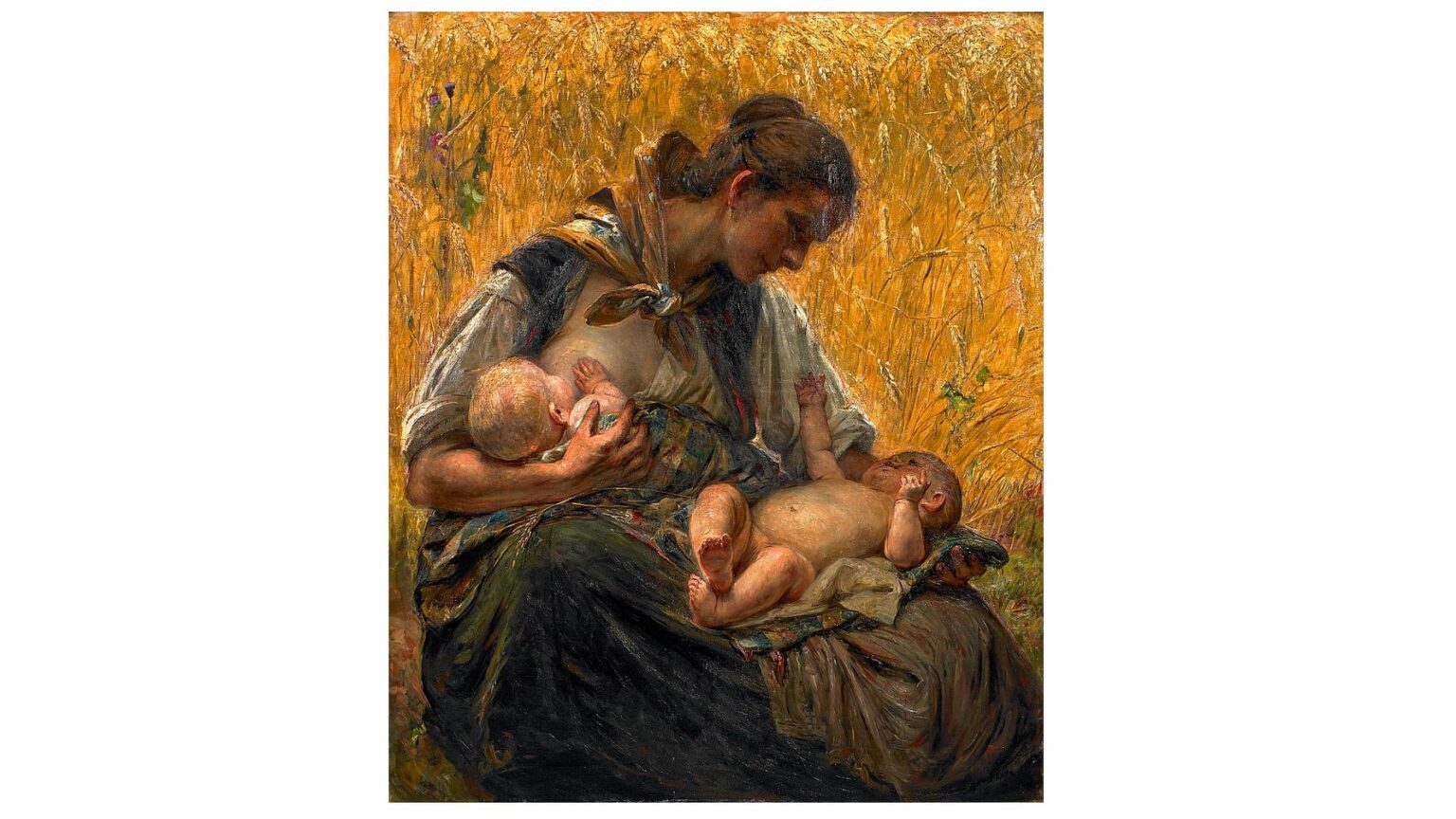
Recently, Poland’s Minister of Culture, Marta Cienkowska, officially welcomed Bertha Wegmann’s painting “Summer” back to the National Museum in Wrocław – after more than 75 years of uncertainty.
The painting, depicting a mother nursing her twins in a wheat field, resurfaced last year in Denmark, where it had been consigned to auction at Bruun Rasmussen. The work immediately raised suspicion with Sofie Normann Christensen, specialist in fine art, who embarked on an extensive investigation to trace the painting’s provenance.
“The work had an unusual character and a motif that stood out. Something didn’t quite add up, so I began digging into archives, old exhibition catalogues, and museum records. Soon it became clear that there might be a connection to a work that had been missing since World War II,” says Sofie Normann Christensen.
A Museum Painting Gone Astray
Bertha Wegmann painted “Summer” around 1906 during a stay in Lower Silesia, then part of Germany. Shortly afterward, she sold the painting to the Art Association in Breslau (now Wrocław), which passed it on to the Schlesisches Museum für bildende Künste, where it became part of the museum’s permanent collection.
In 1939, the painting was loaned to the Viktoriaschule, a girls’ school in Breslau, as part of the Third Reich’s social policy program that emphasized motherhood as a national ideal. During the war, the work likely remained at the school and was never registered as returned.
After 1945, the school building passed to the Polish authorities, and in 1947, four paintings – including Wegmann’s “Summer” – were officially reported missing. The painting was subsequently listed in the Polish database of cultural property lost as a result of the Second World War kept by the Department for Restitution of Cultural Goods in Poland.
From London to Copenhagen – and Back to Wrocław
“Summer” resurfaced in 1990, this time at a Sotheby’s auction in London. From there, the work traveled through auctions in Tel Aviv and at Bruun Rasmussen, until it was consigned to the auction house again last year. The lack of photographic documentation made identification challenging.
“When the painting was being catalogued for auction, I discovered – through old exhibition catalogues from 1911 and 1926, correspondence archives, and descriptions in a 1926 museum inventory – a possible connection between the consigned work and a painting registered in the museum’s collection. This set off alarm bells, and we contacted our partner, the Art Loss Register, who put us in touch with the Polish authorities. After a thorough investigation, they confirmed that ‘Summer’ was indeed the long-lost museum painting,” says Sofie Normann Christensen, specialist in older art at Bruun Rasmussen.
The loss of cultural heritage during the war continues to resonate strongly within the art and cultural world today. In recent years, there has been increasing international focus on identifying and returning works displaced during the war – a framework that shaped this particular case.
“Cases like this are extremely rare at Bruun Rasmussen, but the return of ‘Summer’ highlights the importance of prioritizing research and documentation in an auction house setting – every artwork carries an important story,” adds Sofie Normann Christensen.
A Danish Artist in a European Context
Bertha Wegmann (1847–1926) was one of the most renowned female artists of her time, known especially for her portraits. Ironically, she noted in a 1906 letter:
“The Museum in Copenhagen does not care to own any of my work, so I must be content to be represented abroad.”
Now, over a century later, her work has returned to Poland.