
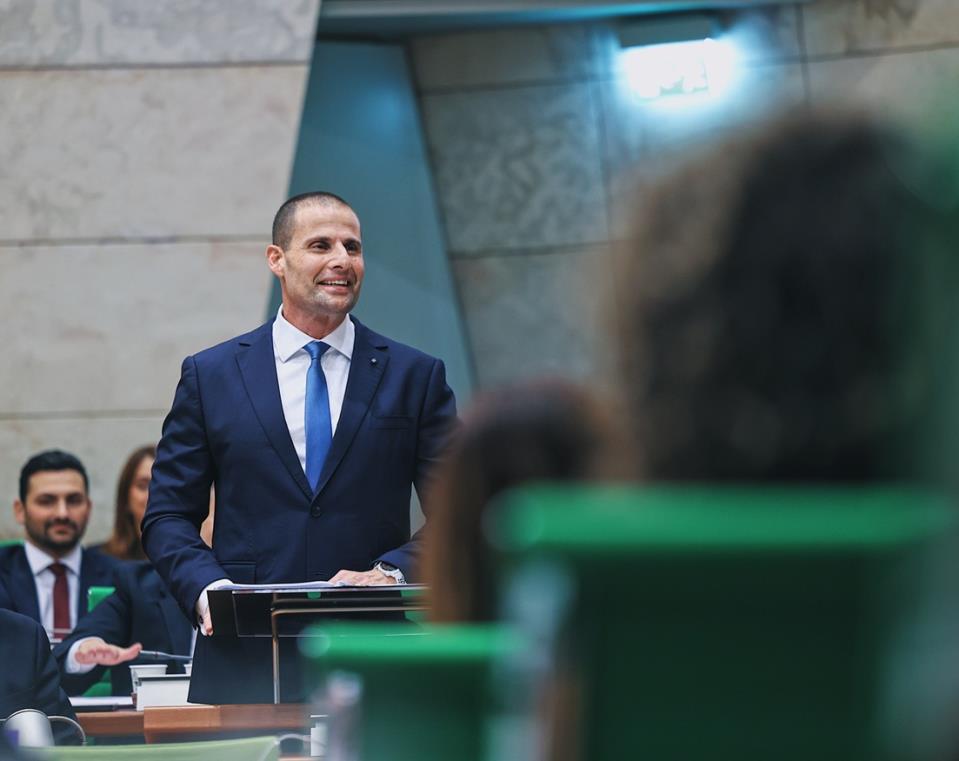

Prime Minister Robert Abela’s speech on the 2026 budget was a carefully calibrated political performance that blended optimism with buoyant confrontation. The tone of his confident address oscillated between defensiveness and reassurance that the country is moving in the right direction, implying that voters should think twice before changing course.
The content reflected a dual strategy: consolidating Labour’s claim to economic stewardship and recasting the government as a guardian of national heritage and environmental integrity. The presentation was forceful and dramatic, punctuated by interruptions and heckling from the opposite benches.
1. Tone: triumphant, defensive, and combative
The tone of Abela’s speech was unmistakably triumphalist. He again positioned the 2026 budget as “the best in Malta’s history”, a superlative claim intended to underline the government’s continuity of economic success. His rhetorical rhythm – celebrating tax cuts, employment growth, and rising pensions – projected a sense of unstoppable progress. He insisted that “the economy cannot pause”. This not only communicated optimism but also reinforced the Labour Party’s self-image as a movement of perpetual motion and national advancement.
Yet triumphalism was paired with defensiveness. The Prime Minister devoted significant time to rebutting the Opposition’s critiques on public debt, economic inequality, and governance. Abela at times turned personal in tone, targeting Opposition Leader Alex Borg and former PN leader Adrian Delia. He accused Borg of plagiarism (“he should at least give Donald Trump credit for stealing his idea”) and dismissed Delia’s criticism of the hospitals deal as “a myth”. Such personal jabs, mocking and sarcastic, reveal Abela’s tendency to use ridicule as a political weapon – deflecting policy criticism by undermining his rivals’ credibility.
His declaration that White Rocks and Manoel Island would be “given back to the people” was delivered with emotive emphasis, as Abela cast himself as a protector of the public interest against “property speculation”. This framing – the government as the custodian of the nation’s land and dignity – evoked a sense of belonging to a national cause.
Overall, the tonal architecture of the speech was layered: celebratory towards his own government, aggressive towards the Opposition, and paternalistic towards the public. It was the performance of a Prime Minister seeking not only to defend a budget but also to reaffirm his leadership.
2. Content: Between policy continuity and symbolic politics
The substance of Abela’s address can be divided into three main axes: environmental symbolism, economic reassurance and political confrontation.
Environmental symbolism
Perhaps the most striking content revelation was that both Manoel Island and White Rocks will be transformed into national parks. The announcement’s symbolic weight was significant. For decades, both sites have been at the centre of development controversies, emblematic of the tension between speculative capitalism and environmental preservation in Malta. By reclaiming these spaces for “the people”, Abela sought to rewrite a historical narrative – attempting to remodel Labour as a pro-environment force seeking to correct the missteps of the past. It is also seen as a counterweight to the planning reform controversy, as Labour battles opposition to the bills it presented before the summer recess.
The Prime Minister explicitly linked the Nationalist Party to “property speculation” and suggested that Labour’s intervention was both corrective and courageous: “I will take the decision which no other government before this one had the courage to take.” The choice of words – “courage,” “decision” – conveys a deliberate explanation, where leadership is equated with bold action against entrenched interests.
Beyond the symbolic, however, the practical implications of these projects remain vague. No detailed plans, financing models, or timelines were mentioned, and this could possibly be seen as pre-election propaganda aimed to secure votes. The emphasis lay not on policy execution but on raising false hype that the government is pro-environment – using the planned reclamation of land as a metaphor for political legitimacy.
Economic reassurance and continuity
The second axis of the speech was the economy. He reiterated Labour’s economic mantra: growth, employment and stability. “We have the lowest rate of unemployment in Europe,” he said, and “the economy has tripled”. This comparison served two purposes: to celebrate Malta’s exceptionalism amid European austerity, and to contrast Labour’s generosity with what he described as the PN’s hypothetical austerity budget.
While other European governments “increase taxes and cut benefits”, Malta, he argued, “gives more”. By labelling social policy as both moral obligations and economic triumphs, he reinforced Labour’s brand as the party of social justice through growth. The repetition of measures (“€160 million tax cut”, “€900 million left in families’ pockets”) exemplifies how numerical precision was used to convey control and competence.
Similarly, announcements of a fourth Gozo Channel ferry, a Grand Harbour regeneration plan, and ongoing mass transit studies were intended to project a vision of forward motion. These infrastructural references bolstered the government’s claim to progress, even if details remained sparse.
Yet, embedded in this reassurance was an undercurrent of anxiety. Abela repeatedly warned that “mistakes can cause the country to collapse” – a strikingly defensive phrase. His appeal for “experience and competence” was also a plea for continuity, subtly invoking fear of change as a justification for Labour’s prolonged rule.
Political confrontation and narrative control
A defining feature of the content was its antagonistic structure. Much of Abela’s speech was reactive – a sustained counterattack to the Opposition’s budget reply. The PN’s leader, Alex Borg, was depicted as immature, derivative, and disconnected. His proposal for a “Child Trust Fund” was ridiculed as a copy of a US Republican measure. Abela even injected humour and sarcasm into his critiques, mocking Borg’s supposed obsession with “taking photos” rather than listening to pensioners.
This blend of humour and derision served two functions: it entertained Labour MPs and supporters, and it reduced the Opposition’s credibility in public perception.
3. Presentation: theatrical, populist, and strategic
Abela’s delivery was dynamic, confrontational and meticulously staged. He combined oratorical authority with a populist register that translated complex economic discussions into moral binaries: generosity versus austerity, courage versus cowardice, the people versus speculators.
His choice of imagery was emotionally charged – “giving land back to the people”, “never built upon again”, “families who still need our help”. These phrases humanised macroeconomic policy, anchoring it in everyday logic rather than fiscal analysis.
The Prime Minister’s speech was visibly performative. The repeated clashes with the Opposition, the Speaker’s interventions, and the overrun of time contributed to a sense of drama. Abela’s persona – confident, indignant, at times humorous – projected an image of vitality and command.
However, this theatricality came at a cost. The heavy reliance on confrontation risked overshadowing the government’s policy detail. The emphasis on achievements and attacks left little room for reflection. The repeated assertion that Malta’s economy “cannot pause” might inspire, but it also evades deeper questions about sustainability.
4. Overall assessment
Taken together, Abela’s budget reply speech can be read as a political consolidation exercise. It reaffirmed Labour’s narrative of competence and compassion while casting the Opposition as petty and unfit to govern. The decision to anchor the speech around two emblematic environmental projects – Manoel Island and White Rocks – was strategically astute. It allowed Abela to pivot from a purely economic defence to a symbolic gesture of stewardship, reclaiming the “green” mantle in a political landscape increasingly attentive to environmental matters.
His economic messaging was steady, focused on visible benefits: tax cuts, pension increases, and job creation. The confrontational exchanges reinforced Abela’s grasp of the parliamentary space and sustained Labour’s populist energy.
In the short term, the speech succeeded in commanding the stage and rallying Labour supporters. In the longer term, its challenge lies in whether Malta’s citizens will continue to equate confidence with competence – and whether a society increasingly attentive to sustainability and transparency and Labour’s talk of unstoppable progress can continue to go hand in hand.