
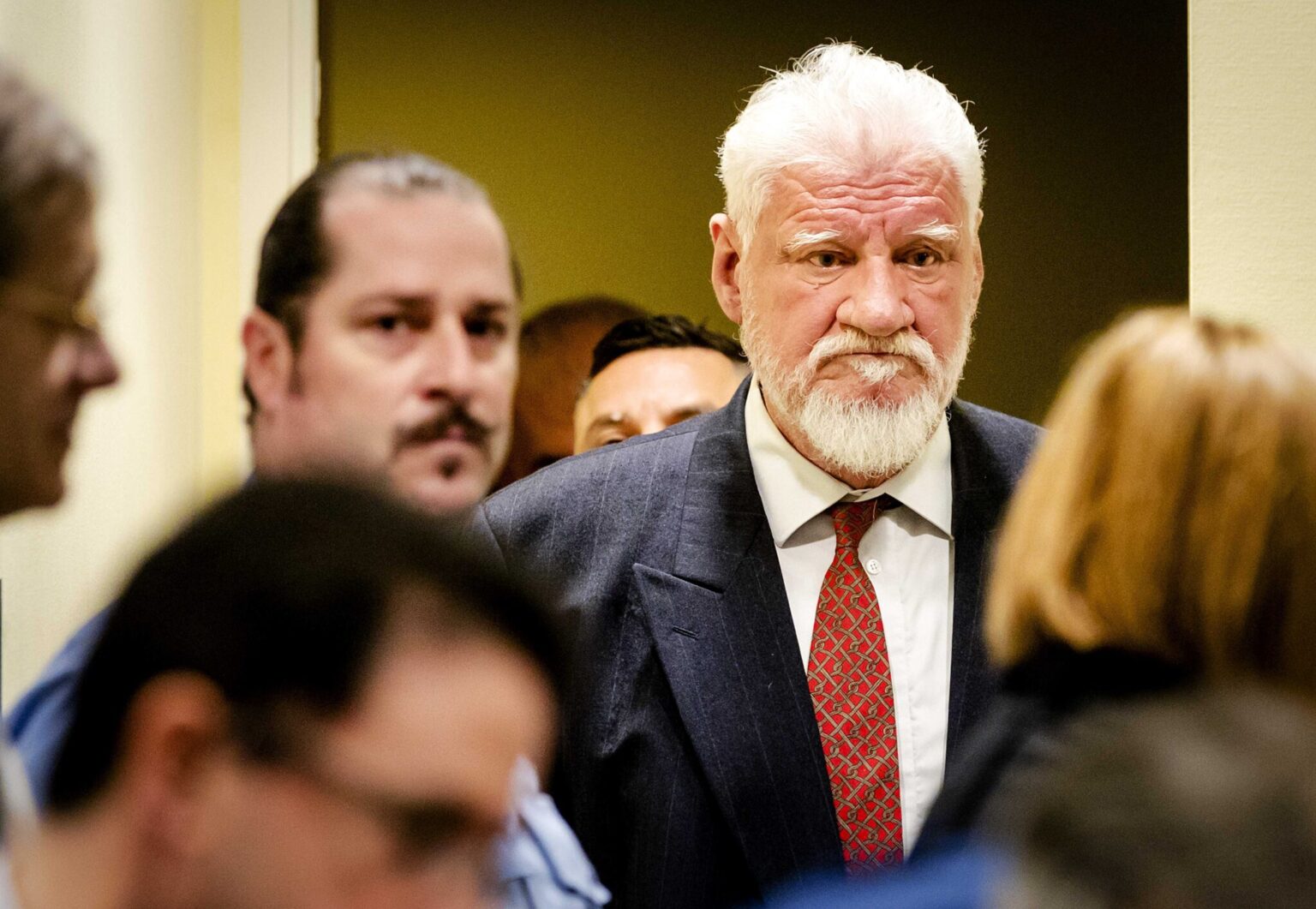
Slobodan Praljak enters the court in The Hague, November 2017. Photo: EPA/ROBIN VAN LONKHUIJSEN/POOL.
The Bosnian state prosecution has begun investigating after the unveiling of a monument in Capljina commemorating Slobodan Praljak, a deceased former officer of the Croatian Defence Council, the Bosnian Croat wartime military force, the prosecutor’s office told BIRN.
Praljak swallowed a vial of poison in the Hague Tribunal courtroom when the verdict convicting him of wartime crimes was delivered in November 2017. He died the same day.
A photograph of the monument, which was circulated online, shows the image of Praljak carved into a stone, on which is written: “When justice is silent and demons dance, a warrior does not kneel and kowtows to no one. For the ideals of life he breathes a last breath.”
In a video posted on social media, a Catholic cleric can be heard blessing the monument. “No one did as much as General Praljak did for the Muslim people in every respect during the war,” the cleric says.
Praljak, the wartime commander of the Main Headquarters of the Croatian Defence Council, was sentenced to 20 years in prison by the Hague court. He was one of six former political and military officials of the unrecognised wartime Herzeg-Bosnia statelet who were convicted of a series of crimes against Bosniaks.
Emir Hajdarevic, president of the Mostar Association of Camp Inmates, said the installation of a monument to Praljak is a reflection of the situation in a country in which war criminals are glorified and victims are humiliated.
“We live in a time when the criminal is a hero and the victim is something else,” Hajdarevic said. “This is yet another crime against the victims of Herzegovina committed in Capljina, which is known for the crimes at Gabela and Silos [wartime detention camps in the Herzegovina area].”
Amendments to Bosnia and Herzegovina’s criminal code, imposed in July 2021 by the High Representative, the international overseer of the continued implementation of the Dayton peace agreement, made it a crime to create memorials to anyone convicted under a final verdict, of genocide, crimes against humanity or war crimes.
No one from the Catholic diocese in Mostar or the Capljina parish responded to BIRN’s calls or inquiries by the time of publication.
BIRN was also unable to obtain a comment from the Herzegovina-Neretva Canton police or the local authorities in Capljina by the time of publication.