
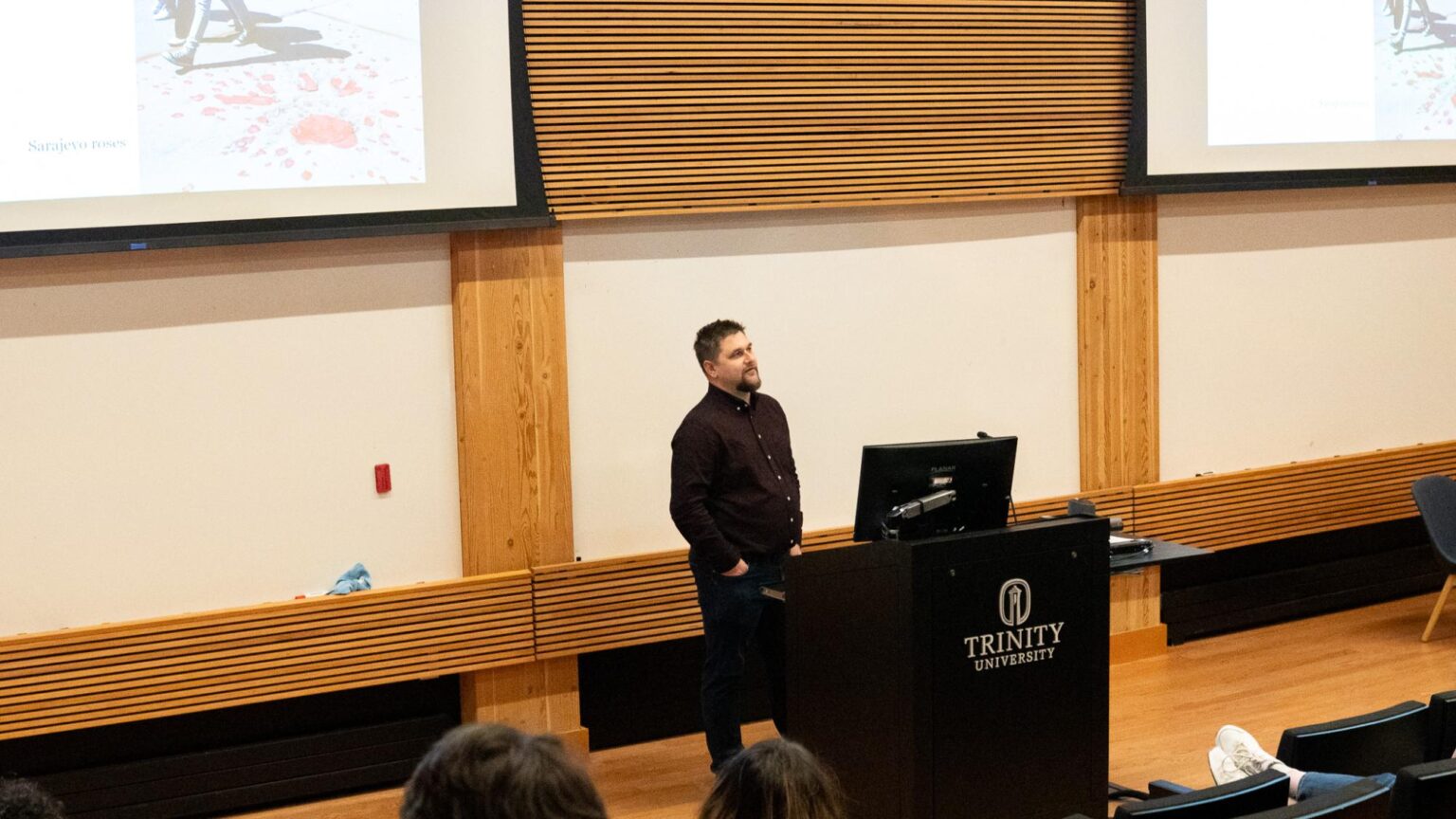
Around 50 students and staff members filed into Dicke Hall on Nov. 3 to listen to genocide scholar Hikmet Karčić’s lecture on the Bosnian genocide from 1992 – 1995 during the Bosnian War. The event was sponsored by the political science and international studies departments.
As the lecture began, Karčić spent time explaining the region’s history of ethnic diversity between Muslim Bosniaks, Orthodox Serbs and Catholic Croats. He talked of the modern history surrounding former Yugoslavia and how its collapse in 1980 and rising nationalist sentiments ultimately led to the Bosnian genocide. The room quieted as he displayed photographs of people, malnourished in camps, standing behind barbed wire. Audience members audibly gasped at a picture of a mass grave, the corpses mangled and muddied in graphic detail. He paused as he reflected on a personal story of a teacher-turned-police chief who embraced Serbian nationalist beliefs and sent his students off to their deaths at the hands of the army as a result.
“Genocides have been happening since mankind has been here,” Karčić said in an interview with the Trinitonian. “The good thing is that we’re finally talking about it. It’s important that we can probably in the future be able to prevent these, and I think we are almost getting there.”
Karčić is a Bosnian senior researcher for the Institute for the research of crimes against humanity and international law at the University of Sarajevo. Karčić had already spent 10 years working with Trinity departments and faculty for the study abroad program in Bosnia, and this week was his first time coming to campus in person. Chair of the political science department, associate professor Rosa Aloisi, who is also the primary leader of the Beyond the Classroom study abroad program in Bosnia, met Karčić through collaborating on this program. She had also previously worked with the team for the International Criminal Tribunal for the Former Yugoslavia (ICTY) in 2009 and personally witnessed the prosecution of war criminals up close.
“I’m thrilled for the students to learn about the roots of the Bosnian genocide,” Aloisi said. “Not from me, I’m a legal scholar more than I am a historian, but from someone who is from the area and who was at the pulse of the situation right now. So what is happening right now? What is the legacy of the violence that was perpetrated?”
The lecture had an impact on the students there, including students from international studies and sociology departments. Among the attendees of the lecture was Nina Pollak, senior political science and Spanish double-major. Having attended the Beyond the Classroom program in Bosnia in the summer of 2024, she met Karčić there and studied the history of the war and genocide.
“It’s a horrible history, but it truly should be talked about way more than it is,” Pollak said after the lecture. “I wanted to come to the talk because I love them all, and they’re great people. And this topic is fascinating.”
The lecture was not the end of Karčić’s stay in San Antonio. For the remainder of the week, he continued to work with Trinity students and staff on campus. There was a second event, a screening for “Quo Vadis, Aida?,” a documentary further exploring the events of the genocide, on Wed. Nov. 5, at 5:30 p.m. in Dicke Hall, 108. On Thurs. Nov. 6, he concluded his stay with a final lecture entitled “Bosnia and the Transatlantic Far Right” at 5:30 p.m. in the same lecture hall.