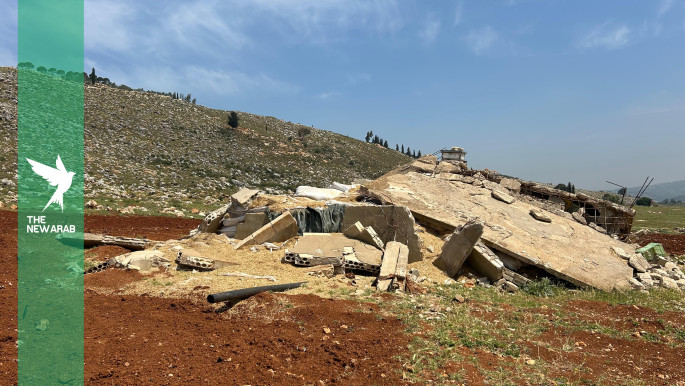
Israel’s war and continued attacks have devastated farming in southern Lebanon [Getty]
Nearly a year after the November 2024 ceasefire was meant to halt Israel’s war in Lebanon, farmers across the south of the country and the eastern Bekaa Valley are still trying to live amid destruction and ruin.
Farmland lies abandoned, livestock have perished, and families who once lived off their crops are now surviving on aid.
What should have marked the start of recovery instead exposes the long reach of Israel’s devastation and its lasting grip on Lebanon’s agricultural heartlands.
A new joint report by Action Against Hunger, Oxfam, and Insecurity Insight, titled “We Lost Everything: The Impact of Conflict on Farmers and Food Security in Lebanon”, documents the severe economic and humanitarian consequences of Israel’s continuing violations of the ceasefire agreement.
The findings build on the agencies’ earlier report, entitled “When Bombs Turn the Taps Off”, which detailed Israel’s destruction of Lebanon’s water infrastructure, leaving more than 150,000 people without clean water months after the ceasefire.
A system in collapse
The latest report found that almost 90 percent of farmers surveyed have seen their food production plummet since October 2023, when the conflict between Hezbollah and Israel started.
For many people in Khiam, Bodai, Saaideh, Baalbek, and Aitaroun, agriculture has stopped completely, cutting off entire communities from their main source of income.
“Some farmers have lost everything, and this will have devastating repercussions not just for them and their families, but the communities they help to feed,” Christina Wille, director and a founding member of Insecurity Insight, told The New Arab.
“The majority of interviewed farmers told us they had been unable to access their agricultural land at some point since October 2023, and most felt unsafe accessing land for planting, harvesting crops or grazing livestock.”
From burned orchards and shattered greenhouses to destroyed irrigation systems, the pattern of damage points to deliberate targeting and long-term incapacitation of Lebanon’s food systems.
“Our findings show that around 90 percent of farmers we interviewed have seen their food production drop since October 2023,” said Drew East, researcher at Insecurity Insight. “That is a systemic collapse, not a seasonal shock.”
The report also notes that Israeli troops continue to occupy parts of southern Lebanon, despite a February 2025 deadline for their withdrawal. For many, this prevents any return to normal life.
“Agricultural losses are not only caused by shelling or burning,” Wille explained. “When farmers cannot reach their land because of displacement or military presence, the outcome is the same: fields go unplanted, and food disappears.”
Satellite imagery from 3 and 8 June 2024 shows extensive burn scars across farmland along the southern Lebanon border area [Insecurity Insight/The New Arab]
Contaminated land and lasting danger
The new findings reveal that Israel’s use of explosive weapons and white phosphorus has left vast areas of land contaminated, threatening the environment and those who depend on it.
Farmers across southern Lebanon described dangerous contamination from unexploded ordnance, with some unable to return to their fields for fear of sudden detonation.
“Explosive contamination freezes life in place,” said Wille. “It keeps people displaced, keeps fields uncultivated, and keeps entire communities in limbo.”
Rights groups warn that white phosphorus, repeatedly used by Israel during the conflict, can destroy soil fertility and poison water sources, making recovery nearly impossible.
“The presence of explosive remnants of war can put people’s lives on hold, making it too dangerous to return home or to work,” Wille said.
Farmers across southern Lebanon described dangerous contamination from unexploded ordnance, with some unable to return to their fields for fear of sudden detonation [Insecurity Insight/ The New Arab]
Hunger, displacement, and a broken ceasefire
Israel’s continued presence and bombardment have deepened Lebanon’s food insecurity crisis. Almost half of the farmers interviewed have been displaced, and nearly 82,000 people remain unable to return home nearly a year after the ceasefire.
“The repeated attacks on farmland in South Lebanon and Bekaa are not only destroying livelihoods but undermining Lebanon’s food security,” said Bachir Ayoub, Oxfam’s country director in Lebanon.
“There must be an immediate end to these violations and the full withdrawal of Israeli forces so that farmers can safely return to their land and rebuild their lives,” Ayoub added.
The damage has been worsened by historic droughts and restricted access to essential materials.
“Farmers across Lebanon are already in crisis as historically low rainfall has led to the worst drought on record,” said Suzanne Takkenberg, Action Against Hunger’s country director.
“This climate stress is being exacerbated by the ongoing effects of the conflict, including contamination of the land, restricted access and disruption to supply chains. Urgent action is needed to restore hope for farmers and communities who rely on them,” Takkenberg added.
Map showing areas of southern Lebanon affected by Israeli displacement orders issued between 1 and 7 October 2024 [Insecurity Insight/ The New Arab]
Beyond rebuilding: the human cost
The report calls for comprehensive assistance, including cash support, land rehabilitation, and large-scale clearance of explosive remnants. It also emphasises the need for psychological support to help farmers cope with the trauma of displacement and loss.
“The most urgent needs are to help people safely return home and to work, and address food insecurity as soon as possible,” Wille said. “Support must go beyond food aid – it must enable people to rebuild their livelihoods.”
One farmer’s testimony struck a deep chord with researchers. “The war affected the spirit before the land,” he said.
For East, that comment captured the invisible wounds left by Israel’s campaign.
“The war has created a psychological frontline as real as the physical one,” he said. “Fear, trauma, and uncertainty are now major barriers to food production. You cannot harvest crops if you are preparing to flee at any moment.”
A damaged greenhouse and scorched farmland in southern Lebanon, where repeated Israeli bombardments have destroyed crops and agricultural infrastructure [Insecurity Insight/ The New Arab]
Accountability under international law
Under international humanitarian law, food sources and agricultural land are protected as “objects indispensable to the survival of the civilian population”. Yet Israel’s ongoing violations through the targeting of farmland, water systems, and livelihoods shows a blatant disregard for these obligations.
“All parties to the conflict have clear obligations under International Humanitarian Law to protect foodstuffs, agricultural areas, crops and livestock,” the agencies said in their report.
They urged the international community to press for Israel’s full withdrawal and ensure accountability for violations that continue to devastate Lebanese civilians.
Nearly one year since the ceasefire, Israel’s military actions have left Lebanon’s farmers trapped between displacement, contamination, and despair, with little left to harvest but the wreckage of their livelihoods.
“The presence of explosive remnants of war can put people’s lives on hold, making it too dangerous to return home or to work,” Wille said, noting that Israel’s ongoing violations keep people displaced, fields uncultivated, and entire communities in limbo.