
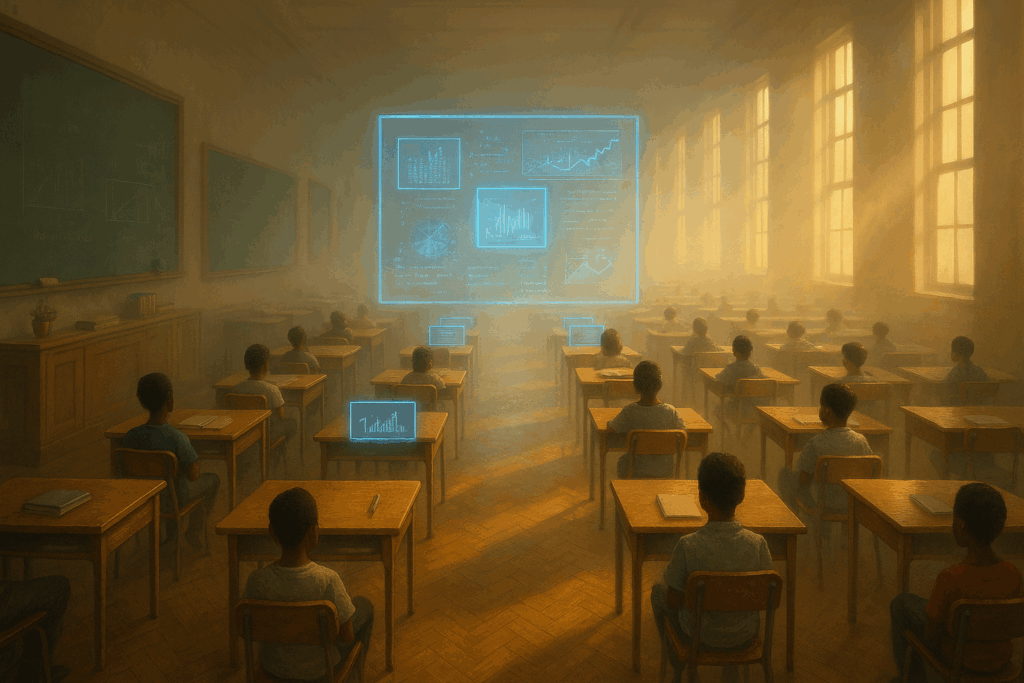
 AI-generated image
depicts students
learning with the
help of artificial
intelligence tools in
the classroom. [Submitted]
When the Maricopa Unified School District began rolling out artificial intelligence tools to students, it was the quiet culmination of three years of meetings, hallway brainstorms and committee sessions. The technology had been looming. Like a dust storm on the edge of town, it was coming whether anyone wanted it or not.
The question was not if, but how.
The preparation started three years ago with a technology task force, led by new Principal Christine Dickinson, then the technology director. She brought together staff, parents, students and community members to ask the sort of questions that any tech skeptic was eventually going to ask of her:
Is artificial intelligence good for children? Will it change what teachers do? How do we stop it from becoming a shortcut?
In those early sessions, they built what would become the district’s “stoplight” system for AI: green for approved uses, yellow for teacher-permissioned territory, red for what was off-limits. The posters went up in classrooms like quiet mental guardrails.
Tools in the classroom
This year, many new tools rolled out for returning students. The marquee tool is Khan Academy’s KhanMigo, an “AI powered tutor for students and assistant for teachers,” as Khan Academy’s Chief Learning Officer Kristin DiCerbo calls it.
“When students are practicing, they often get stuck,” Dicerbo told InMaricopa. “It’s hard for a single teacher in a whole class to give individual help to every student who needs it. And we’ve built KhanMigo so that the students, when they’re stuck, can say, ‘I don’t know how to do this. Can you help me figure this out?’ And rather than just answering the question for them… it helps guide students themselves to the answer.”
Maricopa students aren’t the only ones using this tool. AI technology has grown exponentially across education, surprising even those who developed it.
“We initially launched and had about 40,000 users, and then last year we went up to 700,000. Nothing that I’ve seen before in educational technology has had that kind of quick adoption,” said Dicerbo. “I think it’s just because there’s a low barrier to entry. You don’t have to have special equipment; you don’t have to know how to code. You can just talk to it in plain language.”
This summer, the MUSD Governing Board approved the use of KhanMigo and other AI tools in classrooms. In Maricopa, teachers have begun using KhanMigo to give instant feedback on essays, to translate lessons and help tutor math.
“I’ve got a couple kids who would never raise their hand, and now they’ll type their question in,” said Dr. Robin Rice, technology integration specialist at Maricopa Wells Middle School and Maricopa Elementary School. “It’s not that they don’t want to learn, it’s that they’re scared they’ll get it wrong in front of everybody.”
And it is not just KhanMigo. There is Securly Chat, a monitored chatbot that nudges students toward outlines and ideas without writing their essays. Canva’s AI image generator lets a middle schooler put a cover on her story, while also learning to reject the results that miss the mark. Grammarly AI reads over drafts, spotting tense shifts and awkward phrasing before a teacher ever sees the paper. Adaptive programs in math and reading tailor lessons based on skill gaps. It is a kind of individualized attention that used to be a luxury.
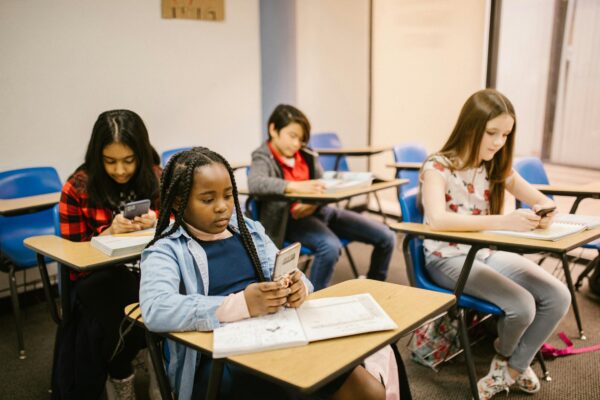 Students use KhanMigo in the classroom. [Submitted]
Oversight, not abolition
The guardrails are firm.
“All of the students’ chat transcripts are available for their teachers and parents to review,” DiCerbo said. “We have moderation features that flag things like violence and hate and self-harm. We have agreements with those companies that… they cannot use that data to train their models and they have to delete it after 30 days.”
Teachers notice the change in their workflow.
“It’s really a support to teachers,” said MUSD Director of Education Technology Nicole Cantrell. “It’s like reinforcement; different support for each individual child.”
When teachers can see a student’s rough draft, then see the feedback they got from AI, “You can see the progress shift,” added Rice.
AI also functions like a triage tool for teachers, helping them prioritize which students need attention first.
“They’re using it really to meet the needs of every child in their classroom,” explained Rice.
The U.S. Department of Education’s 2024 Artificial Intelligence in Education report calls for AI to be “inspectable, explainable and overridable,” language echoed in MUSD’s contracts with vendors. The report stresses AI should “supplement, not supplant” teacher judgment, and warns against overreliance before long-term impacts are understood.
A research study last year notes that while early results suggest productivity gains for teachers and improved student feedback loops, they also introduce “new dependencies that, if unmonitored, risk narrowing the range of student thought.”
The short version of the latter is AI threatens to do the work for students, limiting the need for critical thinking. That caution resonates with MUSD’s stoplight system: technology moving forward, but not without a brake pedal.
What’s next for AI in schools?
Inside the district, leaders talk about what comes next. More multimodal AI, where a tutor can see the geometry problem a student is working on and draw right alongside them. Greater integration into curriculum from the big publishers. A generation of students who will leave high school not just familiar with AI, but literate in how it works and when to use it.
Cantrell, the ed-tech director, believes if they are not taught with artificial intelligence in K–12, students will be at a disadvantage.
“College expects them to know how. Employers expect them to know how. We can’t graduate kids who are ten years behind the tools they’ll see on Day One,” she said.
What comes next? It’s hard to say. The bigger challenge is staying current.
“You can’t stay in front of it,” said Cantrell. “You just try to keep up.”
Even Google Classroom, a fixture for more than a decade, quietly added AI features over the summer.
It is here to stay.
“It’s like when graphic design moved from pen and paper to computer screen, or when blueprints went to CAD. The work changes, but the purpose remains,” said Rice, the tech integrator.
In Maricopa’s classrooms, AI is not replacing the chalkboard or teacher’s voice. It is a hand extended to the student who is stuck, another set of eyes on a paragraph, a partner in the slow work of trying, failing and ultimately, learning.