
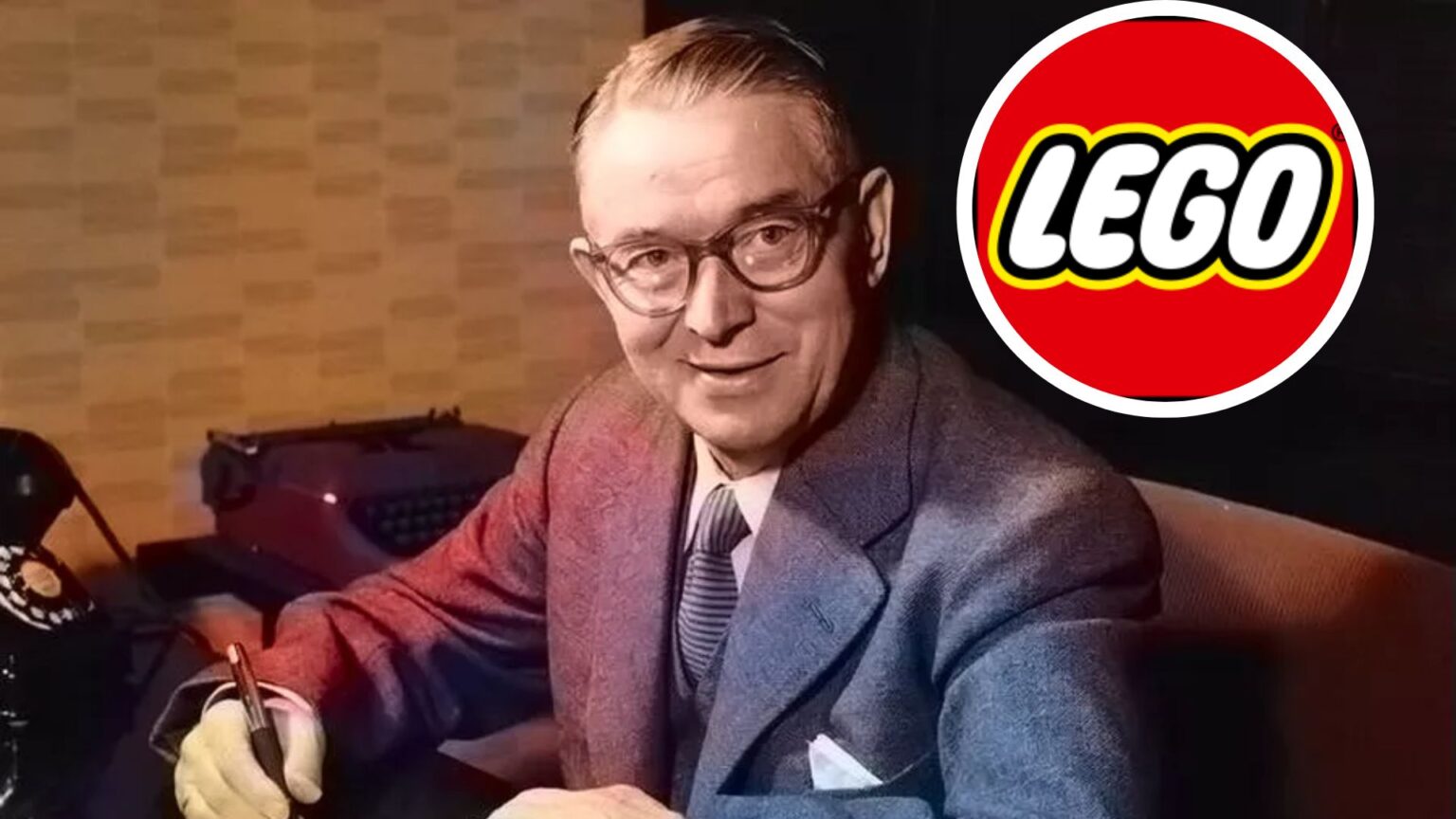
A simple man, four children, and a ruined workshop: the true story behind LEGO, the brand that taught the world how to rebuild.
A Danish carpenter saw his life crumble during the great depressionThe crisis took everything he had, his wife passed away, and he was left alone, surrounded by debt and with… four young children to create.
Years later, the small workshop that once almost closed its doors would transform into an empire valued at over US$8 billion, present in 140 countries and recognized worldwide as a symbol of creativity, perseverance and reinvention.
This man was Ole kirk christiansen, the visionary who founded the LEGOBefore creating one of the most iconic toys on the planet, he manufactured… ladders and ironing boards. In 1932Trying to survive the economic crisis that was devastating Europe, it began to produce wooden toys and he sold them door to door for a few coins.
But fate would test him again. In 1942A fire completely destroyed his workshop, multiplying his debts and jeopardizing his family’s livelihood. 51 yearsExhausted and discouraged, Ole even considered giving up.
It was then that a new idea rekindled his hope. In 1949He decided to invest in a material considered promising, but underestimated by many: the plasticHe created simple and colorful interlocking blocks, believing they could transform the way children played and learned.
Most people doubted it — “nobody will want that,” they said.
Even so, he persisted. In 1958, recorded the definitive interlocking system, an innovation that would revolutionize the world of toys and remain unchanged to this day.
Currently, the LEGO sells more than 600 million kits per year, employs about 25 thousand people and continues as The best-selling and most recognized toy on the planet..
The origins: faith, wood, and the first fire.
The story of LEGO begins in a forgotten village… Rural Denmark, at the beginning of the XNUMXth century.
Em 1915, the young craftsman Ole kirk christiansen heard about a small carpentry workshop for sale in Billund, a province with fewer than 100 inhabitants.
Born into a poor family, Ole grew up tending to cows and sheep, learning early on the value of manual labor and faith.
He was determined to change his own destiny. With the help of his brothers, he managed to get a small loan and bought his dream home. One-story White Housewhere he set up his workshop.
The invoices proudly displayed the name:
“Woodworking and carpentry – Billund.“
During First World WarDenmark’s neutrality allowed farmers to prosper by selling grain and meat. 1916 and 1918Ole had so much work that he could barely keep up with the orders.
But, with the end of the war, came the global economic crisis…and the money disappeared from the region.
Even so, he didn’t give up. Driven by faith and the responsibility of supporting his four children— Johannes, Karl Georg, Godtfred and Gerhard — kept the business alive.
Until, in April 1924Fate tested his resilience: the workshop caught fire.
The fire, accidentally started by the young children, destroyed everything.
With the help of his neighbors, Ole rebuilt the house and the workshop — now in solid bricks.
It was the first of many new beginnings.
From the Great Depression to wooden toys
When the Great Depression of 1929 It hit the world, and Denmark plunged into crisis.
Exports of grains, butter, and meat have plummeted.
Wood became expensive, credit dried up, and Ole watched his orders disappear.
But the carpenter’s creative mind found an unexpected solution.
Em 1932He and two apprentices began manufacturing small wooden toys — miniature ladders, Christmas tree stands, colorful little trucks.
They were simple, inexpensive, and carried a silent magic: each toy held a piece of its creator’s hope.
The idea worked.
A local merchant visited the workshop and was impressed by the quality of the pieces.
He placed a large order for Christmas, and that order saved the company.
In the same year, a new coup shook Ole.
Your wife, ChristineShe, pregnant with her fifth child, fell ill and died at the age of 40.
“I saw my father cry for the first time,” his son would recall years later. Godtfred, who would inherit the leadership of the company.
Even though he was devastated, Ole kept the faith.
When asked years later how he managed to overcome so many tragedies, he replied simply:
“We need to pray. Pray that orders come in. Pray to be able to produce. And pray that they get paid.”
Over time, the prayers began to be answered.
Em 1935Seeking a fresh start, Ole renamed the company.
Inspired by Danish words “Leg godt” — “play well” —, the name that would change the world was born: LEGO.
Revenue nearly doubled that year, reaching 177.200 Danish kroner.
In 1939, it was already over 50.000 crowns annually, consolidating the small factory as a promising player in the toy market.
The turning point: plastic, the interlocking system, and the global empire.
During Second World WarDenmark was occupied by Germany, and the lack of timber threatened the trade.
Even so, Ole and Godtfred continued production; between 1940 and 1945, revenue jumped from 74 thousand to 357 thousand crowns.
Em 1947Ole bought the Denmark’s first plastic injection molding machine — something considered madness at the time.
He and his son studied the British blocks. Kiddicraft, Hilary Fisher PageThey improved the fitting system, making it sturdy and universal.
Em 1949They filed the patent application.
Is on 1958, was born the The ultimate LEGO system, still used today.
with the death of Ole kirk christiansenin that same year, Godtfred He took over and expanded the company to… Germany, where sales quickly surpassed those in Denmark.
The legacy of three generations: from pain to building dreams.
The decade of 1960 It marked the modern era of LEGO.
Under GodtfredThe company abandoned wooden toys and focused on innovation.
Em 1962, the launch of first LEGO wheels It allowed the creation of cars, airplanes, and entire cities.
O LEGO system It became the heart of the brand.
Em 1968, the first LegolandIn Billund, the company celebrated creativity and solidified its reputation as a family-run business.
In the 2000s, the most serious crisis in the company’s history occurred.
Excessive diversification has distanced LEGO from its original concept, leading to losses in 2003.
The following year, a new CEO from outside the Christiansen family restructured the company, focusing on blocks and franchises such as Star Wars e Harry Potter.
Video games and adult collections restored the brand’s luster.
According to the channel Curious MarketLEGO registered in 2022 growth of 17%, reaching 64,6 billion Danish kroner (about US $ 9,2 billion) and employing 25 people in 140 countries.
For over a century, LEGO has survived fires, wars, and crises.
Every tragedy became an opportunity: the fire of 1924 led to modernization; great depression It created wooden toys; the 1960 fire** consolidated plastic; and the crisis of the 2000s rescued the essence of building blocks.
Today, each piece LEGO represents the human capacity to rebuild and innovate, transforming losses into new possibilities.
From a rural workshop in Denmark to the world’s largest toy manufacturer, LEGO proves that even the most fragile dreams can be built—piece by piece—until they become eternal.
“Only the best is good enough.“
– Ole kirk christiansen