
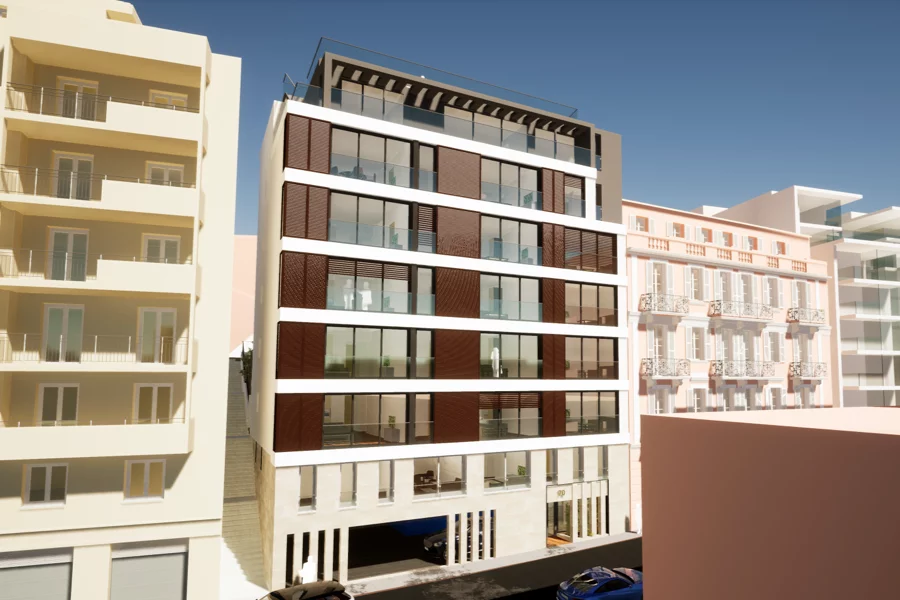
While Monaco remains a major economic hub, its attractiveness is increasingly undermined by the growing difficulty of finding housing and by daily commuting constraints for cross-border workers. The shortage of affordable housing near the Principality has become severe, while daily journeys from the Alpes-Maritimes or Liguria are increasingly time-consuming and discouraging for employees. To address this, some of Monaco’s largest employers have decided to invest directly in real estate to provide accommodation for their staff — among them, Société des Bains de Mer (SBM), Giraudi Group, and the transport and logistics company Transcan.
 Sophie Vincent © Photo Stephane Danna / Direction de la Communication
“Salary and pension arguments are no longer enough”
As Monaco’s largest employer, with 4,723 permanent staff and between 900 and 1,200 seasonal workers each year, Société des Bains de Mer faces this challenge daily. “There have been cases where employees left us after finding a similar job closer to home, or where candidates withdrew from the recruitment process due to housing difficulties. Salary, pension, and social benefits alone are no longer sufficient to attract or retain talent,” explained Sophie Vincent, Director of Human Resources, in an interview with Monaco Business News this summer. SBM already owns 210 staff housing units, but the group has now been forced to launch the construction of two new buildings entirely dedicated to its employees.
SBM invests in two new residential buildings
In Roquebrune-Cap-Martin, a site located on Sentier des Tennis, near the Monte-Carlo Country Club, will host by December 2026 a residence featuring six shared apartments (a total of 37 rooms). The total project cost amounts to €6 million including taxes, covering design fees, construction, and furnishing. At the same time, in Beausoleil, SBM has purchased a new building at 70 Avenue du Maréchal Foch, also scheduled for delivery in December 2026. The investment totals €14.8 million including taxes, to which the cost of interior fit-out will be added. This residence will offer 12 shared units (54 rooms), one apartment, and seven studios, primarily intended for seasonal staff. “These two developments will provide us with more than a hundred additional beds, ready for the 2027 season,” said Sophie Vincent. In the meantime, the company is renting temporary accommodation in a serviced residence in Menton — “which, as you can imagine during high season, represents a very significant cost,” she noted.
The Giraudi Group purchases housing for seasonal employees
Another major player in Monaco’s economy, Riccardo Giraudi, CEO of the Giraudi Group — a leading company in the international meat trade and high-end restaurant sector — has also taken matters into his own hands. “I am constantly faced with the challenge of attracting and retaining talent, largely because of limited access to Monaco and the prohibitive cost of housing,” the entrepreneur told FEDEM Magazine. Facing the same issue, his group has invested in residential properties in nearby French towns to house certain seasonal workers. “Without access to affordable housing close to Monaco, we would lose a large portion of our qualified workforce,” he lamented.
 Riccardo Giraudi © Photo Manuel Vitali / Direction de la Communication
Transcan acquires six apartments in Nice
For Franck Cannata, CEO of Transcan, a logistics group based in Carros and Monaco, the situation has become equally unsustainable. “It has become increasingly difficult to recruit and retain employees in Monaco,” he told Monaco Business News. “Some workers move farther away — into the Var or beyond — forced out by property prices and exhausting commutes. For businesses, that’s an indirect penalty, sometimes even a direct cost: an employee hired from another region may quit after just a few months, right when they’ve been trained and become fully effective.” To counter this, Transcan has purchased six apartments in Nice, on Boulevard Gambetta, reserved exclusively for its staff. However, Cannata regrets that current legislation does not allow rental contracts to be directly linked to employment contracts. “This means a company could lose control over the very investment it made to serve its workforce,” he explained.
 Franck Cannata © Photo DR
The UPE 06 pushes for a legal framework to support employer housing
Now also serving as President of UPE 06 (the Employers’ Union of the Alpes-Maritimes) since June 2025, Cannata hopes to use his term — running until 2028 — to help modernize the legal framework surrounding corporate housing initiatives. “The idea would be to adapt the existing concept of usufruit locatif social — which already allows property ownership to be split between a social landlord (holding usufruct for 15 years) and a private owner — so that the available housing could be allocated specifically to employees of the owning company, with the rental agreement tied directly to the employment contract,” he explained. “This model could even be shared among several companies, or implemented across an industrial zone or wider economic area,” he added.