
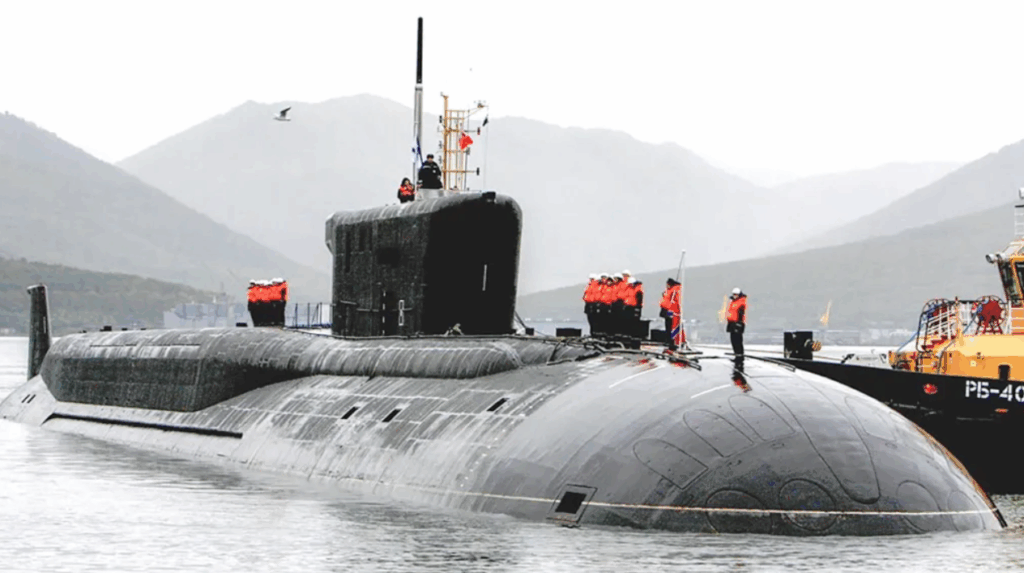

Russia has announced the launch of a new nuclear-powered submarine, Khabarovsk. The launch took place on 1 November, at the Sevmash shipyard in Severodvinsk, Russia. Khabarovsk was laid down in 2014 and is the lead vessel of the Project 09851 class (commonly known as Khabarovsk class). The Ministry of Defence says Khabarovsk “will enable us to successfully secure Russia’s maritime borders and protect its national interests” in all the world’s oceans. The waterline mark and measurements
analysis confirm that the new submarine Khabarovsk is closely related to the Borei-A, but it also sits much lower in the water. This likely indicates that it has significantly less reserve buoyancy, potentially reflecting its specialised capabilities.
Khabarovsk has an estimated displacement of about 10,000 tons and an overall length of 370–440 feet (113–140 meters). Satellite analysis and expert estimates suggest a length of approximately 135–140m and a beam of approximately 13.5m. The submarine is powered by a nuclear reactor, giving it unlimited range and an underwater top speed of up to 30–32 knots. Its crew will number about 100 officers and sailors. Like other modern Russian subs, Khabarovsk is said to include “modern underwater weaponry, including robotic systems of various types”, reflecting its role as what Russia describes as a versatile strategic platform.
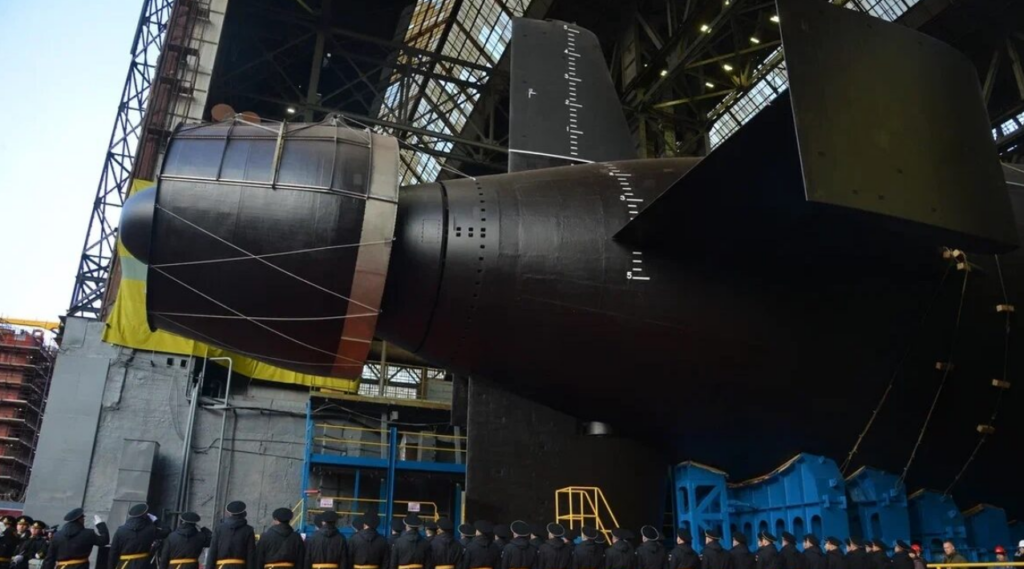 Russia Launches New Nuclear Submarine Khabarovsk. (Photo: Russian Ministry of Defense)
The new key feature of Khabarovsk is its armament of Poseidon (Status-6) nuclear-powered, long-range nuclear-armed drone, often characterised as a torpedo. It can carry six of these 20m long underwater drones. Each Poseidon is a huge torpedo-like weapon, weighing a reported 100 metric tons, armed with a multi-megaton nuclear warhead. Poseidon is designed for extreme range and deep-ocean operation. The Russian military highlights its plan to deploy various underwater drones and robotics and to transform Khabarovsk into a specialized hub for advanced submersible weapons technology.
Strategically, Khabarovsk represents an expansion of Russia’s sea-based nuclear deterrent. It will be the second submarine dedicated to carrying Poseidon drones after the converted Oscar-II class submarine Belgorod (which entered service in 2022). Russia plans a small fleet of these subs – likely three in total – to operate alongside its ballistic missile boats. All these Poseidon-capable subs are to be based in the Pacific and project power across the Pacific and Indian Oceans. Russian officials say Khabarovsk (and its future sister boats) are mainly for “strategic deterrence”. Russia aims to enhance its second-strike capability at sea by adding a new platform and weapon type to its arsenal, indicating the country’s ongoing effort to modernize its naval forces with new strategic systems.