
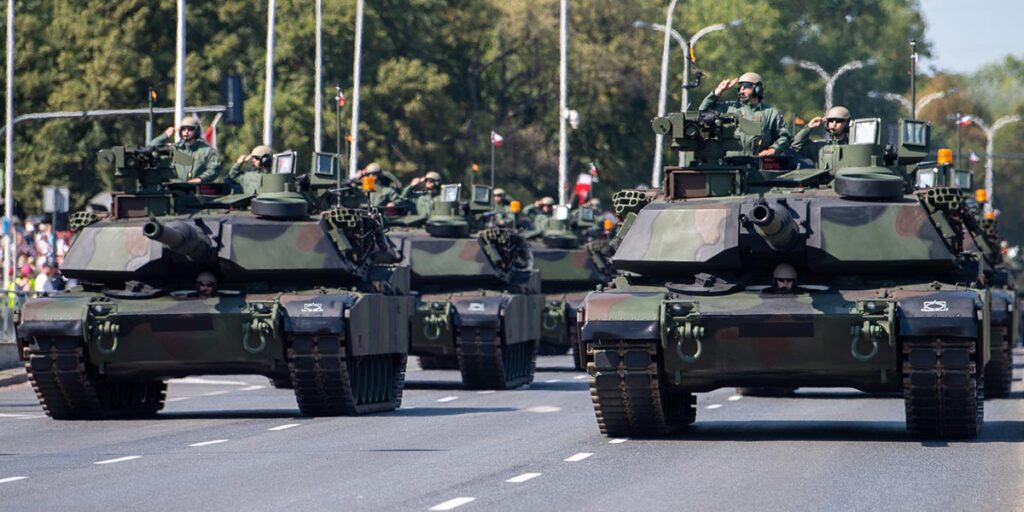
The Polish Army will have around 800 tanks by the end of the year
Every November 11, Poland celebrates the anniversary of the recovery of its independence in 1918, at the end of the World War I.
The characteristics of the Polish K2PL, one of the most advanced tanks in Europe
The M1 Abrams tank shows its Achilles heel in Poland compared to the South Korean K2
Two years after its independence, Poland faced a Russian invasion that ended in a Bolshevik defeat at the Battle of Warsaw on August 15, 1920, the last major victory of the legendary Polish cavalry. In September 1939, Poland suffered another invasion, this time at the hands of an alliance between Nazi Germany and the Soviet Union. This aggression triggered World War II, which ended with a new Soviet occupation of Poland and the establishment of a communist dictatorship imposed by Stalin.

Poland was the first European country where communism collapsed in 1989. Today, the memory of the communist era remains very much alive in the country, undoubtedly one of the most hostile in Europe to Vladimir Putin’s dictatorship. Following the Russian invasion of Ukraine in 2022, the Russian State Duma threatened Poland with being the next country invaded. The Polish government of Mateusz Morawiecki took note of this and undertook a significant rearmament process.

Poland is the European country that has increased its defense spending the most in recent years. The majority of its spending is directed towards the modernization of its Army and Air Force. The Polish Army has given high priority to the purchase of tanks, having donated hundreds of Soviet-made T-72 tanks to Ukraine, as well as some Leopard 2A4 tanks purchased from Germany.

The Polish Army relies on this armored force to deter potential Russian aggression, most likely against the Suwalki Corridor, the strip of land linking Poland and Lithuania, between the Russian exclave of Kaliningrad and Belarus. If Moscow were to seize this area, the Baltic states (Lithuania, Latvia, and Estonia) would be cut off by land. Poland’s role is crucial in preventing this, and the tanks are its iron fist against Russian ambitions.

Currently, the most numerous tank in the Polish Army is the German Leopard 2. The Polish Ground Forces have four versions of this armored vehicle: 105 Leopard 2A5, 46 Leopard 2A4, 82 Leopard 2PL (above; this is a modernized Polish version of the Leopard 2A4) and 2 Leopard 2NJ trainers. The latter two are not combat-ready, so we are talking about an operational force of 233 Leopard 2s.

The second most numerous tank in the Polish Army is the American M1 Abrams. At the beginning of 2023, Poland acquired 116 M1A1FEP tanks that had belonged to the US Marines (recall that in 2021 the USMC decided to dispose of all its tanks). That batch of Abrams tanks has now been fully delivered. In addition, Poland has purchased 250 M1A2 SEP v3 tanks (pictured above), which are currently being delivered. According to the Polish website Defence24.pl, 90 M1A2SEPv3 tanks are expected to be delivered this year, with the remaining 160 arriving in 2026. Therefore, by the end of this year Poland will have 206 M1 Abrams tanks.

The best Polish main battle tank is the South Korean K2 Black Panther, and it will also be the most numerous in the Polish Army’s armored vehicle fleet. By August, Poland had already received 160 of the 180 K2GF tanks it had purchased. In addition, Poland is expecting 820 K2PL tanks, a version adapted to the specific needs of the Polish Army, of which 320 will be manufactured in South Korea and the remaining 500 in Poland. In total, the Polish Army will have 1,000 K2 Black Panthers, a vehicle more suitable than the Abrams in the swampy areas of the east of the country.

On the other hand, according to Defence24.pl, the Polish Army still has between 173 and 203 PT-91 Twardy tanks, a modernized Polish version of the Soviet T-72. It is a highly mobile tank with a powerful 125mm gun, but it is expected to be replaced by the more modern K2 Black Panther and M1 Abrams tanks.

Thus, the Polish Army will have around 800 tanks by the end of the year, a figure that will reach 1,600 in the coming years, including the withdrawal of the PT-91s. We are talking about one of the most powerful armored forces in NATO in Europe, with tanks more modern than those Ukraine had at the beginning of the Russian invasion.
—
Photos: Ministerstwo Obrony Narodowej / 16 Dywizja Zmechanizowana / 9 Braniewska Brygada Kawalerii Pancernej / Agencja Uzbrojenia.