
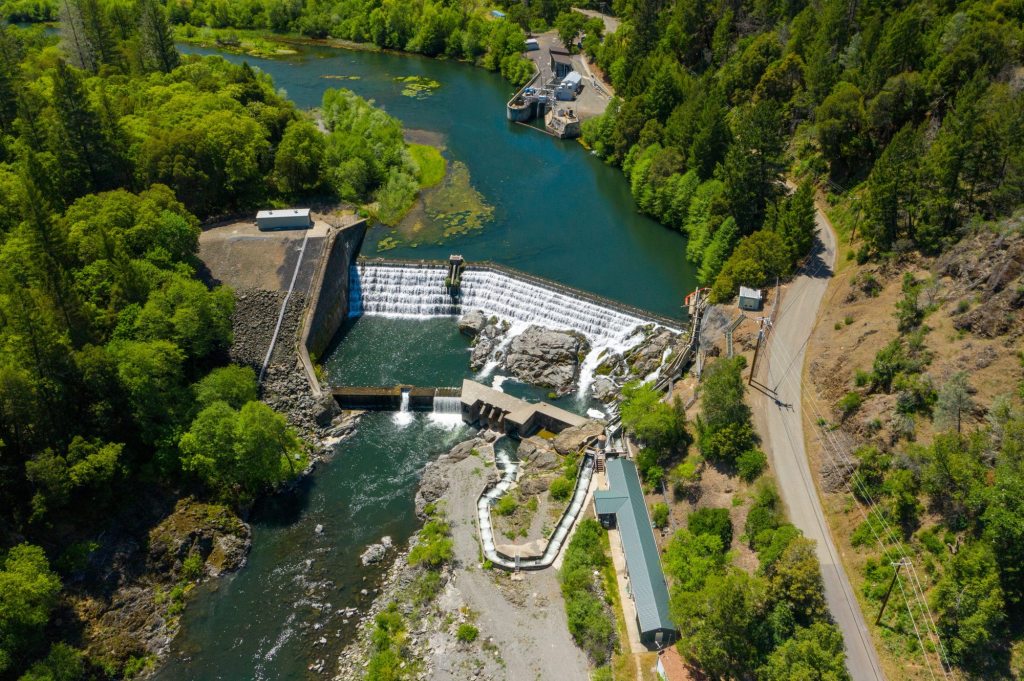
This month, the Federal Energy Regulatory Commission is accepting public comments on PG&E’s surrender and decommission plan for the Potter Valley Project, which would remove the Scott and Cape Horn dams from the lower Eel River and replace the utility’s water diversion facility with a New Eel Russian Facility.
Friends of the Eel River and Save California Salmon, alongside other partners, have teamed up to host a series of events along the North Coast to update the public on the dam removal process and help community members navigate FERC’s public commenting process.
The first of those events, a virtual meeting that can be accessed via Zoom at tinyurl.com/SCS-Eel-Zoom, takes place Wednesday evening at 6 p.m.
“These dams have not generated power since 2021, have caused major ecological harm to our river and pose a safety threat to down river communities,” Alicia Hamann, executive director of Friends of the River, said in a news release. “We are happy to see PG&E moving forward with the process, and it is important for the public to let regulators know that we support what they are doing. Returning the Eel’s native fish to the abundant, high-quality habitat trapped behind the dams is just around the corner.”
“Removing the dams on the Eel River is one of the most important things we can do to bring back fishing jobs, recreational opportunities and clean water to the North Coast,” said Regina Chichizola from Save California Salmon. “It is also a major step in restoring justice and creating opportunities for Eel River Tribes and other local communities. Luckily, PG&E wants their dams down and the Klamath has provided an example on how to do it safely. Now we just need to encourage FERC and the state to move quickly and make sure dam removal is done in a way that benefits local communities and fish.”
The group is also hosting a meeting and dinner on Friday, Nov. 14, from 5:30 to 7:30 p.m. at Synapsis, 1675 Union Street, Eureka. A Ukiah meeting hosted by the Sierra Club Redwood Chapter and California Trout will take place on Tuesday, Nov. 18, from 5 to 7 p.m. (attendees can register online at tinyurl.com/53fyavum). And a Redway meeting and dinner will be held on Friday, Nov. 21, from 6 to 8 p.m. at the Mateel Community Center at 59 Rusk Lane in Redway.
Opposition to removal
Though the two dams no longer function as hydroelectric facilities, have potentially serious seismic risk involved in their continued use and obstruct fish passage in an important salmonid habitat, there are many opponents of dam removal, particularly in the Russian River watershed, where agricultural interests enjoy water diversion from the project. Opponents of dam removal point out that the Scott Dam supports Lake Pillsbury, a recreational community and a source of water storage for Potter Valley agricultural interests.
The Lake Pillsbury Alliance, a community group dedicated to preserving the Scott Dam and Lake Pillsbury, also issued a statement encouraging opponents of dam removal to address comments to FERC. The alliance posted instructions and sample comment letters at tinyurl.com/5n7ec6yc.
“I strongly oppose PG&E’s proposed action to dismantle Scott Dam and drain Lake Pillsbury because it will directly threaten the health and safety of the Lake Pillsbury communities and other communities within the region who depend upon this secure, year-round water source for their families, farms and fire protection,” a sample comment letter reads. “As a Lake Pillsbury property owner and long-time recreational user, I have witnessed first hand how important Lake Pillsbury is for rapid fire-fighting response — especially as rivers and streams above Scott Dam dry up seasonally during peak fire season. Without the lake, property and lives will be lost. The threat of decommissioning has decreased my property value and PG&E’s decision to reduce Pillsbury water storage by 25% has impacted area water supply, water quality and rendered most marinas and docks unusable by mid-July.”
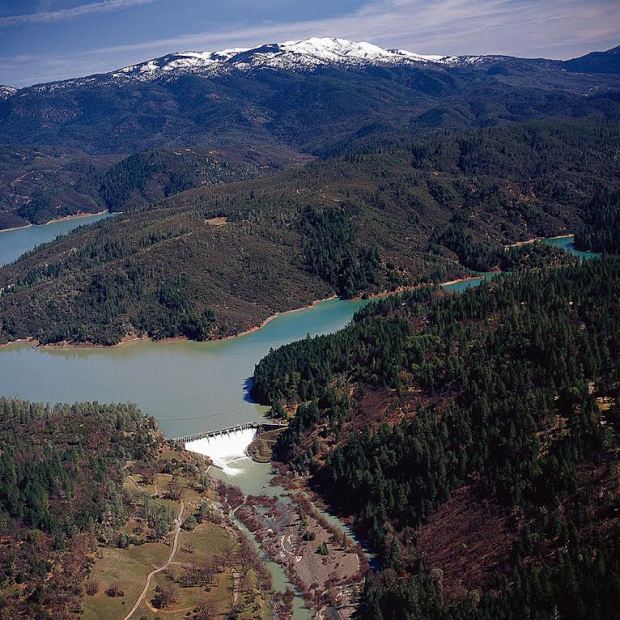 An image shows Lake Pillsbury as interned by the Scott Dam on the Eel River. (Friends of the Eel River/Contributed)
Stakeholders in the project
Reached by telephone Tuesday morning, Chichizola clarified to the Times-Standard that the comment period was not specifically a referendum on the Two-Basin Solution and the broader effort by stakeholders in the region to preserve seasonal flows to the Russian River while restoring the ecology of the region post-dam removal. She said that there are a number of reasons why expressing support for dam removal via public comment to FERC is important at this juncture.
“One (reason) is to show support to take out these antiquated dams, which are no longer producing any electricity,” Chichizola said. “But also, there are a lot of things FERC can do to make sure that there are really good restoration plans, or really good water quality monitoring plans, or that a lot of the restoration and decommissioning jobs stay local. So it’s a good time for people to get involved, to comment and to ask that the dam removal be done in a really safe way that really prioritizes local people, local jobs and local restoration and that the plan is a really good plan where we can make sure that all the benefits from dam removal happen.”
Chichizola pointed out that there is no water right specifically allocating water from the Eel to Russian River interests (water diversions were traditionally a byproduct of the hydroelectric project) and said that stakeholders along the Eel River had gone out of their way to ensure that the post-dam removal plans were a good compromise between local interests in the Russian River and those along the Eel River watershed.
“It’s important to remember that these dams are no longer safe,” Chichizola said. “Dams do have a shelf life. They don’t last forever, and when they’re no longer safe, they’re no longer providing benefits, they’re no longer providing electricity, that’s the time that they need to come down. And these dams are private property, so PG&E does have the right to take them down, and we just want to make sure that that happens in the best way possible for everyone.”
Other stakeholders in the project affirmed their support for dam removal this month.
Late last month, the Mendocino County Board of Supervisors rejected a resolution to express disapproval of the Potter Valley Project’s broad decommission and dam removal plan. Instead, the board passed a resolution affirming its commitment as a stakeholder in the project in a split vote over the objections of supervisors Madeline Cline and Bernie Norvell.
In a press release, Round Valley Indian Tribes tribal member and SCS organizer Nikcole Whipple noted the project’s importance to tribal communities throughout the Eel River watershed.
“Dam removal is critical to Tribes on the Eel River’s culture, we believe water is life,” Whipple said. “Our Indigenous people prioritize the rights of water first, we honor the river as a living being, a place of cultural healing and wellness. Culture is wellness in Indian Country, and we require access to cultural resources provided by our Eel River. Returning the free-flowing river and riparian ecology in our watershed will benefit generations to come. We need FERC to free the Eel, now!”
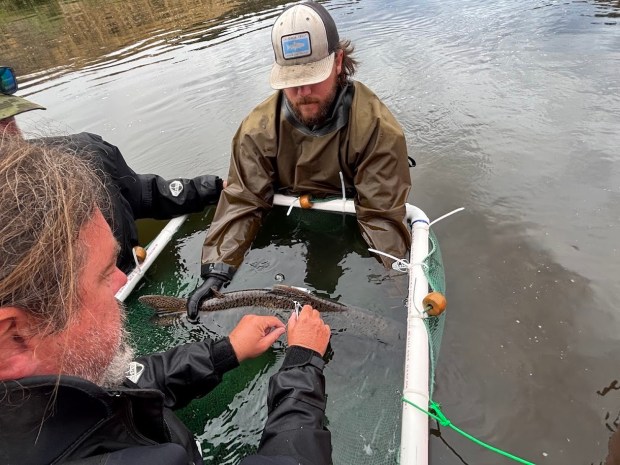 Scientists work to install tags on a fish that will allow telemetry tracking in the Klamath River Basin. Successful dam removal and restoration efforts have led to a dramatic increase in salmonid populations along the Klamath watershed. (Courtesy of California Trout)
Chichizola said that dam removal on the Klamath River, which she was involved in, offers a good example of how successful dam removal efforts can be.
“The healing of the Klamath happened so quickly, and the water quality was improved so quickly, and the salmon came back way before we could ever hope,” she said. “… And I just think it’s an example that we can lean on for the Eel River, of how quick the salmon can come back, how quickly a river can be restored, and that if we work towards it, we can have a lot of local benefits and just make sure that all the communities involved can stay whole and be able to see salmon come home.”
The FERC comment period on the Potter Valley Project is open until 2 p.m. PST on Dec. 1. Individual comments can be made through the commission’s online portal at tinyurl.com/yc74vcf8.
Robert Schaulis can be reached at 707-441-0585.