
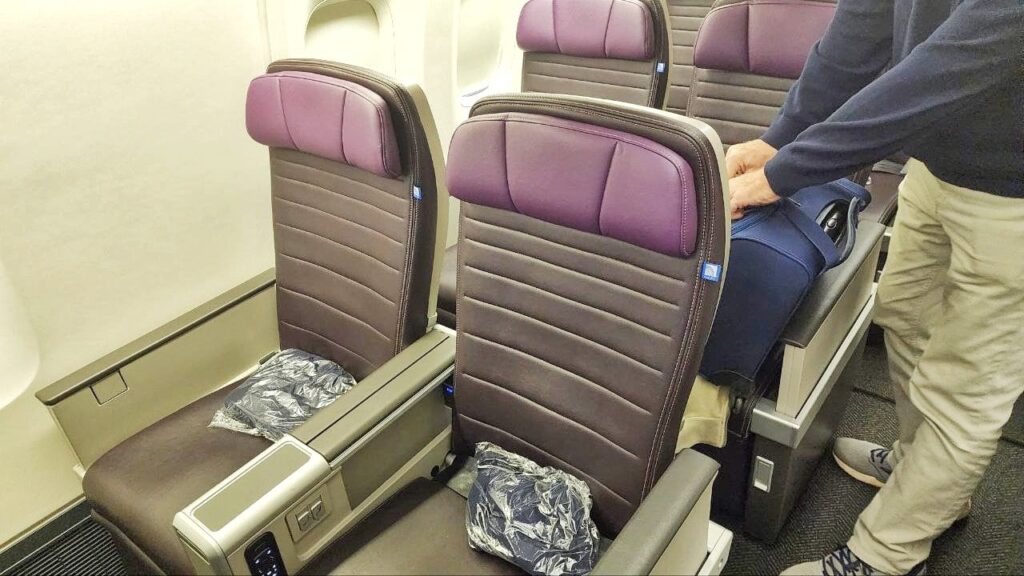
For many travelers heading to Hawaii, the long flight starts as part of the adventure until hours in, when your knees are pressed against the seat in front of you, and you realize economy isn’t what it used to be. Premium economy promises relief, but on Hawaii routes it remains an evolving, sometimes confusing, often hard-to-find middle ground between comfort and cost. With fares climbing and cabin layouts shrinking, here’s what’s really behind the “premium economy” label on Hawaii flights.
What premium economy really means on Hawaii flights.
On some Hawaii widebody flights, premium economy is a clearly defined offering. This is not extra legroom economy. You get a separate cabin, wider seats, better recline, upgraded food and service on real china, real headsets, and sometimes even amenity kits.
At present, only United, American, and Delta offer a true separate-cabin premium economy, and only on select wide-body aircraft to Hawaii. Hawaiian and Alaska do not yet have it, although Alaska plans to add premium economy to Hawaiian’s A330 fleet following its purchase of the airline. That upgrade is still in development and details have not yet been revealed.
When we flew from Washington DC to Honolulu in United Airlines Premium Plus, the difference was noticeable, not dramatic, and not entirely as we had expected. The seats were unique and felt higher quality, offering more overall comfort and cushioning, but the legroom fell seriously short of expectations. If there had been just two more inches of space, it would have been totally comfortable. Discussing it with a flight attendant, they felt the same way. For two tall men, it was tight. Service was friendly and attentive, and the cabin quieter, but that legroom gap was a major disappointment.
What you actually get.
Service improves noticeably. Cabin crews in premium economy tend to be far more attentive, and boarding is earlier and easier. You are offered better food and drinks, and a larger screen. Meals vary by carrier. United, American, and Delta offer this true premium economy experience only on wide-body aircraft, with upgraded food service, real glassware, and a quieter, smaller cabin.
Expect around 38 inches of pitch and a slightly wider seat on wide-body flights. It sounds generous until you’re actually sitting in it. On our United flight, that translated to noticeably tight space for two tall men. Premium economy is not a lie-flat experience and in many cases there is not even enough room to cross your legs comfortably.
When it is worth paying for.
Extra space and better service matter most on long nonstop flights between Hawaii and major mainland hubs like Chicago, Newark, Dallas, and Atlanta. On those routes, premium economy can cost $700 to $1,500 roundtrip more than standard economy, depending on route, season, and how close you book. It is a major price jump, but for overnight or ten-hour flights, the difference in comfort can make it worthwhile. We’d suggest checking on a case-by-case basis.
Reader Mike from Seattle summed it up best: “For me, premium economy is not about luxury, it is about arriving in Hawaii without feeling wrecked.” If the fare difference fits your trip budget, the quieter cabin, upgraded service, and slightly wider seat can make a long travel day far less punishing.
For two traveling together, there is another calculation. We often use the three seat trick to buy an extra seat in economy for more space. Premium economy renders that unnecessary. Even though legroom is not dramatically greater than extra legroom with three seats, the overall experience, including fewer people per row, better food, and a calmer environment, can make it equal or better value than purchasing a third seat in economy. It’s a trade-off we always weigh.
When to skip it.
Most Hawaii flights use narrow-body aircraft without true premium economy. On these flights, you’re choosing between standard economy and extra-legroom products like Delta Comfort Plus or Alaska Premium Class. These offer a few more inches of pitch and priority boarding, but seats are identical and service remains largely economy. On West Coast routes, paying more than $100–$150 each way for this modest upgrade rarely makes sense, so many choose to save money.
Who offers the best Hawaii premium economy right now.
Among the three U.S. airlines that fly wide-bodies to Hawaii, the differences in premium economy are modest. United operates the most routes with a true separate-cabin Premium Plus, primarily on flagship flights from Chicago, Newark, and Houston to Honolulu and Maui. American flies its 787 and 777 aircraft from Dallas–Fort Worth to Honolulu and Maui, while Delta uses wide-bodies mainly from Atlanta and Minneapolis to Honolulu and Maui. Premium economy to Hawaii is available only on these long-haul routes.
Hawaiian’s situation is about to change dramatically. As Alaska continues integrating Hawaiian following the September 2024 purchase, the carrier plans to retrofit Hawaiian’s A330s to include a new premium economy cabin that sits between lie-flat first class and Extra Comfort. This represents one of the few areas where the merger may significantly improve the passenger experience, as Alaska’s investment in premium products pushes Hawaiian beyond its legacy extra legroom economy offering. It will not appear on Hawaiian’s A321neo or Alaska’s narrow-body fleet, so travelers should not expect premium economy on most West Coast routes anytime soon. When those A330s are reintroduced, it will finally give Hawaii’s hometown airline a cabin tier to match mainland competitors.
Knowing which airlines deliver real value matters, but so does knowing when to buy. Here’s how to book premium economy without overpaying.
When and how to book smart.
Premium economy fares fluctuate more than any other cabin. Prices tend to rise inside 60 days of departure, and on popular routes the cabin often sells out weeks or even months in advance. One strategy is to book economy early, then check daily for upgrade offers starting about 90 days out, although that is certainly not a guarantee.
Our experience booking six months ahead: even after constant checking, the price never dropped, and the premium economy cabin sold out months before our 11-hour flight. To create the best value, we used miles for one ticket and cash for the other.
Travelers with elite status or airline credit cards should look for upgrade certificates or mileage offers.
What the future looks like.
Premium economy on Hawaii flights is likely to improve, albeit slowly. Seat pitch should settle near 38 to 40 inches, with modest privacy dividers and improved headrests. Hawaiian’s retrofitted A330s may set a new benchmark when they enter service, and Alaska’s influence will likely bring a cleaner, more consistent design.
Airlines have learned that Hawaii travelers will pay for comfort. What used to be standard legroom now costs extra. Segmentation is the model, and it is not going away.
Competition is driving some of this improvement. United’s established premium product and Delta’s service reputation are pressuring both Hawaiian and Alaska to close the gap. Within a few years, most long-haul mainland routes to Hawaii should offer a clearer ladder from economy to premium economy to lie-flat business/first.
The bottom line.
Premium economy to Hawaii can be a worthwhile splurge or a disappointing half-step depending on you, your route, and your aircraft choice. The key is to know what you are getting. True premium economy exists only on wide-body planes and brings wider seats, better service, and more rest. It also brings modestly more legroom.
For frequent travelers or those on long overnight flights, it can mean the difference between arriving ready to explore or arriving exhausted. For everyone else, it might still feel like paying more for the same sore knees.
Have you flown premium economy to Hawaii? Did those extra inches actually matter?
Get Breaking Hawaii Travel News