
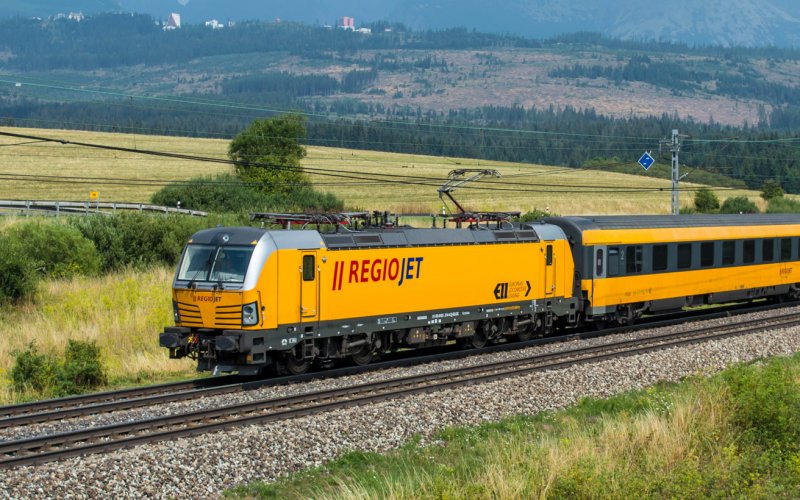
Czech operator RegioJet has called for a faster rollout of the ETCS safety system in Slovakia after one of its trains narrowly avoided a collision last week, with the driver preventing “a serious incident” at the last moment. Just two days later, a similar red-signal violation resulted in a real crash that left 79 people injured.
RegioJet has called on the Slovak government to accelerate the rollout of the European Train Control System (ETCS) after one of its express services narrowly avoided a collision on Friday, 7 November, near Bratislava–Rača station. The company said the incident occurred when a passenger train from state operator ZSSK departed the station despite a “Stop” signal, entering the same track as RegioJet service RJ 1045.
According to RegioJet, disaster was only avoided thanks to the quick reaction of its driver, who brought the train to a stop before impact. The station where the incident occurred is not yet equipped with ETCS, which automatically prevents trains from passing red signals.
Two days later, a similar red-signal violation resulted in a serious collision between two passenger trains near Pezinok, around 20 kilometres northeast of Bratislava. Seventy-nine people were injured in the crash, prompting national scrutiny over Slovakia’s rail safety systems. RegioJet’s owner Radim Jančura said the events showed an urgent need for investment, stating that “Slovakia should as soon as possible equip all main lines with ETCS and allow only vehicles with this system to operate on them.”
RegioJet’s appeal for safer corridors
RegioJet said the near collision at Bratislava–Rača had exposed gaps in Slovakia’s signalling infrastructure that leave rail operations “exposed to serious risks that could have tragic consequences.” The company went on to urge the Ministry of Transport and Slovak Railways (ŽSR) to take immediate steps to increase rail safety, insisting that technological modernisation must match traffic density. The company stressed that ETCS would bring Slovak operations in line with European standards and prevent future human-factor errors like those seen on 7 and 9 November.
The 9 November collision, which occurred on the Pezinok–Bratislava mainline, involved ZSSK’s Ex 620 Tatran from Košice and the REx 1814 service from Nitra. The crash, which injured 79 passengers but caused no fatalities, was caused by one train passing a red signal and being struck from behind at over 100 km/h.
The Pezinok line, one of Slovakia’s most modern, is already equipped with ETCS Level 1, raising questions about whether the system was active on both trains or fully interoperable. In the wake of the accident, Prime Minister Robert Fico convened an extraordinary government meeting, while the Interior and Transport Ministers visited the scene and ordered an investigation into potential human and technical failures.
Slovakia currently has 181 kilometres of track fitted with ERTMS, placing it 16th in the EU for ETCS-equipped network length. Most installations are Level 1 systems, with limited automatic train protection functions compared to Level 2.

Already have a subscription? Log in.
Considering a corporate subscription? Contact us to find out more.
Or
Want to read this article for free?
You can read one free article per month. Enter your email and we’ll send you a free link to access the full article. No payment required.