
The Louisiana Supreme Court has sided with a company that had been seeking to build a controversial grain terminal in St. John the Baptist Parish, reversing an appeals court decision seen as a victory for environmental groups fighting the industrial project.
But what the court’s ruling on a decades-old zoning change means for the now-canceled grain project is unclear, as a slew of related cases are ongoing.
Parish leaders in St. John followed state law when they passed a 1990 zoning ordinance that changed land from residential to industrial use, the state’s high court found. Officials 35 years ago enacted that rezoning for another company, Formosa Plastics, that wanted to build a plant in the area.
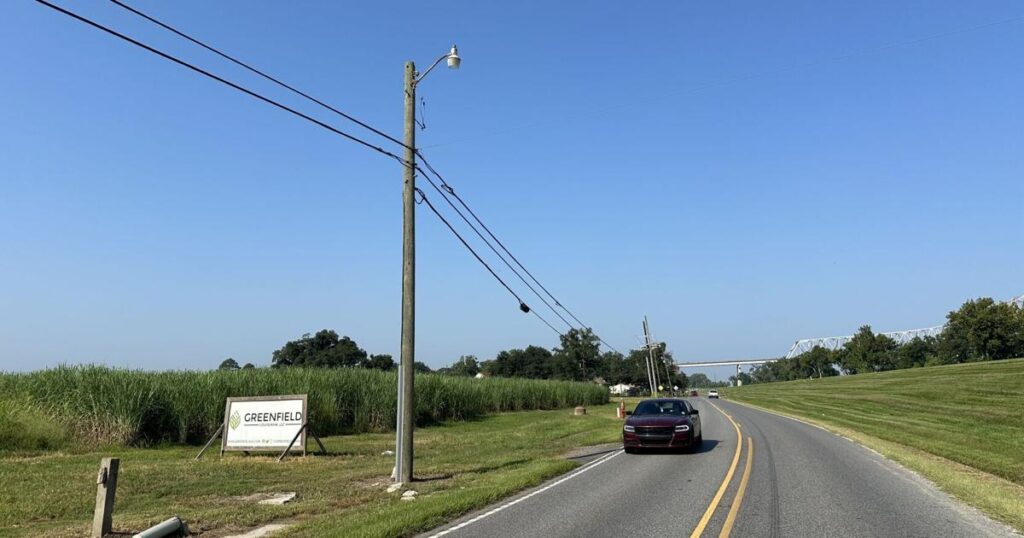
The Formosa deal imploded and sent the then-parish president to federal prison on corruption charges, and the plastics facility never materialized. But the decades-old zoning change set the stage for Greenfield, the company that tried to build the grain terminal in the majority-Black town of Wallace.

Aerial view of the proposed Greenfield Louisiana LLC grain terminal and dock adjacent to Wallace, La. On Thursday, March 21, 2024, the Descendants Project requested a St. John the Baptist court to block rezoning for the project. (Rendering courtesy of Greenfield Louisiana)
Greenfield halted plans for the $800 million facility last summer, citing permitting delays at the U.S. Army Corps of Engineers. The surprise announcement drew sharp criticism from some Louisiana officials, including Gov. Jeff Landry, and praise from environmental groups and historic preservationists who stressed that the grain facility would disturb a region rich with Afro-Creole history.
Lynda Van Davis, counsel for Greenfield, did not respond to requests for comment.
William Most, an attorney for The Descendants Project, the most prominent opponents of the project, said the advocacy group “is prepared to pursue its legal options, and this ruling does not diminish its will to fight for the community.”
‘Lower courts erred’
The state Supreme Court ruling on the 1990 zoning change reverses a series of lower court and appeals court decisions that the rezoning was illegal. Most recently, the state’s Fifth Circuit Court of Appeals ruled in April that the Parish Council failed to follow procedure by making an amendment to the land use changes without going to the planning commission.
St. John the Baptist Parish President Jaclyn Hotard
Photo from Jaclyn Hotard
“The lower courts erred in finding the amendment to the proposed ordinance had to be reviewed by the planning commission,” the Supreme Court found Wednesday. The ruling said that the Parish Council’s changes were not substantial enough to warrant returning the zoning question to the planning commission, which had earlier approved the original version of the measure.
One judge, associate justice John Michael Guidry, dissented in the case, arguing that he saw “no error in the lower courts’ rulings.”
The parish had aggressively pursued the grain elevator project, citing the economic development and revenue it would bring.
Ongoing lawsuits
While the grain project itself appeared to die, a slew of lawsuits related to the facility continued.
In one case, The Descendants Project alleges that Parish President Jacqueline Hotard signed off on a separate 2024 rezoning agreement for the grain elevator to the potential benefit of her husband and mother-in-law. It is unclear how this week’s ruling will affect the pending case.
Hotard did not respond to requests for comment, though she has earlier criticized “frivolous lawsuits” related to the project.
Sisters Joy and Jo Banner pose at Fee-Fo-Lay Cafe in Wallace
Photo by Sophia Germer / The Times-Picayune
The Descendants Project also filed a lawsuit against the parish and the Port of South Louisiana earlier this year, alleging that Greenfield never paid the millions of taxes it owed to the sheriff’s department and the port.
And the advocacy group appealed a federal court ruling in a free speech case that centered on whether Hotard improperly shut down Joy Banner, who co-runs The Descendants Project, at a public meeting. A jury concluded in January that the parish president was not liable. Following the verdict, Hotard called the outcome “a victory for St. John.”