
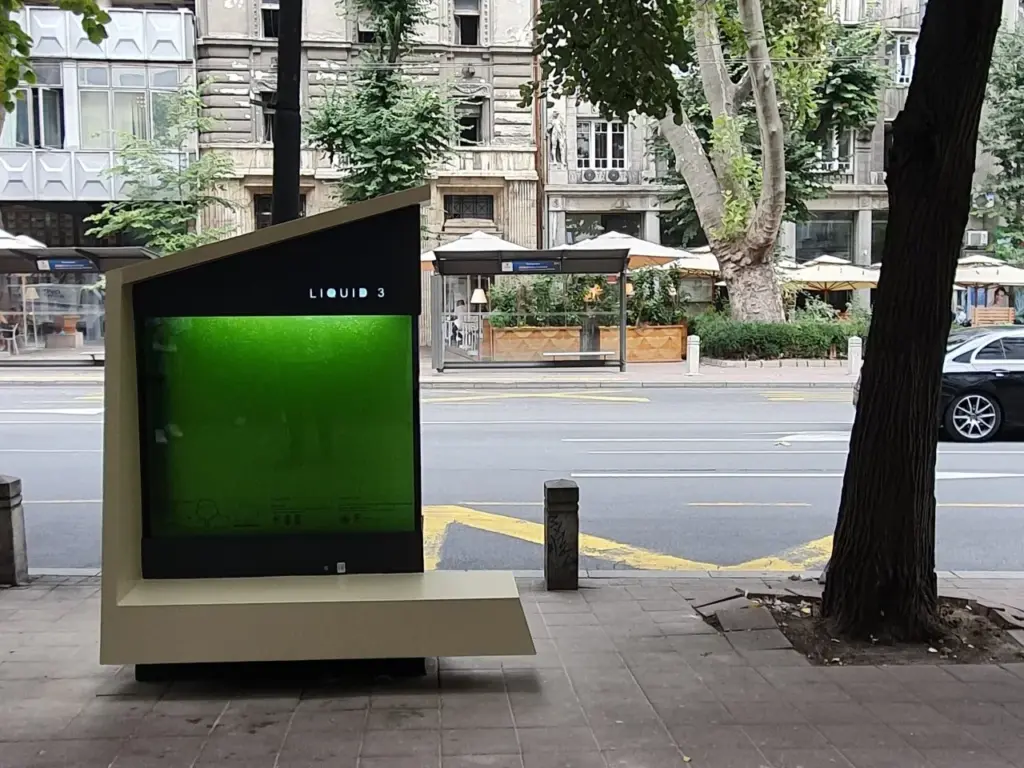
Trees are among the planet’s most powerful allies in fighting climate change and cleaning the air. Through photosynthesis, they absorb carbon dioxide (CO₂) and release oxygen, acting as natural air purifiers. But in densely built urban areas, planting new trees is often difficult: space is limited, and pollution levels can make it hard for saplings to survive. That’s where the concept of a “liquid tree” comes in. Instead of soil and roots, imagine a bioreactor full of water and tiny, fast-growing microalgae doing the same job but more efficiently and in places where a traditional tree can’t be grown.
Serbia’s Pollution Challenge
Serbia faces a serious air-quality crisis, especially in its cities. Two large coal power plants near Belgrade contribute heavily to emissions. According to the Institute for Health Metrics and Evaluation, pollution causes an alarming number of premature deaths; as some reports note, it kills three times more people annually than HIV/AIDS, tuberculosis, and malaria combined.
In 2020, Serbia ranked 28th globally for worst air quality, with annual PM2.5 concentrations 4.9 times above the World Health Organization’s guideline. A 2019 Global Alliance for Health and Pollution report placed Serbia at 175 pollution-related deaths per 100,000 people, the highest in Europe. Meanwhile, 59% of Serbians live in urban areas, a figure that is rising, amplifying demand for clean-air solutions (acc. to UNDP).

Why the “Liquid Tree” Proposal Emerged
Given Serbia’s dense urban centers and limited green space, traditional tree planting has serious limitations. According to Francine Pickup of UNDP Serbia, although cities are responsible for around 75% of global CO₂ emissions, many urban neighborhoods lack free land for landscaping. Belgrade, for example, sees such high pollution in its central districts that planting trees there can be impractical; some trees struggle to survive in those conditions, while microalgae tolerate them well.
In response, Dr. Ivan Spasojevic, from the Institute for Multidisciplinary Research at the University of Belgrade, and his team designed an innovative device: the LIQUID 3 photobioreactor, nicknamed the “liquid tree.”
What Is the Liquid Tree? Scientific and Technical DetailsBasic Design and Function
- Volume & Structure: A transparent tank (photobioreactor) containing 600 liters of water filled with microalgae.
- Microalgae: Single-celled freshwater algae naturally found in Serbia’s ponds and lakes. These algae are resilient—they grow in ordinary tap water and tolerate a wide temperature range.
- Photosynthesis Mechanism: The algae absorb CO₂ from the air and, using sunlight, convert it into oxygen (O₂).
- Efficiency: According to the developers, the algae are 10 to 50 times more efficient than trees in fixing CO₂.
- Equivalence to Vegetation: One LIQUID3 unit is claimed to replace two 10-year-old trees or about 200 square meters of lawn in carbon-absorption capacity.
Additional Features
- The structure doubles as a public bench, integrating utility with function.
- It includes solar panels to power built-in lighting at night and USB charging ports for mobile phones.
- The system also captures pollutants beyond CO₂: it can filter PM (particulate matter), heavy metals, and carbon monoxide (CO).
- For maintenance every six weeks or so, the algal biomass is harvested (as it divides) and replaced. The removed biomass can be used as a bio-fertilizer.
- The algae are effectively continuous after harvesting; fresh water and minerals are added, and the algae grow again indefinitely.
Resilience & Durability
- The design works in all climates and weathers, according to its developers.
- There is a temperature regulation system in the bioreactor to keep the microalgae within optimal growth conditions even when external weather fluctuates.
- The system is low-maintenance, in contrast to tree saplings that require long-term care, watering, soil, pruning, and risk of dying under heavy pollution.
The Solution Was Implemented
- The first LIQUID3 unit was installed in September 2021, in Belgrade’s Stari Grad municipality, on Makedonska Street, a busy, polluted urban area.
- The project was supported and recognized by the United Nations Development Programme (UNDP) in Serbia, in collaboration with Serbia’s Ministry of Environmental Protection under the Climate Smart Urban Development initiative.
- LIQUID3 was chosen among the 11 best climate-smart and innovative solutions under that program.
The Problem It Addresses
- Urban Space Constraint: Many city areas do not have free soil for planting trees. Traditional afforestation isn’t always practical in built-up neighborhoods.
- High Pollution Zones: In cities like Belgrade, pollution (especially CO₂ and particulate matter) is concentrated, and many trees may struggle or die in such environments. Microalgae, by comparison, are more tolerant of poor air quality.
- Rapid CO₂ Sequestration: Given their high growth rate and photosynthetic activity, microalgae can absorb carbon at a rate much faster than trees—making them especially useful for immediate pollution mitigation.
- Multifunctionality: Because each unit doubles as a bench with charging stations and lighting, the design adds social value beyond air cleaning.
- Biomass Reuse: The algae biomass produced can be harvested and reused as fertilizer, contributing to a circular, sustainable model.
- Scalability & Adaptability: The system is designed to work across seasons and in different climate conditions, plus its modular nature means it can fit into small or discomfiting urban pockets.
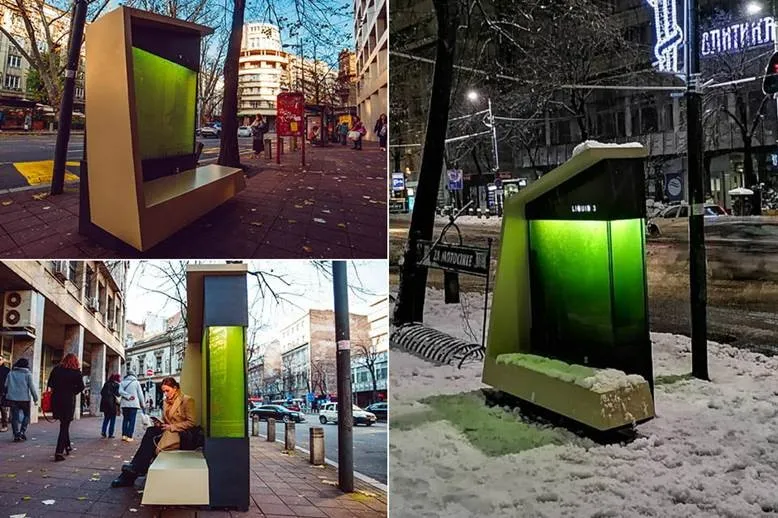
Inside the System: The Science Behind the Liquid Tree
The Liquid Tree relies on single-celled microalgae chosen for their ability to thrive in local Serbian conditions. These organisms are highly efficient at photosynthesis, pulling CO₂ from the air and converting it into oxygen and biomass at a rapid rate. Their fast reproduction cycle is a major reason the system delivers stronger carbon-absorption performance than traditional vegetation.
At the center of the setup is a photobioreactor, a transparent tank designed to capture as much natural or artificial light as possible. This constant light exposure enables steady photosynthesis. The unit also uses pumps to pull in surrounding air rich in CO₂, and may include mechanisms to help stabilize internal temperatures so the algae remain productive.
Beyond CO₂ absorption, the system also helps remove other harmful pollutants. Its design supports the capture of particulate matter, heavy metals, and carbon monoxide, adding value in urban environments where air quality often suffers from mixed-source contamination.
Durability is one of its strengths. The selected algae can withstand broad temperature swings, keeping the reactor operational even during harsh winter conditions. As the algae grow, they’re harvested in cycles; fresh water and mineral additives are then introduced, allowing the culture to regenerate. This closed-loop process keeps the system running with minimal input.
The installation includes solar power to operate night lighting and, in some cases, the internal pumps, reducing the device’s environmental footprint. Even the biomass collected during harvest serves a purpose once removed; it becomes a usable bio-fertilizer, turning what the system extracts from polluted air into a practical resource.
Criticism & Challenges
While “liquid trees” are innovative, they are not without critics or limitations:
- Not a Replacement for Real Trees: The creators themselves emphasize that LIQUID3 is not meant to replace forests or large-scale tree planting.
- Public Perception: The idea of a glowing algae-filled bench may feel dystopian or sci-fi to some. Questions have been raised about whether cities should invest in such tech when more green space could be preserved or restored.
- Maintenance & Costs: Even with low maintenance, the reactor needs periodic cleaning, water and mineral replenishment, and potentially energy for pumps. Scaling this across a city could be cost-intensive.
- Long-term Viability: Though algae reproduce fast, long-term stability (resistance to illness, contamination, and system failure) needs careful observation.
- Limited Impact Relative to Scale: One unit equals two ten-year-old trees, or 200 m² of lawn, but for a very polluted city, many such units would be needed to make a significant dent in CO₂ or particulate levels.
The “liquid tree” Serbia’s LIQUID 3 photobioreactor is a scientifically grounded, multifunctional tool that tackles carbon emissions, improves urban air quality, and uses biological systems in a clever, space-efficient way. While it doesn’t replace the role of real trees, it fills a unique niche, providing green, breathing infrastructure where soil and space are scarce. As cities around the world look for smart, nature-based solutions to pollution, such liquid trees may well grow into a key part of the urban landscape of tomorrow.