
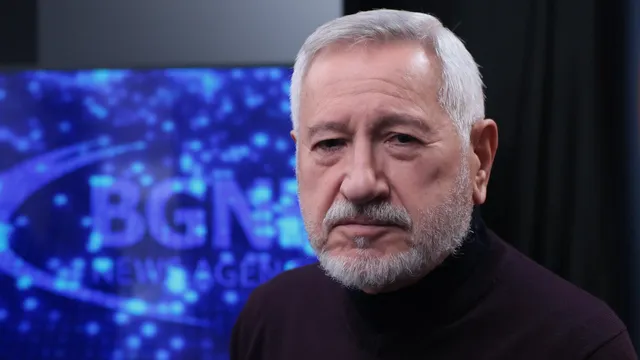
The politicization of the joint historical commission comes from Skopje, not from Sofia. Our counterparts refuse to acknowledge the notion of a “shared history.” Their reluctance to accept historical facts has blocked the commission’s work. And the current orientation toward Belgrade and Budapest is unlikely to deliver what Skopje expects. Questions must be answered clearly and directly, not with evasive rhetoric.
This is what bulgarian historian and diplomat Prof. Angel Dimitrov, co-chair of the Joint Multidisciplinary Expert Commission on Historical and Educational Issues between Bulgaria and North Macedonia, said in an interview with BGNES. We spoke to him about who is politicizing the commission’s work, whether we are dealing with “incidents” or a consistent state ideology, and whether Skopje is violating the 2017 Treaty of Friendship.
BGNES: You have stated that after eight years and 38 meetings, the Commission has gone nowhere and is in stagnation that mirrors the situation inside North Macedonia. Foreign Minister Timcho Mucunski responded by saying: “Politics has no right to interfere in academic freedom.” Who is actually interfering with academic freedom in the work of the Commission?
Prof. Dimitrov: My assessment is based solely on facts. No one can dispute how long we have worked, how many meetings we have held, and the fact that we have progressed only to the 11th century — that is, to two textbooks for primary school, where lessons barely fill a page. As professional historians in Commission, our task is not academic research but evaluating curricula and textbooks in both countries. The pace is so slow and irregular that it is deeply worrying.
The Commission exists because the Treaty of Friendship and Good-Neighbourliness required regular meetings to help overcome tensions accumulated for decades. I fully agree with Minister Mucunski that discussions must be grounded in scholarly arguments. Yet his statement has two serious flaws. First, he inexplicably directs the accusation at us. Anyone familiar with the Commission’s work knows that politicization comes from the other side. We have repeatedly insisted that present-day political perspectives cannot dictate interpretations of the past.
The core obstacle is our colleagues’ categorical refusal to acknowledge the term “shared history” — a term explicitly included in the Treaty, both in the preamble and in the article defining the Commission’s mandate. Respecting the Treaty is not “politicization”; it is part of our responsibilities, since the Commission exists because of that very document.
The second flaw in his statement is that, while accusing us of politicization, he himself enters academic territory by giving instructions on how the Commission should function. Comparisons with Franco-German or Polish-German commissions are misguided; our situation is entirely different. There is no history of centuries-long wars between Bulgaria and North Macedonia. Exaggerating tensions only hinders the genuine spirit of “shared history,” which is meant as an outstretched hand. That is what we try to uphold.
BGNES: Prof. Vancho Gjorgjiev has returned to the Commission. Often, sharp statements from Skopje are dismissed in Bulgaria as isolated incidents. Are we dealing with accidents or a state ideology?
Prof. Dimitrov: His critique should concern the previous Macedonian members, because I see no real difference between the two compositions. Their approach to discussions and sources is almost identical. The “evergreen” topic of the Ohrid Archbishopric has been on our agenda for nearly three years with no progress whatsoever. Recently, we do not even reach substantive debate; we spend meetings preparing protocols from old sessions — work that should be done separately online.
Our arguments are fully documented in the protocols. If our colleagues believe we politicize the work, they should agree to make the protocols public. As for accusations directed at me personally — in the Commission I use only scholarly arguments. Interviews I give represent my civic stance. And when it comes to North Macedonia, I have the right to speak: I was the first Bulgarian ambassador there and spent nine years shaping bilateral relations.
BGNES: If the Commission is the only mechanism from the 2017 Treaty that is still functioning — though without results — is Skopje violating the Treaty? Does the government in Skopje use the Commission as an alibi before the EU?
Prof. Dimitrov: Unfortunately, the Treaty has been treated in Skopje primarily as a ticket into the EU after joining NATO. Whether and how it will be implemented has remained secondary. This is painful for me, because I know the country well. Bulgaria wants not just good relations, but for both states to move forward together. Accusations that Bulgaria is blocking Corridor 8 — something I’ve heard over the years — are simply absurd. The idea for that railway is 150 years old, and Bulgaria has consistently supported it. I have witnessed countless “first stone” ceremonies. Its completion would benefit both countries immensely.
If bilateral relations improve, the Commission’s work will also improve; we will be able to focus solely on professional arguments.
BGNES: Isn’t the stagnation in the Commission and in the European integration process a sign of geopolitical reorientation?
Prof. Dimitrov: Political reorientation is visible in the warm ties being fostered with Belgrade and Budapest, with the expectation that they might ease North Macedonia’s EU path. Anyone well-informed understands this will not happen. Meanwhile, relations with Bulgaria are being frozen — a contradiction even on a logical level.
BGNES: Macedonian colleagues defend positions that are untenable not only for Bulgarian but for global historiography. At the same time, Serbian flags are waved in Skopje, Serbian state holidays are celebrated, and there is a minister affiliated with the “Serbian World” project. How is this possible?
Prof. Dimitrov: This duality reveals a deeper problem — an inability to critically assess the country’s own past. As long as the late-1940s period is praised as a “national value,” there will be difficulties. A political force continues to shape public life and prevent movement beyond old ideological frameworks.
BGNES: Should Bulgarian diplomacy react more firmly to attempts at reviving Serbian hegemonic projects?
Prof. Dimitrov: I have served as ambassador in Serbia and cannot ignore this topic. The increasingly tight embrace between Belgrade and Republika Srpska is visible. Nationalism in Serbia has gradually become state doctrine. This is dangerous in a region as fragile as the Western Balkans. In North Macedonia, pro-Serbian and pro-Russian forces have recently gained strength, which inevitably influences public attitudes.
BGNES: What about the idea of a “Shopi/Šopska nation,” promoted by some Serbian academics?
Prof. Dimitrov: This is not new. Attempts to present regional nicknames as separate ethnic identities have long existed. Such pseudo-scholarly claims must be countered firmly. Bulgaria’s goodwill should never be mistaken for weakness.
BGNES: Ultimately, EU integration of the Western Balkans is in Bulgaria’s core interest.
Prof. Dimitrov: Absolutely. Bulgaria was the country that returned the Western Balkans to the EU agenda at the Sofia Summit. Some European partners forget that our Treaty with North Macedonia preceded the Prespa Agreement.
BGNES: Is there a path to unblocking the Commission?
Prof. Dimitrov: I prefer realism to pessimism. Progress is possible only if North Macedonia regains stability, embraces a measure of self-criticism and listens to the messages coming from the EU. Under such conditions, space for advancement may emerge. I sincerely hope so. | BGNES