

While Europe still harbors hope that Donald Trump could broker peace in Ukraine, the US president’s recent moves in Bosnia are helping Russia destabilize the continent.
The Trump administration lifted sanctions on Milorad Dodik, the nationalist former leader of Republika Srpska, on October 29. This came shortly after the US Treasury Department lifted sanctions on four of Dodik’s allies on October 17.
The United States imposed sanctions on Dodik in 2017 for organizing a referendum that officially marked the establishment of a separate “Republika Srpska” within Bosnia, declared in 1992. The move was an open endorsement of Serbian war aims during the Bosnian civil war. It was also a direct violation of the Dayton Peace Accords, which ended the war and set a framework for coexistence and power-sharing among Bosnia’s three constituent peoples.
The Dayton Agreement has repeatedly been on the verge of collapse – most often as a result of Dodik’s secessionist policies. Now, by lifting sanctions on Dodik, the Trump administration has strengthened the very forces that Russian President Vladimir Putin is counting on to destroy the peace established in Dayton and weaken Europe from within.
Dodik’s alliance with Moscow began soon after he was elected prime minister of Republika Srpska in 2006. By then, the United States had already shifted its attention from the Balkans to the wars in Afghanistan and Iraq, while NATO had handed over the peacekeeping mission to a smaller, more cautious European Union force a few years earlier. Britain’s Paddy Ashdown, the last high representative in Bosnia with real power, announced his departure in late 2005. His successors have been reluctant to use the so-called “Bonn powers” – a mechanism that allowed them to remove obstructive officials and impose laws. In Brussels, however, the priority has shifted from reforming Bosnia to managing migration.
By tolerating Dodik, rather than confronting him, Europe has enabled him to test the limits of the Dayton Agreement and suppress international oversight. Putin has noticed this and made Dodik his man in the Balkans.
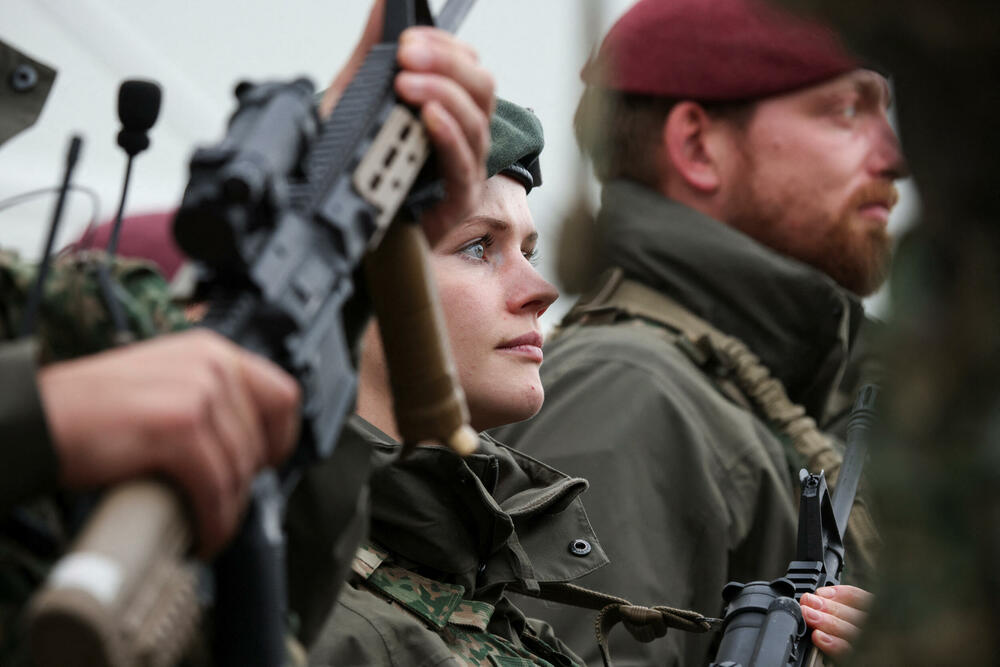
EUFOR members at Butmir base on November 3rdphoto: Reuters
Dodik became a regular guest at the Kremlin, where Putin received him not as a regional politician but as a head of state. Russian state media broadcast his speeches, and Orthodox church dignitaries blessed his nationalist campaigns. Dodik threw the door wide open for Gazprom, the Russian state-owned energy giant, as well as Russian banks and companies to enter the Serb-majority entity in Bosnia – lining his own pockets while maintaining Bosnian Serbs’ dependence on Moscow.
Russia has also shielded Dodik from accountability. In 2021, Moscow lobbied to remove all references to the Office of the High Representative (OHR) from the United Nations Security Council resolution renewing the mandate of the EU peacekeeping mission. The change weakened the OHR’s authority in implementing the Dayton Agreement. In essence, it separated civilian oversight from military enforcement, significantly reducing the West’s ability to rein in those who threaten Bosnia’s fragile order.
While Russia undermined international oversight of Bosnia, it simultaneously used regional politics to deepen its influence. At the regional level, Bosnia became a useful tool for Russia to keep Serbia in its orbit and prevent it from moving closer to the European Union.
Serbia began negotiations to join the European Union in 2014, a year after Croatia joined. But those talks have not progressed much so far. That outcome plays into Putin’s hands — and Dodik’s. The stalemate allows Dodik to promote his narrative of a “Greater Serbia.” It’s the same narrative that ignited the Bosnian civil war in 1992 — and one that Serbian President Aleksandar Vučić cannot dismiss without damaging his nationalist credibility. At the same time, it’s a narrative that Vučić cannot fully embrace without jeopardizing Serbia’s European path. It’s precisely this tension that allows Moscow to maintain influence in the Balkans.
While Russia undermined international oversight of Bosnia, it also used regional politics to deepen its influence. Regionally, Bosnia became a useful tool for Russia to keep Serbia in its orbit and prevent it from moving closer to the European Union.
Another channel of influence that Moscow has successfully exploited is Hungarian Prime Minister Viktor Orban. Budapest has repeatedly blocked or delayed the imposition of EU sanctions against Dodik, shielding him from the kind of concerted pressure that could curb his secessionist moves. Orban’s obstruction has allowed the Kremlin to extend its influence within the EU itself—undermining unity over Bosnia and exposing Europe’s vulnerability to internal disruptions.
Russia initially acted as a defender of Bosnia. It was a key member of the Contact Group in the 1990s, which worked with Britain, France, Germany, Italy and the United States to find a solution to end the war. After the signing of the Dayton Accords, Russia sent about 1.200 troops to NATO’s Implementation Force (IFOR) and later to the Stabilization Force (SFOR). These units helped patrol central Bosnia, secure weapons depots and coordinate – sometimes with a certain amount of tension – with NATO partners. It was one of the few genuine moments of post-Cold War cooperation between Moscow and the West.
The Trump administration’s decision to lift sanctions on Dodik achieves one of the key goals of Putin’s strategy: the dismantling of the Western order. Bosnia may no longer make the world’s headlines, but if Europe ignores it now, it soon will again. Its disintegration would destabilize the continent and weaken efforts to counter Russian aggression. If Europe wants to remain steadfast in defending Ukraine, it must also defend peace in Bosnia—and show that it can still shape stability on its own continent.
Dodik could work with Bosnian Croat leaders to dismantle the Dayton Accords by creating an autonomous Croatian entity. Or he could redouble his efforts to pursue a secessionist plan for Republika Srpska. Either way, the outcome will be a victory for Putin and a defeat for Bosnia and the EU.
Trump’s decision to lift sanctions appears to have less to do with the policy toward Bosnia itself and more to do with the fact that Dodik’s government has hired several Trump associates as lobbyists. Among them is the disgraced former Illinois governor Rod Blagojevich, whose prison sentence was commuted by Trump in 2020 and then pardoned in 2025. Blagojevich, the son of Serbian immigrants, has portrayed the sanctions against Dodik as a form of political persecution.
For Dodik, the lifting of sanctions is a confirmation of what he calls a “grave injustice” against the Serbian people. More importantly, it gives him an opportunity to further consolidate his power. The Election Commission of Bosnia and Herzegovina annulled his presidential mandate in August. Trump’s move now restores his political legitimacy at home, allowing him to reassert his dominance within the Republika Srpska political apparatus.
Accountability mechanisms are already weakening. Last week, Bosnia and Herzegovina’s state prosecutor suspended an investigation into Dodik and two other Republika Srpska officials for “attacks on the constitutional order” – a move that, whatever the motives, shows how reluctant state institutions have become to confront him.
Dodik will now likely try even harder to destabilize Bosnia’s institutions. He could work with Bosnian Croat leaders to dismantle the Dayton Accords by creating an autonomous Croat entity. Or he could redouble his efforts to pursue a secessionist plan for Republika Srpska. Either way, the outcome will be a victory for Putin and a defeat for Bosnia and the EU.
The article was taken from the magazine “Forin Polisi”
Translation: A. Š.

News