
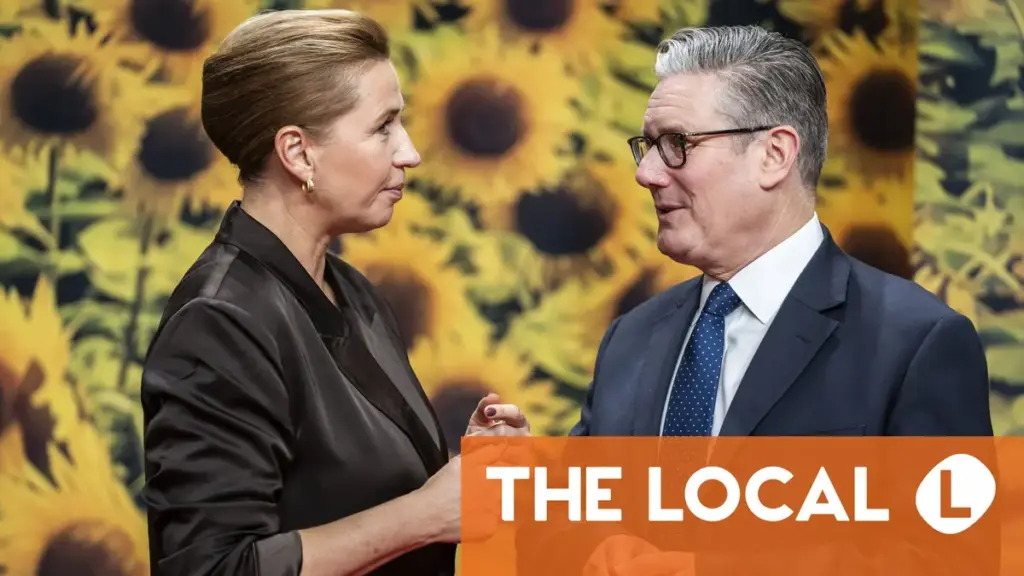
Has the US-Denmark standoff over Greenland changed in character? Why does the UK government think Denmark’s immigration and asylum policies will help it politically? Our weekly column Inside Denmark looks at some of the stories we’ve been talking about this week.
New phase of Danish-US standoff over Greenland?
After a period of relative quiet in relation to US President Donald Trump’s desire to take control of Greenland, the last two weeks have seen a number of events that have passed without major fanfare or drama.
Last week the new US Ambassador to Denmark, Ken Howery, attended an audience with King Frederik but avoided directly addressing Trump’s past assertions that the US “must have” the territory, citing security needs.
He said his priorities included “strengthening our defence and security cooperation, trade and investment ties, and working together with the Kingdom [of Denmark, ed.] to address our shared concerns about security in the Arctic, especially in Greenland.”
When the ambassador was asked by a Danish journalist for his “message” to both the king and Danish people in relation to Greenland, an aide interrupted and said there was not time to answer the question.
He later said he has no direct knowledge of any ‘interference’ campaign orchestrated by the United States in Greenland, adding he does not believe the US government to be behind it.
That was in relation to broadcaster DR’s reports in August that at least three US officials close to Trump have been involved in ‘interference’ activities in Greenland aimed at creating division with Denmark.
Foreign Minister Lars Løkke Rasmussen has also met with Howery, telling him that Denmark’s “red line” for cooperation is its “territorial integrity.”
Advertisement
“I have always said we are open to any kind of cooperation. But of course there is a red line, and that is the territorial integrity of the Kingdom,” Løkke said.
“It would be strange if I hadn’t said that today, so I have naturally done that,” he said.
With this background, Greenland’s parliament, Inatsisartut on Friday adopted new rules on foreign property ownership amid a reported increase interest in real estate in the country from the United States.
The new legislation broadly means only people and companies from Greenland, the Faroe Islands and Denmark will be allowed to buy property and land-use rights in Greenland. Foreign nationals must live in Greenland for at least two years before being able to do so.
This seems like a significant step by Greenland – rather than Denmark – to guard itself against encroaching US influence.
It’s happening at the same time as the newly-arrived ambassador from the US appears to be taking a conciliatory approach after the bad feeling caused by Trump’s repeated comments and stunts like Vice President JD Vance’s visit to the US base Pittufik on Greenland earlier this year.
Howery has said that he wants “Greenlanders to decide” whether to become part of the United States. That also suggests a more long-term view from the US even if it would still prefer to have control of Greenland, something Greenlanders have answered in polls by saying they don’t want.
Whether Trump shares Howery’s view may become clearer next time he comments on the topic.
Advertisement
The UK government wants to use Denmark’s asylum model, but is it misguided?
Reports in the UK last weekend suggested that the Labour government is set to base a new, stricter approach to immigration on policies set by Denmark’s Social Democrats.
The British government said it wants to emulate Denmark’s asylum and immigration system, which is indeed strict and has seen many new rules introduced by Prime Minister Mette Frederiksen’s Social Democratic party – an approximate Danish tandem to Labour – during a six-year (and counting) period in government.
It’s also true that, by adopting a strict approach to asylum and immigration more broadly, the Social Democrats succeeded in diminishing the influencing of the far-right in Danish politics (entering a centrist coalition with the centre-right in 2022 is also a major factor in this).
READ ALSO: Why do governments across Europe want to copy Denmark’s immigration policies?
The Danish government’s 2019 ‘paradigm shift’ and subsequent restrictive policies and harsh rhetoric on asylum – and also on other areas of immigration such as foreign labour – have been a signature of the Nordic country for years.
Many of these policies and their outcomes raise legal, ethical and moral questions which – as outlined in this excellent article – often go under the radar in Denmark.
But another matter is whether adopting them will benefit the UK’s Labour government politically as it faces the rising challenge from the far-right Reform Party and its leader Nigel Farage.
Advertisement
Danish and UK asylum policy has already overlapped in the past – governments in both countries have, for example, worked for offshore asylum processing in Rwanda – but the fact remains that the contexts of either country are too different to simply implant a successful strategy from the Danish Social Democrats into the UK’s Labour party.
British PM Keir Starmer is no Frederiksen, an effective leader who is decisive and consistent, and prepared to do things which make her unpopular with voters.
The Danish far right has a different character to the UK’s, and the electorate is also very different and not necessarily concerned with the same issues, even if there is a large proportion of immigration-skeptical voters (this can be said about all European countries).
Many people on Denmark’s left, including a lot of Social Democratic voters, have found the party’s restrictive immigration policies objectionable for various reasons, but it’s always been clear that the party means what it is saying on the topic.
The Labour party may be able to look to Denmark if it wants to implement restrictive immigration policy, but it needs to find its own way to succeed against far-right movements as Frederiksen and her party have managed to do.