
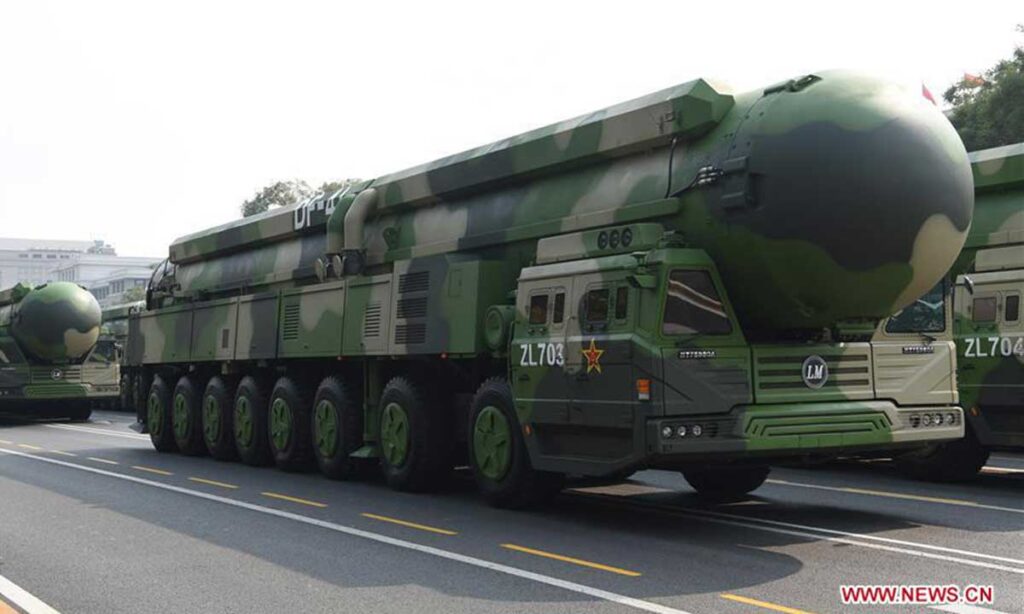
President Donald Trump’s recent statement that the United States will restart nuclear weapons testing marks one of the most important policy shifts in global security since the end of the Cold War. The U.S. has not conducted a full-scale nuclear explosion since 1992, when Washington, Moscow, and Beijing—despite their political differences—fell into an informal rhythm of limit. For more than three decades, this suspension helped slow the pace of the nuclear arms race, eased environmental concerns, and encouraged multilateral arms-control agreements.
Yet, in a brief but startling announcement ahead of his meeting with President Xi Jinping, President Trump declared that the Pentagon would begin nuclear testing “on an equal basis” with Russia and China. The move, he argued, was necessary to match Moscow’s fresh missile demonstrations and what he described as Beijing’s expanding and impervious nuclear activities. By placing the initiative straight in America’s hands, Trump suggested that the burden of the curb should now shift to the other two major nuclear powers.
The declaration has promptly set off alarms—not only in foreign capitals, but also in Washington’s own policy spheres. Supporters, such as Senate Foreign Relations Committee chair Jim Risch, have admired the decision as a “reasonable” response to the evolving nuclear posture of enemies. Critics, including senior Democrat Jack Reed, warn that restarting nuclear testing risks unraveling decades of painstaking non-proliferation progress and could trigger a new global nuclear arms competition. Both sides acknowledge, however, that the consequences of such a move could be far-reaching.
A Look Back: The History of Nuclear Testing
Nuclear testing has designed the modern world in ways few other technological developments have. The first nuclear explosion—the 1945 Trinity Test in New Mexico—steered humanity into the atomic era. Over the following decades, the United States, the Soviet Union, the United Kingdom, France, and China conducted hundreds of tests, often in remote deserts, islands, and oceans. Each test helped improve weapon designs, develop new delivery systems, and demonstrate geopolitical strength. But the costs were enormous: radioactive contamination, environmental devastation, displacement of local populations, and long-term health effects on unknowingly exposed communities.
Public pressure against testing steadily grew throughout the 1960s, and limited agreements began to emerge. The 1963 Partial Test Ban Treaty banned atmospheric, underwater, and outer-space tests but allowed underground tests to continue. It was not until the 1990s, after the end of the Cold War, that a broader global consensus began to form around ending nuclear explosions overall. This led to the creation of the Comprehensive Nuclear-Test-Ban Treaty (CTBT)—a milestone pact meant to stop nuclear weapons development at its roots.
The CTBT: A Cornerstone of Global Restraint
Adopted by the United Nations in 1996, the CTBT is designed to ban all nuclear explosions—whether underground, underwater, or atmospheric, whether for military or so-called “peaceful” purposes. Today, 187 countries have signed the treaty, and 185 have ratified it, making it one of the world’s most widely supported non-proliferation instruments.
But here lies the problem: the treaty has still not entered into legal force.
For that to happen, only 44 states listed in the treaty—countries with nuclear weapons or nuclear technology at the time—must endorse it. Eight still have not: the United States, China, Iran, Israel, Egypt, India, Pakistan, and North Korea. As long as even one of these states refuses to ratify, the treaty remains a powerful symbol—but not a compulsory legal barrier.
Despite this lag, the CTBT has formed meaningful global norms. It established an extraordinary International Monitoring System (IMS) of 337 stations using seismic, hydroacoustic, infrasound, and radionuclide sensors to perceive even the smallest nuclear explosion. The system has worked effectively, identifying all of North Korea’s nuclear tests, including those conducted as recently as 2017.
The CTBT’s broader purpose is clear:
· to stop the improvement of nuclear weapons,
· to prevent new nuclear powers from evolving,
· and to foster a world where nuclear weapons become less credible and less usable.
It is fair to say that for nearly 30 years, the CTBT has helped keep the nuclear genie partially inside the bottle.
A New Arms Race? The Risks Are Real
The danger of the U.S. recommencing nuclear tests is not limited to the tests themselves. The larger risk is what comes next.
If Washington breaks the decades-long moratorium, it almost guarantees that Moscow and Beijing will respond, either through their own tests or augmented weapons development. Other nuclear states—particularly India and Pakistan—may see it as a strategic requirement to resume their own testing actions. This cascading outcome is the nightmare scenario non-proliferation advocates have long warned against: a global nuclear arms race in the 21st century, at a time when humanity faces extraordinary challenges like climate change, pandemics, and economic volatility.
India and Pakistan: A Particularly Fragile Equation
South Asia is home to two nuclear-armed adversaries whose relationship is shaped by mistrust, land disputes, and historical grievances. India conducted nuclear tests in 1998, calling them crucial for national security. Pakistan responded within weeks with its own tests, arguing that it had no choice but to reestablish strategic balance.
If the United States resumes nuclear testing now, it may encourage India—already pursuing an ambitious military modernization program—to resume its own testing cycle. India’s desire for thermonuclear enhancement and more advanced warheads is well known. Any such move by New Delhi would certainly provoke a response from Pakistan, which cannot afford to fall behind in deterrence capabilities.
But unlike the superpowers, India and Pakistan both face severe structural liabilities.
They struggle with:
· climate change and water shortage,
· economic stagnation,
· high poverty rates,
· public-sector underinvestment,
· and friable social infrastructures.
A nuclear arms race in South Asia would distract precious resources away from education, healthcare, climate adaptation, and poverty reduction. The real victims would be the people—ordinary citizens who bear the burden of policy decisions made far above their heads.
Even a minor military escalation between the two countries could twist unpredictably, given their short missile flight times and explosive political environments. A major conflict would be catastrophic not only for the region but for the whole world.
The Humanitarian Cost of Nuclear Brinkmanship
Nuclear weapons are often discussed in intellectual terms—megaton yields, delivery systems, strategic doctrines. But their true impact is devastatingly human. The hibakusha of Hiroshima and Nagasaki, the victims of atmospheric testing in the Pacific, and the residents of Semipalatinsk and Nevada—all help as reminders that nuclear explosions leave behind generations of suffering.
In any future nuclear exchange, the immediate deaths would be only a fraction of the total toll. Long-term cancers, genetic mutations, economic collapse, forced migrations, and the collapse of public services would haunt societies for decades. A nuclear winter scenario could destroy agriculture worldwide, dipping millions into starvation.
Seen in this light, resuming nuclear testing is not merely a strategic maneuver; it is a step toward normalizing weapons capable of ending human civilization.
A Moment for Leadership, Not Escalation
The world today is more interrelated, more brittle, and more aware of existential risks than ever previously. Reviving nuclear testing looms to undo decades of progress in building global rules against the use and expansion of nuclear arms. Instead of re-entering an era of nuclear strategy, this moment calls for leadership that prioritizes dialogue, curbs, and the consolidation of international treaties like the CTBT.
If the United States, Russia, and China commit to renewed diplomacy—rather than reciprocal escalation—the CTBT could finally move toward universal endorsement. If India and Pakistan resist the temptation to chase new nuclear capabilities, the region could refocus on the real threats facing their populations: extreme weather, hunger, water scarcity, unemployment, and inflation.
The world already has enough nuclear weapons to destroy itself many times over. What humanity needs now is not more explosions underground, but more cooperation above ground.
We stand at a junction. One path leads us back to the darkest chapters of the 20th century. The other leads toward a safer, more stable, more humane world. The choice belongs to today’s leaders—but its consequences will be borne by future generations.