
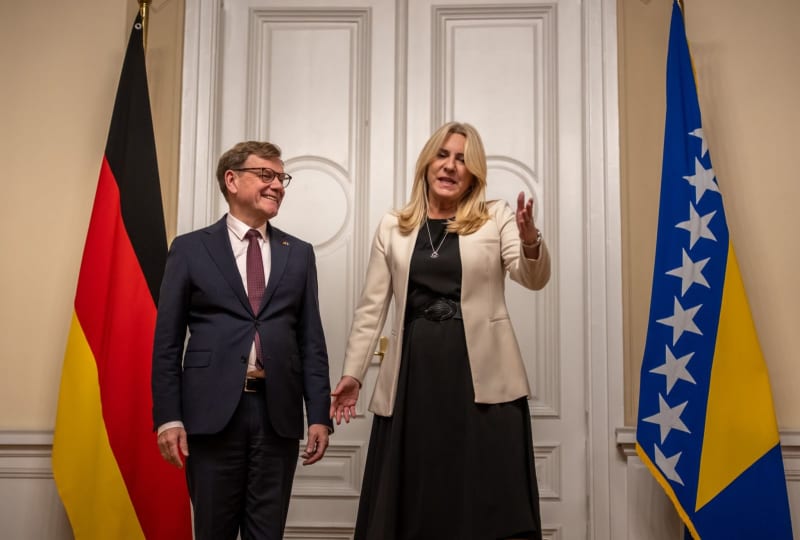
German Foreign Minister Johann Wadephul arrived in Sarajevo on Sunday as part of a tour of all six Western Balkan states focusing on their long-running EU accession process, which for some countries has dragged on for decades.
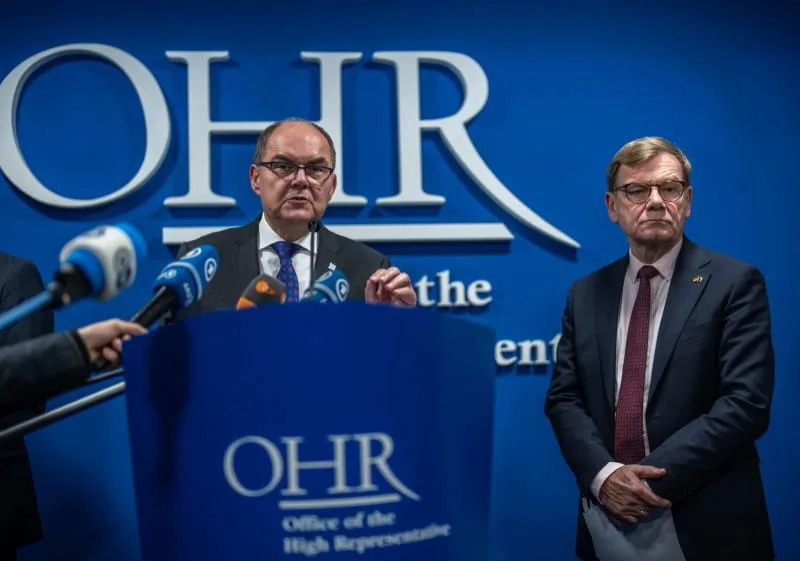
After arriving, Wadephul met with the High Representative for Bosnia and Herzegovina, Christian Schmidt, who is also German and holds significant powers to uphold the 1995 Dayton Agreement, which ended the Bosnian War.
Peace and stability in the heart of Europe remain “obligatory for us,” Wadephul said, calling on the government of Bosnia-Herzegovina to continue on the path towards the European Union.
“For us it is important that the fundamental principles of Dayton are upheld, that is, safeguarding the sovereignty and territorial integrity of the state as a whole.”
Afterwards, a meeting was planned with Željka Cvijanović, the Serb representative in the tripartite presidency of Bosnia-Herzegovina.
On Monday, Wadephul plans to visit Montenegro and Albania and fly on to Serbia in the evening. On Tuesday, a visit to Kosovo is on the agenda, with onward travel to North Macedonia in the evening.
Before his departure, Wadephul urged the Western Balkan states to implement further reforms, saying this is essential to advance their long-running bids for EU membership and to counter attempts by Russia and China to exert influence in the region.
“The rule of law, the fight against corruption and the protection of fundamental rights are non-negotiable,” Wadephul said. Committing to shared values is a prerequisite for EU accession, he added.
NATO allies Montenegro and Albania had made important progress, while other countries still needed to catch up significantly, Wadephul said.
In 2003, the European Union agreed that the Western Balkan countries would be eligible to become members once they had completed a number of reforms.
Today, the states are at different stages on their path to joining the EU, with growing frustration over the lengthy process.
The EU fears this could push some to turn towards political rivals such as China and Russia.
“The six Western Balkan countries are an integral part of the European family,” Wadephul said, adding: “The EU is not a distant promise, but a concrete prospect.”
Montenegro is considered the furthest along in its EU accession process, but there is not yet a date in sight for it to join the bloc.
The EU has been conducting accession negotiations with Montenegro and Serbia since 2012 and 2014, respectively.
Negotiations with Albania and North Macedonia began in 2022, while Bosnia-Herzegovina holds candidate status but has not yet entered into negotiations. Kosovo is a potential candidate country.
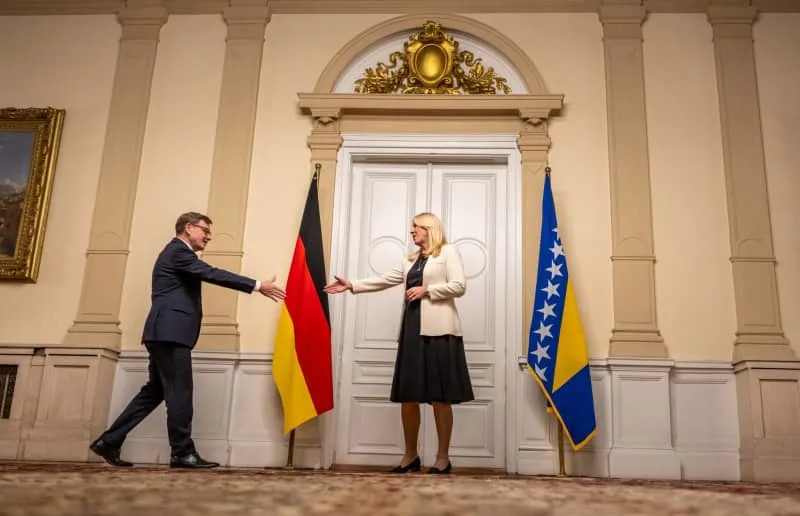
Germany’s Foreign Minister Johann Wadephul (L) shakes hands with Zeljka CvijanoviC during a meeting with Bosniak, Serbian, and Croatian representatives at the start of his Western Balkans trip. The EU has offered accession prospects to the region-including Albania, Bosnia-Herzegovina, Kosovo, North Macedonia, Montenegro, and Serbia-since 2003. Michael Kappeler/dpa
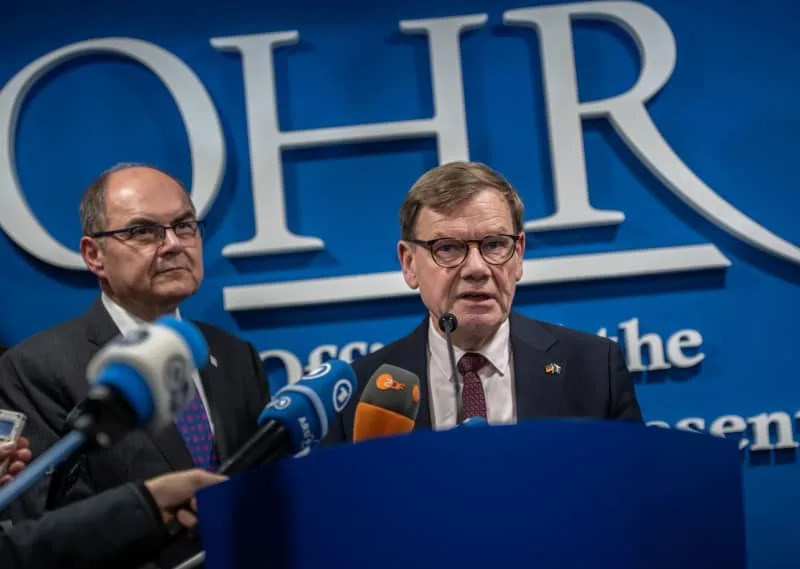
Germany’s Foreign Minister Johann Wadephul (R) stands with Christian Schmidt, High Representative of the International Community in Bosnia-Herzegovina, during his Western Balkans tour. The EU has offered accession prospects to the region-including Albania, Bosnia-Herzegovina, Kosovo, North Macedonia, Montenegro, and Serbia-since 2003. Michael Kappeler/dpa
Germany’s Foreign Minister Johann Wadephul (R) stands with Christian Schmidt, High Representative of the International Community in Bosnia-Herzegovina, during his Western Balkans tour. The EU has offered accession prospects to the region-including Albania, Bosnia-Herzegovina, Kosovo, North Macedonia, Montenegro, and Serbia-since 2003. Michael Kappeler/dpa