
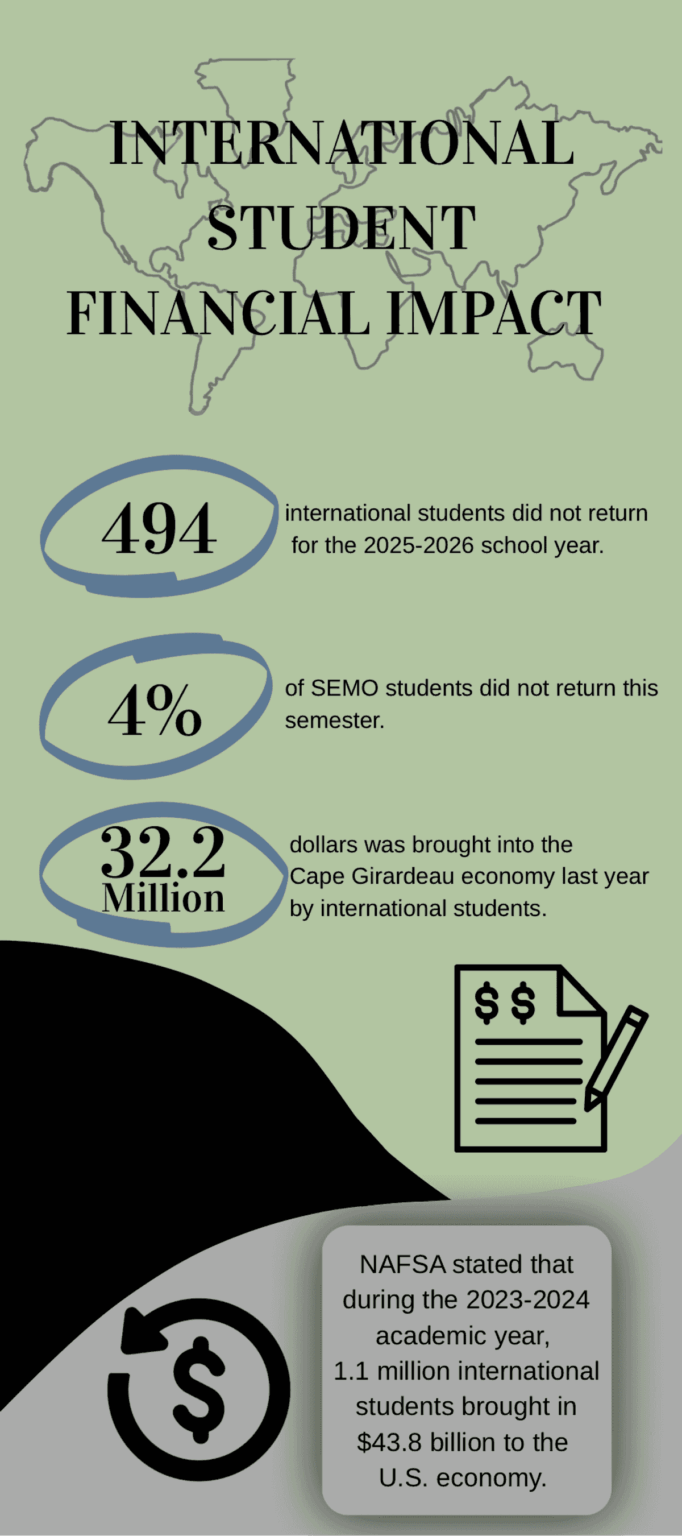
SEMO has seen its international student population fall from 1,279 last spring to 785 this semester.
Interim vice president for enrollment management and student success Bruce Skinner believes the 494-student decline in enrollment is due to many international students who may not have been able to secure a visa in time. He said this has affected the enrollment of every college institution across the country.
Skinner said that since the COVID-19 pandemic, SEMO has made an effort to cater to international students, with the goal of growing the international community to 10% of the undergraduate student body.
“We just felt institutionally that we had the academic programs that aligned with that, particularly over in our College of STEM, and so we made an intentional decision to grow, and the growth in those markets was in Asia, particularly in Nepal and India,” Skinner said.
In 2022, SEMO met its goal with an international student population of 11%. From there, the population rose until it dropped from 13% in the 2024-2025 academic year to 9% this semester.
While this enrollment drop is significant, interim vice president for finance and administration Diana Harley stated in an email that it had a minimal effect on SEMO because of rebudgeting.
“In planning the FY26 budget, SEMO anticipated a reduced number of international enrollments due to the delay in visas being processed. This adjustment in revenue expectation allowed us to realize only a minimal impact of approximately a 1% drop in overall projected revenue for this fiscal year,” Harley stated.
According to SEMO’s Student Financial Services, domestic students pay $22,269.00 for tuition and fees on average, an estimated amount for books and supplies, a room rate and a meal plan for the 2025-2026 academic school year. The cost rises for international students who pay $32,092.14.
While the average international student pays about $7,000 more in tuition, the $32,092.14 also includes estimated personal expenses (toiletries, local transportation, recreation) and the required 12 months of health insurance.
However, the financial impact of international students expands beyond SEMO and can affect the community.
David Yaskewich, professor of economics and department chair of accounting, economics and finance, said losing international students would result in less money going into the local economy.
“Students from other countries would definitely spend money on living expenses,” Yaskewich said. “They would go to grocery stores, and they would need housing. Their expenditures on living expenses would impact local businesses. And if there was some reduction in international students, I would anticipate that would be revenue that those businesses would miss.”
The National Association of Foreign Student Advisers (NAFSA) stated that during the 2023-2024 academic year, 1.1 million international students brought in $43.8 billion to the U.S. economy and supported more than 378,000 jobs nationwide.
NAFSA also stated that in 2023, international students at SEMO brought in $32.2 million and supported 138 jobs, and across the state of Missouri, 32,647 international students contributed $1.1 billion to the economy and supported 8,837 jobs.
Yaskewich said that if America loses international students long-term, it could have some major effects on the economy, claiming that first, colleges would have to tackle the decrease in enrollment, and then other industries would potentially lose workers.
“In terms of other industries, there are fewer international students here, potentially fewer doctors at a time where it’s hard for a lot of hospitals to find skilled physicians to take positions out at hospitals,” Yaskewich said. “The tech industry is probably the biggest advocate against strict immigration policy and the restrictions on student visas, because they’ve recruited highly talented college graduates who can help produce innovative products and services. So these are questions where there could be long-term implications if there is a long-term; we don’t know that yet, there could be bigger implications on the innovativeness and competitiveness of the US economy.”