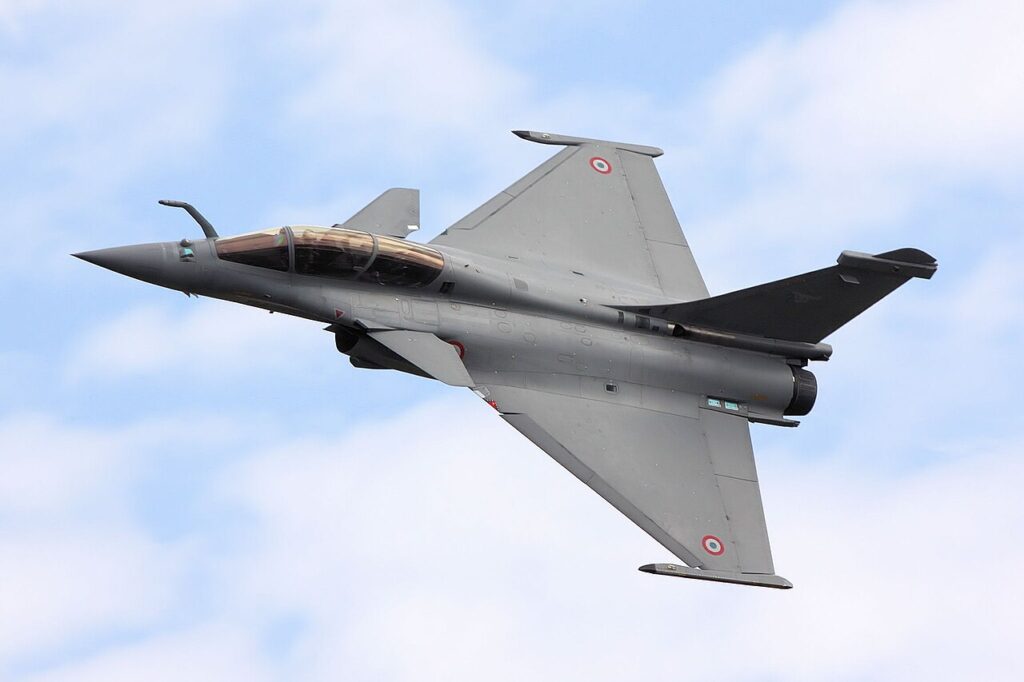
France and Ukraine have signed a letter of intent setting out plans for Kyiv to acquire up to 100 Rafale fighter jets. The agreement was announced at Villacoublay Air Base on 17 November during President Volodymyr Zelenskyy’s visit to France. Neither side has released a schedule for firm contracts or deliveries.
The document sets out plans for Ukraine to receive new-build Rafale jets rather than second-hand aircraft from the French air force. French officials say there is little spare capacity in the current fleet, and that most production slots are already assigned to national and export orders.
French officials describe the move as a long-term defence partnership. In Ukraine’s case, the Rafale would join other Western fighter programmes. The aim is to replace ageing Soviet-era jets and rebuild an air force that has taken sustained losses since 2022.
The Dassault Rafale is a twin-engine multirole fighter designed to handle air-defence, strike and maritime missions. It serves with the French Air and Space Force and Navy and has been adopted by several export customers. Should the deal go ahead, it will give Ukraine a design already proven in multiple operating environments.
The Proposed Package
The outline package covers Rafale aircraft configured to carry SCALP cruise missiles, MICA air-to-air weapons and systems from the Meteor family for long-range engagements. It also includes ground-based assets, including Thales Ground Master 200 radar units and the SAMP/T NG surface-to-air system. Several unmanned platforms from French manufacturers are listed, ranging from reconnaissance-focused models to interceptor designs intended to counter incoming drones.
Financing terms have not been made public. Ukraine has used mixed funding arrangements on earlier large contracts, combining state money, partner backing and export-credit structures. French officials say technical teams will now review how a similar approach could be applied to a fighter programme of this size.
Any eventual deal would bring substantial training and infrastructure demands. Operating the Rafale requires qualified ground crews, secure mission-data networks and facilities for handling guided munitions. Ukrainian defence officials say they want to move towards the standards used by other European Rafale operators. That would require phased investment in bases, simulators and support equipment.
Industrial cooperation is another strand of the letter. Kyiv has asked for maintenance and assembly work to be placed in Ukraine where feasible, arguing that this would support availability and strengthen its aerospace sector. Paris has acknowledged those requests but has not yet specified which activities might be localised.
The announcement marks the start of a longer negotiation process rather than a finished deal. Follow-on work is expected to focus on production sequencing and the order in which aircraft and weapons would arrive. Further talks will also look at how pilot and technician training can be built into Ukraine’s wider force-modernisation plans.