
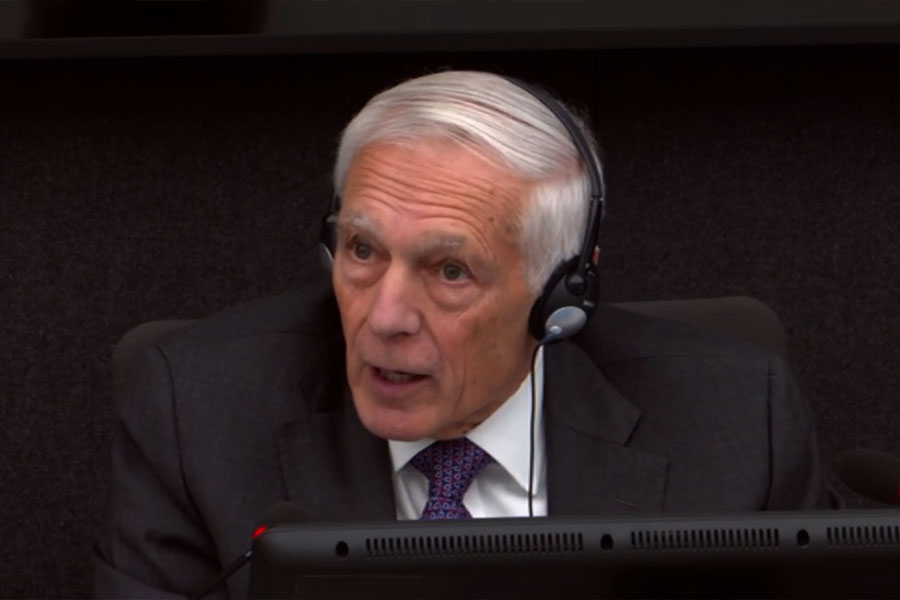
Former Supreme Commander of NATO Allied Forces in Europe, General Wesley Clark, during his testimony at the Specialized Chambers in The Hague in the case against the former leaders of the Kosovo Liberation Army, stated that after the killing of Adem Jashari’s family, he was told that Albanians would retaliate, and for this, he had notified the Pentagon. Following this, the former American general declared that from that moment the plan for NATO intervention was born.
Clark is the seventh and final witness for the defense of former President Hashim Thaçi. He led NATO’s air campaign against Serbian military targets in 1999.
In the courtroom, the four accused are present: former President Hashim Thaçi, former Assembly Presidents Kadri Veseli, Jakup Krasniqi, and former MP Rexhep Selimi.
Initially, Thaçi’s defense lawyer, Lluka Misetiq, gave a summary of what Clark is expected to testify today and in the coming days.
Recommended
Begaj was received in the Vatican, he talks to Pope Francis about the progress of Kosovo
He also added that in Dayton, he and Richard Holbrooke had contacted Slobodan Milošević, but he did not want to speak about the situation in Kosovo.
“Richard Holbrooke and I contacted him, and he said he wouldn’t talk about this; it’s my state, my problem. He refused to discuss this topic and tried more than once. We knew this was dangerous; we knew it had difficulties, but he wanted to talk about this,” emphasized Clark.
The former Supreme Commander of NATO Forces during his testimony explained that after the killings of the Jashari family by Serbian forces, he had met with the then-President of Macedonia, Gligorov, and he told him that after this event, Albanians would retaliate because they would not accept such an event.
“I went to Macedonia; I believe it was in the early days of March. We had an American task force stationed in Macedonia, which had been placed there a few years earlier to stay on the border between Serbia and Macedonia… I had never been there, so I went to inspect it. I had been commander of that post for about 7 months. I went there, and immediately I received a call from the American Ambassador in Skopje, Christopher Hill, and he told me that I needed to speak with the President of Macedonia immediately. I had heard reports that the Jashari family had been killed, and there were concerns about this. But when I met with President Gligorov, he explained that this would now begin a conflict because of this. He told me that Albanians would retaliate and would not accept what happened; they would retaliate for this murder,” he said.
Regarding the action plan that Clark had planned after the meeting with President Gligorov of Macedonia, the former American general said he had communicated with the Pentagon to inform them of the possibilities that Milošević might create a new conflict in Kosovo.
Recommended
The union of Albanian political parties in North Mitrovica is expected to increase their influence in the assembly
And after the ministerial meeting in May 1998, he was asked to create a plan.”After I met with President Gligorov, I immediately contacted the Pentagon to inform the personnel there and to warn them that Milošević would create a new conflict, that he would open a new conflict. I suggested that maybe we should repeat the so-called Christmas warning from 1992. At this point, the U.S. and NATO said that we had no policy for Kosovo, and during the period of March-April 98, Serbian attacks on the population in Kosovo intensified, escalating to the point where foreign ministers began speaking with the U.S. Secretary of State about this issue. I thought I knew what had to be done under these circumstances. But according to NATO procedures, we had no authority without political instructions; there were no concrete plans. I spoke with the U.S. Secretary of State about this but did not speak with any foreign minister on this matter. The U.S. instructed me not to discuss this issue with anyone else. But I think what happened at the ministerial meetings in the spring after May 1998 was that I was asked to prepare a plan. I don’t know if it was the foreign ministers or the defense ministers, but that’s where the instruction came to prepare a plan,” he said.
Clark laid out the plan he had developed for NATO’s air campaign.
“First, I needed permission to develop a NATO plan. It was clear that many assets and voices from the U.S. would be part of this plan. It started with an idea that would demonstrate the competence and power of the U.S. to continue with attacks on Serbia, and there was a development in case this cleansing continued. Then we would continue with bombing campaigns in Kosovo, and if Milošević did not comply, then we would continue bombing in Serbia. And if this also didn’t work, we had options to move on the ground,” he said.
The former Supreme Commander of NATO Allied Forces for Europe, General Wesley Clark, referred to the period of 1998 as a painful time for the Albanian people.
“It was a painful period because I remember at one point a brigadier from the Albanian army came to meet me and said, ‘Look at the situation in Kosovo,’ while we were seeing what the circumstances were, because in fact, they were throwing bombs, grenades, and fighting in all possible forms in the Albanian villages. And it’s about the same person and the same process,” he said.
Meanwhile, Clark is also being accompanied in the court in The Hague by the representative of the United States of America, Terra Gerhard Serra.
At the beginning of this session, the trial chamber announced that Thaçi’s defense had urgently requested a change in the list of material evidence. The prosecution had not changed this, and as a result, the request was accepted.
The process of presenting evidence by the defense began on September 15 with the testimony of the former U.S. Assistant Secretary of State, James Rubin. Later, Paul Williams, the former legal advisor to the Albanian delegation in Rambouillet, testified.
On September 22, John Stewart Duncan, former political advisor to General Clark in NATO, also testified, completing his testimony the next day. Meanwhile, on September 30, the testimony of James Peter Covey, former deputy to the UN Special Representative in Kosovo Bernard Kouchner, began and concluded on October 2.
The Specialized Chambers have announced that November 14 will mark the conclusion of the defense phase.
Recommended
Hoxhaj congratulates Blinken, hopes for a deeper interstate cooperation between Kosovo and US
Final submissions, as well as statements regarding the impact of the alleged crimes on the victims, are expected to be submitted by December 22, 2025.
In support of the leaders of the Kosovo Liberation Army, four protests have been held in Pristina, The Hague, Tirana, and the latest one was in Strasbourg.
Meanwhile, November 5 marked five years since the KLA leaders have been in pretrial detention. The former KLA leaders are accused of alleged war crimes, for which they have pleaded not guilty.