
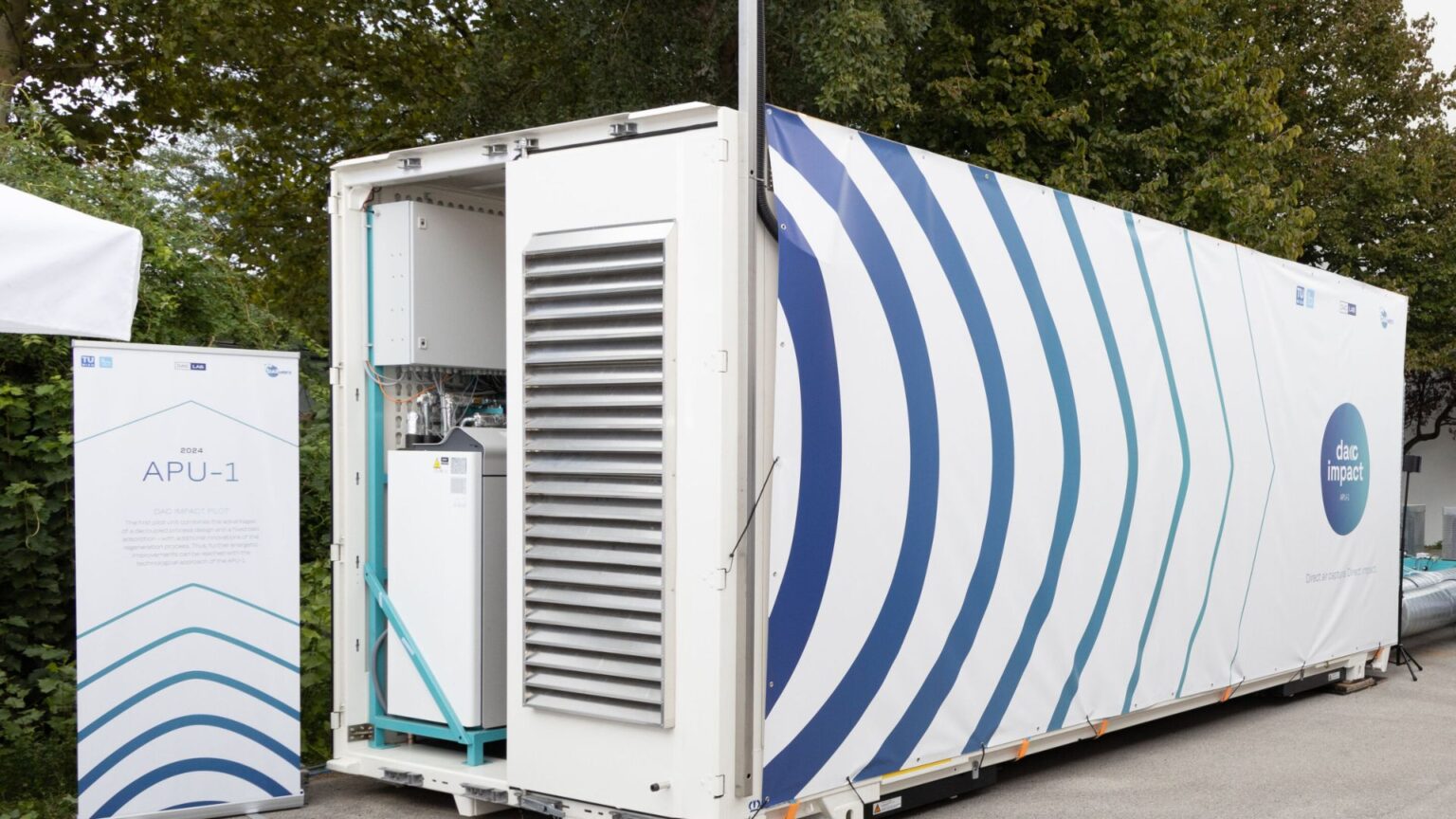
A new Direct Air Capture (DAC) pilot plant, the Austrian Pilot Unit 1 (APU1), has been recently commissioned in Austria.
Filtering atmospheric CO2 is an old idea; the innovation here is the focus on achieving the lowest possible energy consumption for direct capture.
The container-sized facility is being hailed as a potential game-changer for its record-low energy consumption. Interestingly, it extracts CO2 from the atmosphere with an efficiency of less than 2,000 kilowatt-hours per ton.
It is designed to remove 50 tons of CO2 annually and is now entering a critical development and scaling-up phase.
Thanks to its modular design, the plant can be scaled to fit any need, from individual units for small users to combined modules creating large-scale facilities.
Novel design minimizes energy loss
The plant’s process is based on finely granulated solid materials, like amines, that effectively capture CO2 when air is passed through them.
The Austrian approach successfully tackles the most energy-intensive step: regenerating the filter material.
The key innovation is a two-zone process that eliminates energy waste from cyclical heating.
To eliminate this waste, the APU1 developed a novel technique: the filter material is automatically transported between a cold container (for filtering) and a hot container (for regenerating), ensuring only the material itself is heated.
Filtering occurs in a cold container where air is pumped through the saturated solid sorbent. The saturated material is then automatically transported through a system to a separate hot regenerator.
In this process, only the material is heated in the regenerator to release the bound CO2, after which it is returned to the cold side.
Notably, the “trick” avoids repeatedly heating the entire surrounding structure and technical equipment, achieving the breakthrough energy balance.
Traditional methods combine filtering and regenerating in one location, leading to major energy loss from repeatedly heating and cooling the surrounding equipment.
“This trick results in an energy balance that outperforms other systems. Less than 2,000 kWh is needed to capture 1 ton of CO2,” the press release noted.
Scalable, decentralized future
The APU1 is built as a compact, flexible module, positioning the technology for a scalable, decentralized future. The research team and investors believe this model will make the technology economically viable.
“The idea is not necessarily to build a large, centralized CO2 capture facility but rather to offer a compact, scalable technology that can be installed based on individual needs—similar to how customized photovoltaic systems are installed today,” the researchers from the Vienna University of Technology noted.
Moreover, multiple modules can be combined to form a large-scale capture plant, with the next step being the establishment of a 1,000-ton facility.
The pilot plant is launching at a crucial time because climate models rely on large-scale carbon capture to prevent the worst outcomes. Reducing emissions is mandatory, but removing existing atmospheric CO2 is what scientists emphasize as the other essential requirement.
Eventually, the new unit’s efficiency offers a vital way to turn Direct Air Capture into an accessible and central climate solution.