Good news: trillions of dollars of investment in Africa has just resulted in the generation of more poor people.
11160704 on
I guess mainly because of the rapid population growth in sub Saharan Africa.
If you look at the share in absolute poverty, the picture probably looks different
DeathMetal007 on
Welcome to r/dataisbunk
Where a single quote explains why data is a belief system rather than empirical.
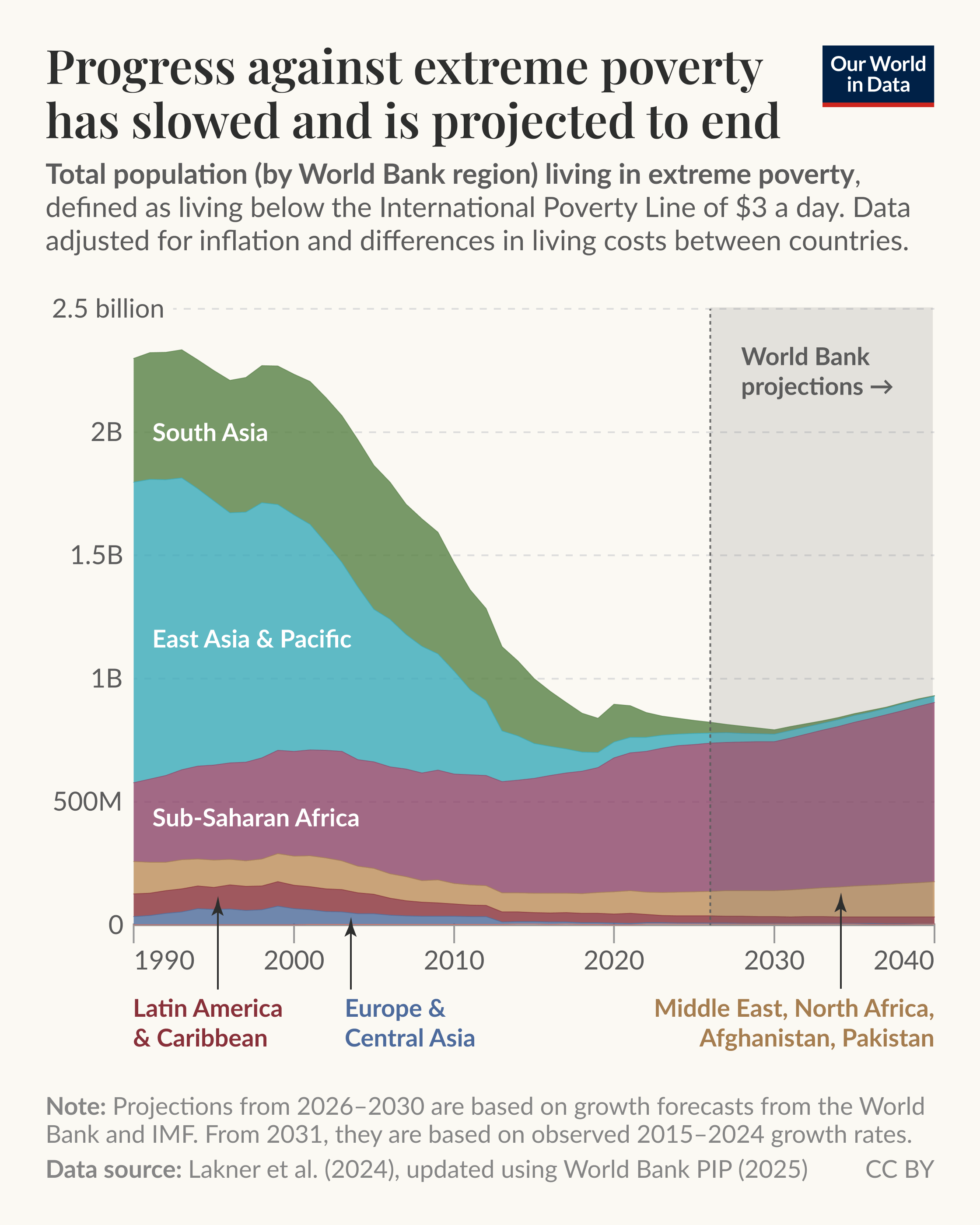
>This chart is based on the latest available projection made by the researchers at the World Bank.2 Up to 2030, this projection is based on the latest growth projections from the World Bank and the IMF. From 2031 onward, poverty projections are based on the average growth rates observed from 2015 to 2024.3
Let’s pick a random decade and say that will be the expected growth for the foreseeable future discounting current growth trends because – just because.
Prasiatko on
How does the proportion of people living on poverty in the growing regions look? Is it simply because once people are no longer living in extreme poverty their fertility rate decreases sharply?
weatherghost on
Increase appears to be nearly all sub-Saharan Africa (as well as a little of North Africa/Middle East). So countries like Nigeria, Mali, Niger. Other parts of the world have mostly maxed out what they can do relatively so they have little ability to continue changing poverty overall.
Those sub-Saharan countries are expected to explode in population in that time period. Couple that with them expected to remain under-developed, and you have a recipe for more poverty. Also the richer countries, with the exclusion of maybe China, have generally reduced how much aid they provide around the world. And. China’s goal isn’t generally to reduce poverty – more to increase their influence.
harpswtf on
This is the kind of graph that should be have a proportional y axis
daking999 on
Doing the threshold without accounting for cost of living differences makes no sense to me. Living on $10/day in the US would be incredibly difficult.
Antimony04 on
We need a better way relative to measure standard of living and the cost of living. For instance, for shelter without electricity or water, how many hours does a person have to work per month to afford it? And with modern amenities, how many hours do people need to work for a studio apartment? A 2 bedroom? How many hours does a person need to work to afford a day’s supply of fresh drinking water? How many hours per month goes toward groceries? Personal care item? Tuition? Etc.
$3 day isn’t even enough to buy water to survive in Manhattan for even a few days, not unless you’re supplementing with Penn Station bathroom sink water, etc., so USD in a vacuum never gives me a good frame of reference. No way 4 Billion people are sleeping clustered in an allyway without any shelter or water. People who live on a few thousand USD can be homeowners! Meanwhile I would pay 65% of my net pay annually on renting a one bedroom apartment, if I didn’t share it with my partner, and that’s in an older building with cheap landlords who don’t repair what they should, and an oven so old it doesn’t have a way to read temperature. But I have an oven. It would have been $1600/month 4 years ago to live in two rooms in a basement, without a kitchen at all, not even a kitchen sink, and no physical security or privacy. The NYC metro area has crazy high costs of living. Last year, a navy recruiter told me that their off base housing stipends are $4500 a month. I have less than half that to make work, again, losing 65% of my net income on a (relatively) low priced apartment. Because there’s two of us, we only pay over 30% each to stay housed in a place with solid ceilings, a kitchen, and heat in the winter, which is better than it could be otherwise, for sure. I’m fortunate but living is very expensive.
Yellowbug2001 on
According to the article this is from the reason progress isn’t projected to continue is that the majority of the remaining poorest people are in economies that have been stagnant for a long time- i.e., when China’s and India’s economies took off, the poorest people in those countries benefited and were lifted out of extreme poverty, but Malawi, Madagascar, and a few other countries are still about as poor as they ever were, and unless that changes their poorest citizens are trapped. I wonder what it would take to spark growth in those countries’ economies? They look pretty bleak, but no bleaker than a bunch of other countries did 50 years ago that are doing much better now.
BeardySam on
Because extreme poverty is getting rarer, right Anakin?
ayymadd on
Asia’s progress is unbelievable.
Lord_Bobbymort on
It’s only slowed because progress in Sub-Saharan Africa never happened. The population only increased and poverty rate has only decreased from 90% in 1990 to 87% now.
An_Oxygen_Consumer on
I wonder if africa will eventually start developing like east asians countries did.
daishi55 on
Damn. The communist party of China is truly a gift to the world.
grimorg80 on
As if living on 5$ in the West is not absolute poverty. All the people considered in poverty within national boundaries should just be happy and stop complaining.
Madman_Sean on
Because it isn’t the scope of the economics but in the poltics. If Africa ended their endless civil wars, they would develop pretty fast
fiahhawt on
We have trillionaires now
The working class doesn’t have money to spare to donate to building wells
These are connected
Maxasaurus on
Title the graph.
Label your fucking axes.
This is not difficult, and it makes the data actually interpretable.
djdood0o0o on
Does this graph account for the army of robots and ai that is going to take all the jobs?
RustySilverSpork on
Do they not track extreme poverty rates in North America? Or are they so low that they’re negligible – cause it’s not zero.
endreeemtsuyah on
This sub seems to be king of making graphs and charts, that while being based on solid data, are misleading and leave out a lot of context. According to this, you’d think we were on the brink of ending poverty. That’s just laughably not true. You can go anywhere in the world, US included, to see that’s not true. What good is data if it can’t be communicated in a way that tells a more complete story?
Nice graph though. I would like to see the same thing, but with it also taking per capita in to account as well.
ottawalanguages on
great work! what software did you use to make this? do you have github?
psilicyguy on
Can’t wait to see one of these for America in 4 years
Traditional-Storm-62 on
so it was China all along huh
Ok_Wait2050 on
Amazing how fast the life in Asia is improving
ketamarine on
Go look at birth rates in those regions.
I’ll wait here…
nim99 on
So basically the graph after 2030 is useless since it predicts based on previous data which is not realistic ofc
steelmanfallacy on
Say what you want about China, but moving 1B people out of abject poverty in less than a generation is an enormous achievement.
AliceLunar on
With all the money going to Africa, why is there no progress being made at all there, at least in terms of statistics.
Monsjoex on
Pretty sure solar prices dropping every year will make electricity so cheap in africa anyone can get a panel for next to nothing and drive mechanisation.
Easier to operate a well with electricity than manpower.

![[OC] Progress against extreme poverty has slowed and is projected to end](https://www.byteseu.com/wp-content/uploads/2025/11/y4jnt01pz02g1-1229x1536.png "[OC] Progress against extreme poverty has slowed and is projected to end")
32 Comments
Data sources: Lakner et al. (2024), updated using the World Bank Poverty and Inequality Platform (2025)
Tools used: Initial chart generated using the [Our World in Data Grapher](https://github.com/owid/owid-grapher); finishing in Figma
Read more in the new article by Max Roser, “[The end of progress against extreme poverty?](https://ourworldindata.org/end-progress-extreme-poverty)”
Idk if I would call this beautiful
Good news: trillions of dollars of investment in Africa has just resulted in the generation of more poor people.
I guess mainly because of the rapid population growth in sub Saharan Africa.
If you look at the share in absolute poverty, the picture probably looks different
Welcome to r/dataisbunk
Where a single quote explains why data is a belief system rather than empirical.
>This chart is based on the latest available projection made by the researchers at the World Bank.2 Up to 2030, this projection is based on the latest growth projections from the World Bank and the IMF. From 2031 onward, poverty projections are based on the average growth rates observed from 2015 to 2024.3
Let’s pick a random decade and say that will be the expected growth for the foreseeable future discounting current growth trends because – just because.
How does the proportion of people living on poverty in the growing regions look? Is it simply because once people are no longer living in extreme poverty their fertility rate decreases sharply?
Increase appears to be nearly all sub-Saharan Africa (as well as a little of North Africa/Middle East). So countries like Nigeria, Mali, Niger. Other parts of the world have mostly maxed out what they can do relatively so they have little ability to continue changing poverty overall.
Those sub-Saharan countries are expected to explode in population in that time period. Couple that with them expected to remain under-developed, and you have a recipe for more poverty. Also the richer countries, with the exclusion of maybe China, have generally reduced how much aid they provide around the world. And. China’s goal isn’t generally to reduce poverty – more to increase their influence.
This is the kind of graph that should be have a proportional y axis
Doing the threshold without accounting for cost of living differences makes no sense to me. Living on $10/day in the US would be incredibly difficult.
We need a better way relative to measure standard of living and the cost of living. For instance, for shelter without electricity or water, how many hours does a person have to work per month to afford it? And with modern amenities, how many hours do people need to work for a studio apartment? A 2 bedroom? How many hours does a person need to work to afford a day’s supply of fresh drinking water? How many hours per month goes toward groceries? Personal care item? Tuition? Etc.
$3 day isn’t even enough to buy water to survive in Manhattan for even a few days, not unless you’re supplementing with Penn Station bathroom sink water, etc., so USD in a vacuum never gives me a good frame of reference. No way 4 Billion people are sleeping clustered in an allyway without any shelter or water. People who live on a few thousand USD can be homeowners! Meanwhile I would pay 65% of my net pay annually on renting a one bedroom apartment, if I didn’t share it with my partner, and that’s in an older building with cheap landlords who don’t repair what they should, and an oven so old it doesn’t have a way to read temperature. But I have an oven. It would have been $1600/month 4 years ago to live in two rooms in a basement, without a kitchen at all, not even a kitchen sink, and no physical security or privacy. The NYC metro area has crazy high costs of living. Last year, a navy recruiter told me that their off base housing stipends are $4500 a month. I have less than half that to make work, again, losing 65% of my net income on a (relatively) low priced apartment. Because there’s two of us, we only pay over 30% each to stay housed in a place with solid ceilings, a kitchen, and heat in the winter, which is better than it could be otherwise, for sure. I’m fortunate but living is very expensive.
According to the article this is from the reason progress isn’t projected to continue is that the majority of the remaining poorest people are in economies that have been stagnant for a long time- i.e., when China’s and India’s economies took off, the poorest people in those countries benefited and were lifted out of extreme poverty, but Malawi, Madagascar, and a few other countries are still about as poor as they ever were, and unless that changes their poorest citizens are trapped. I wonder what it would take to spark growth in those countries’ economies? They look pretty bleak, but no bleaker than a bunch of other countries did 50 years ago that are doing much better now.
Because extreme poverty is getting rarer, right Anakin?
Asia’s progress is unbelievable.
It’s only slowed because progress in Sub-Saharan Africa never happened. The population only increased and poverty rate has only decreased from 90% in 1990 to 87% now.
I wonder if africa will eventually start developing like east asians countries did.
Damn. The communist party of China is truly a gift to the world.
As if living on 5$ in the West is not absolute poverty. All the people considered in poverty within national boundaries should just be happy and stop complaining.
Because it isn’t the scope of the economics but in the poltics. If Africa ended their endless civil wars, they would develop pretty fast
We have trillionaires now
The working class doesn’t have money to spare to donate to building wells
These are connected
Title the graph.
Label your fucking axes.
This is not difficult, and it makes the data actually interpretable.
Does this graph account for the army of robots and ai that is going to take all the jobs?
Do they not track extreme poverty rates in North America? Or are they so low that they’re negligible – cause it’s not zero.
This sub seems to be king of making graphs and charts, that while being based on solid data, are misleading and leave out a lot of context. According to this, you’d think we were on the brink of ending poverty. That’s just laughably not true. You can go anywhere in the world, US included, to see that’s not true. What good is data if it can’t be communicated in a way that tells a more complete story?
Nice graph though. I would like to see the same thing, but with it also taking per capita in to account as well.
great work! what software did you use to make this? do you have github?
Can’t wait to see one of these for America in 4 years
so it was China all along huh
Amazing how fast the life in Asia is improving
Go look at birth rates in those regions.
I’ll wait here…
So basically the graph after 2030 is useless since it predicts based on previous data which is not realistic ofc
Say what you want about China, but moving 1B people out of abject poverty in less than a generation is an enormous achievement.
With all the money going to Africa, why is there no progress being made at all there, at least in terms of statistics.
Pretty sure solar prices dropping every year will make electricity so cheap in africa anyone can get a panel for next to nothing and drive mechanisation.
Easier to operate a well with electricity than manpower.