
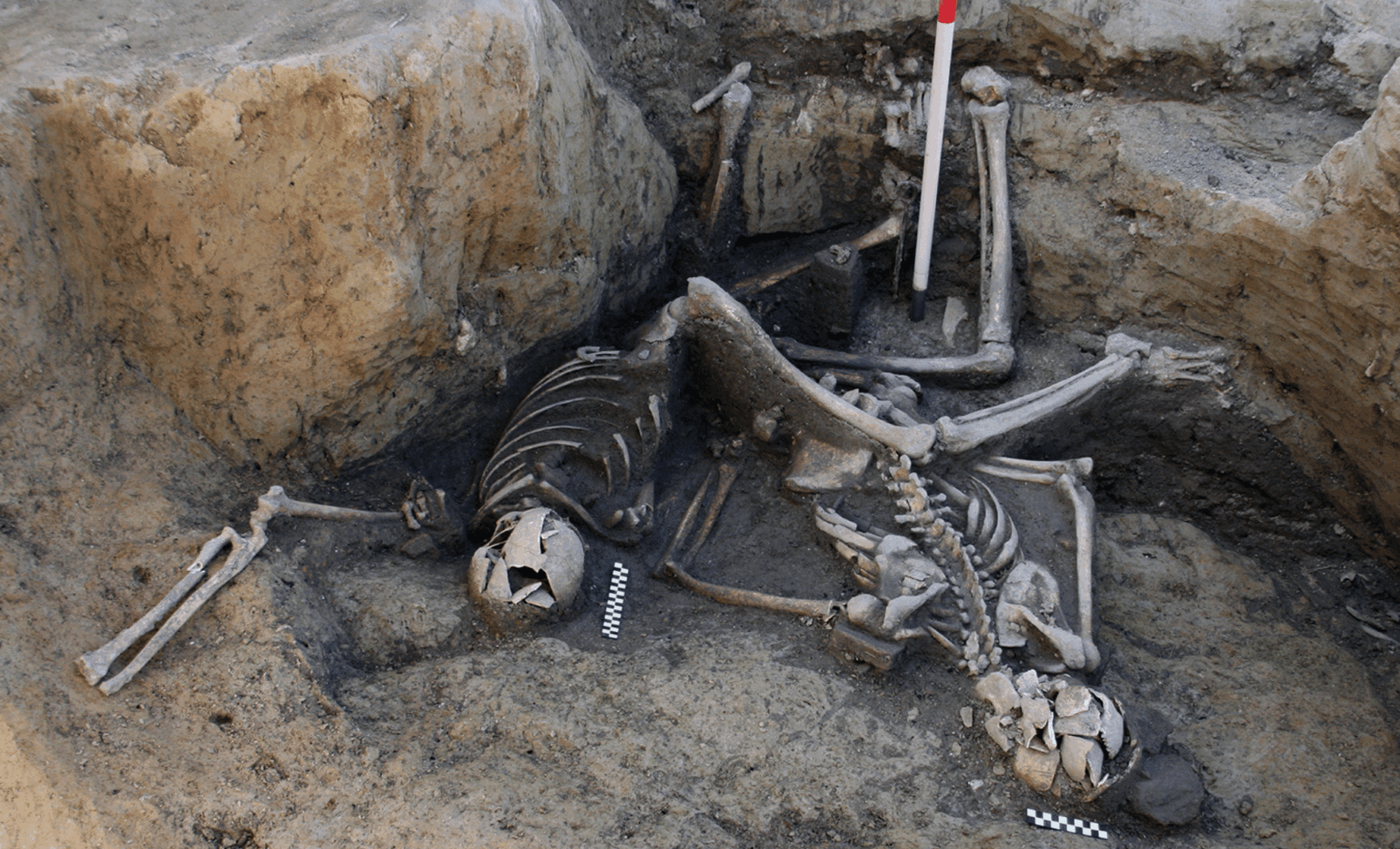
Archaeologists in Osijek, Croatia, have finally solved a 14-year-old mystery buried beneath a construction site. Seven skeletons found at the bottom of a Roman-era well have been identified as elite military men, fallen in one of the empire’s bloodiest civil wars. Their remains paint a grim picture of hand-to-hand combat, tactical defeat, and hurried burial. A new study shines light on what likely happened during the Battle of Mursa in 260 C.E.—a moment deeply tied to the Crisis of the Third Century.
Battlefield Beneath The Streets: How A Routine Excavation Uncovered A Forgotten Roman Tragedy
In 2011, a construction project on the grounds of a local college in Osijek, Croatia, halted when archaeologists stumbled upon an unusual cluster of skeletons. The remains—seven in total—lay awkwardly stacked inside a disused Roman well. At first glance, little pointed to who these men were or why they had been buried without ceremony, weapons, or artifacts. For years, the discovery remained enigmatic.
Now, after more than a decade of forensic analysis, a multidisciplinary team has unraveled their story. Using radiocarbon dating, ancient DNA analysis, and stable isotope testing, researchers identified the men as Roman soldiers likely killed during the Battle of Mursa—a major conflict tied to one of the empire’s most unstable periods. As stated in the study, published in the journal PLOS One,
“The presented multidisciplinary analyses of the Mursa mass grave strongly suggests that the studied individuals were Roman soldiers, victims of a catastrophic event occurring as the result of the Crisis of the Third Century, most probably the Battle of Mursa from 260 C.E.”
This battle, part of a wider civil war during the Third Century Crisis, marked a brutal power struggle within the Roman Empire. The site of Mursa, today’s Osijek, was a major Roman outpost near the Danube frontier. These seven bodies, stripped of valuables and tossed into a well, are stark reminders of how civil strife gripped even the empire’s periphery.
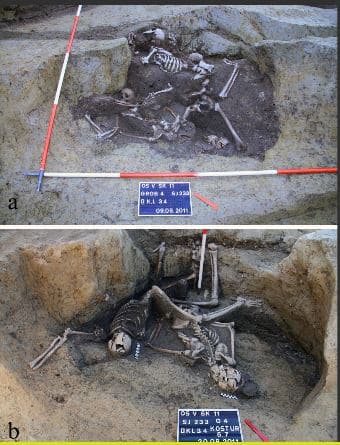 The well SU 233/234 during different excavation phases showing the position of the skeletons: (A) SK 2, SK 3 and SK 4; (B) SK 5 and SK 7.
 (PLOS One)
Soldiers, Not Locals: What The Bones Reveal About The Men Of Mursa
Far from being local townspeople or refugees, the remains belonged to trained and physically imposing adult males, aged between 18 and 50. Bioarchaeologist Mario Novak, the study’s lead author, told All That’s Interesting, “All males are quite robust and strong, and their stature is well above the average male height for that time period—again, we know from Roman sources how soldiers were supposed to be built; definitely all of them show evidence of intense physical activities.” This profile—tall, muscular men with signs of strenuous life—aligned strongly with known Roman military recruitment standards of the era.
Their skeletons told a tale of violent death. Multiple individuals bore skull fractures, broken ribs, and even marks likely caused by arrows or spears. One suffered a hip injury suggestive of an attack from behind. The wounds weren’t just fatal—they hinted at close-quarters combat, possibly even desperate last stands. “Presumably, all of the individuals were stripped of any valuables—weapons, armor, equipment, jewelry, etc.—before they were thrown into the well,” Novak told Live Science, reinforcing the idea of a chaotic aftermath with either looting or tactical cleanup.
Dietary and isotopic analysis further supported their outsider status. The men consumed mostly vegetables with only modest levels of animal protein and virtually no marine foods—an unusual pattern for urban Romans but typical for provincial soldiers. The ancient DNA revealed no genetic continuity with the region’s Iron Age population, confirming they were not locals but garrisoned troops or reinforcements brought in for the campaign.
Mursa’s Bloody Legacy And What Comes Next
The Battle of Mursa, fought between Emperor Gallienus and the usurper Ingenuus, was one of many internal power struggles that destabilized the Roman Empire in the third century. The battle itself is poorly recorded in classical sources, but these buried remains give it human texture—one that shows the cost in blood, not just power. The lack of military honors, the disposal in a well, and the total absence of personal belongings point to soldiers caught in retreat or ambush, their bodies discarded without formal burial rites.
Interestingly, the discovery of a Roman coin minted in 251 C.E. near the skeletons further confirms the timeline. Researchers now plan to examine a second, similar mass burial found nearby, believing it may hold additional victims from the same conflict.
The authors’ approach highlights how integrated scientific techniques—DNA, isotopes, carbon dating—are rewriting what we know about Roman military history. As Mursa yields more of its dead, the past begins to speak with clarity long buried beneath centuries of soil and silence.