
As big agro-business interests have often faced criticism for not giving adequate attention to social and ecological concerns of India’s villages, as an alternative can we create models of small businesses that are very close to the concerns of protecting environment as well as livelihoods of small farmers?
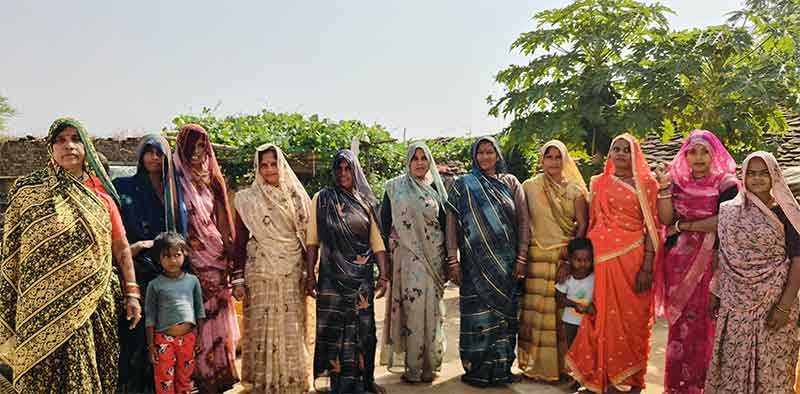
In this context the Ken Betwa Women Farmer Producer Company (KBC in short) is an effort that is raising very interesting and promising possibilities. This is a company led by women and having over 3000 women small farmers of Bundelkhand region as its shareholders.
This is a region of Central India which has often been in news due to crisis of farmers, water scarcity, adverse impacts of climate change and ecological ruin. In such conditions, if there can be a rural women based venture that is based on protecting environment and small farmer livelihoods, then what can be better than this?
This has become possible because of preceding efforts of several years by a voluntary organization (SRIJAN) to promote natural farming among small farmers with special emphasis on women and weaker sections.
In order to make available better returns to them, a logical next step is to initiate processing of farming produce and to form a farmer producer company based on those women small farmers who are increasingly adopting natural farming practices.
While many crops can be processed, the initial emphasis of this company has been on mustard oil and groundnut oil. Desi ghee is also emerging as an important product, as also selected groundnuts and some pulses. In smaller quantities some other products including some spices are also being tried and soon a wider package of products is expected to emerge. As this is an early stage, some other activities to support the effort are also being taken up.
This effort is at present concentrated in Tikamgarh district of Madhya Pradesh, although with further success this can be extended to other parts or similar efforts can be taken up in other districts of Bundelkhand region.
Edible oils being a product of daily consumption, people are generally and increasingly conscious that the edible oils they use should be healthy. With the market being flooded with cheap imports, there is increasing apprehension among consumers that what they buy may be adulterated.
In such a situation KBC hopes to create a reputation based on healthy products that can be trusted by an increasing number of loyal consumers. In fact already these products of KBC are being sold not just at local level but even in cities like Mumbai and Delhi.
The health credentials of KBC edible oils is established on the basis of the produce being grown by natural farming methods and use of cold press processing technology.
The other big scoring point of this effort is that it is very supportive of farmer livelihoods and its profits are shared by its women small farmer shareholders, who in turn are mainly from the weaker sections or relatively weaker sections of rural society.
Another plus point is that this effort is very supportive of empowerment of rural women, including those in very remote villages. Women have been taking up all kinds of responsibilities of this effort and fulfilling them in satisfactory ways.
Abhilasha Pal is the present CEO of KBC. As she told me in her office located in Jatara town of Tikamgarh district, this effort has been able to overcome several initial difficulties and is well on its way to progress.
Abhilasha was earlier the leader of a group of women committed to natural farming in a village of this district. At that time she was also studying in a college. She was able to combine both roles successfully.
Several women members were consulted regarding the selection of the CEO and finally the choice fell on her. So now she has many more responsibilities as the CEO but is still continuing to study further. Meanwhile she has also married and has a child. However she is happily combining all the responsibilities, providing an example of the special ability of women in rural India to combine several roles with grace and creativity.
In several villages that I visited in this district women members and shareholders take pride in being a part of these efforts. They are also benefiting from this all the time in terms of selling their produce more easily and getting a fair price. In addition the company is also useful to them as a provider of quality seeds at a fair price. At processing centers of the company several women members can also use some of the available equipment to process their own produce.
Triveni, an enterprising woman from Pahari village, has been able to combine her personal entrepreneurial work with the efforts of this company, providing some important services and also increasing her income in the process.
Such opportunities can also increase for other women as the company progresses and expands its work.
As a part of spreading natural farming and diversifying farm activities for several years, many small farmers here are growing fruits and vegetables. Hence conducive conditions exist to use these products also to make pickles or jam or similar products in decentralized units and these too can be marketed by KBC once it is well established.
Kamlesh Kurmi, who has played a very supportive role in these efforts, says, “While this company is providing quality healthy products, we hope that people will also recognize the wider social contribution of such businesses which provide a different, innovative and socially very useful model.”
Rakesh Kumar, who has also been very active in helping this effort says, “ When the expansion of a business is directly linked to spreading natural farming and promoting livelihoods of women small farmers from weaker sections, then economic development, social progress and environment protection all can be integrated very nicely.”
Surely this is a very good reason for supporting this and other such efforts.
Get the latest CounterCurrents updates delivered straight to your inbox.
Bharat Dogra is Honorary Convener, Save the Earth Campaign. His recent books include India’s Quest for Sustainable Farming and Healthy Food, Protecting Earth for Children, Planet in Peril, Man over Machine and A Day in 2071.