


Is Tadhg approaching the final Furlong?(Image: ©INPHO/Gary Carr)
Ireland were magnificent on Saturday. Let’s start there.
They tore into Australia with the kind of controlled fury that has become their trademark under this regime — fast, connected, ruthless.
It was one of those nights at the Aviva when you could squint and see a World Cup quarter-final unfolding in front of you, the sort Ireland have never handled well. For 80 minutes, Ireland looked like World Cup contenders.
And yet, if you were watching closely, you may have also felt something else.
A faint tightening of the chest. A little whisper of dread. Because while Ireland might be good enough today, the question we ought to be asking — the only one that really matters — is whether they will be good enough two years from now.
And on that subject, the evidence is becoming uncomfortable. Ireland’s age profile is a ticking clock. A loud one.
Tadhg Furlong is 33. Tadhg Beirne is 33. Iain Henderson, Jack Conan, Jamison Gibson-Park, Stuart McCloskey, James Lowe — all 33. Six major players.
If you were picking Ireland’s best XV to start a World Cup quarter-final tonight, five of those six make the team. That’s not an opinion. That’s reality.
Now add two years.
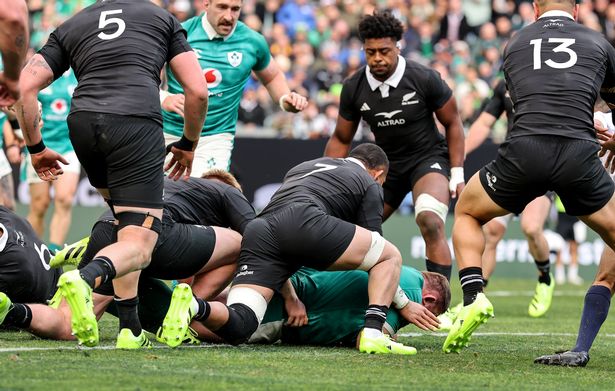
Tadhg Furlong scores Ireland’s first try despite Fletcher Newell and Ardie Savea of New Zealand(Image: ©INPHO/Dan Sheridan)
Furlong at 35 in a World Cup scrum. Gibson-Park at 35 trying to win a footrace with Antoine Dupont. Lowe at 35 chasing kicks. Beirne at 35 in 35-degree heat in Australia.
It’s not pessimism to say this out loud. It’s realism. You don’t win a World Cup with half your starting side in their mid-thirties. No matter how good they were at 33.
And the alternatives? Also deep into their thirties. Finlay Bealham, Furlong’s understudy, is 34. Bundee Aki will be 37 in 2027. Robbie Henshaw is already 32, Garry Ringrose will be 31 in January, Tom Farrell is 32. Even at scrum-half — the position that usually regenerates naturally — an alternative to Gibson-Park is Caolin Blade. He is 31.
This is the spine of the team. Not ageing — aged.
The cold numbers tell the same story. Of the Ireland squad selected this month:
- 9 players are aged 20–25
- 13 players are 25–30
- 13 players are 31 or older
That looks balanced on paper. But scratch beneath the surface.
Of those 13 players aged 31 or over, eight would start a quarter-final tomorrow. Only one of the 20–25 bracket would start. Only two would even make the matchday 23.
That isn’t balance. That’s dependence. Dependency on players whose biological clocks are all set to go off at roughly the same time.
And this is where history should trouble Ireland most.
Because Ireland know this story. They’ve lived it.
2015: Paul O’Connell’s hamstring gives way against France. One of the greatest to wear the shirt, undone by the calendar as much as by contact.
2019: Rory Best, heroic in every sense, but tired in front of our eyes against Japan, and then New Zealand. A giant who ran out of road at exactly the wrong moment.
2023: Johnny Sexton in the last ten minutes against South Africa. One more great man weighed down by the mileage on the clock.

Johnny Sexton and Finn Russell during the 2023 World Cup
You can go back further: Ireland’s World Cup exits often carry the same theme. Leaders pushed to their physical limits because the team could not function without them.
It calls to mind the great line from Joe Frazier about his near-death experience in the ring against Muhammad Ali in Manila: “We went there as kings,” he told the author Mark Kram. “We came back as old men.”
That is Ireland’s fear. The legs don’t warn you. They don’t send a polite email. They just disappear overnight. One week a player is dominant; the next he’s half a yard off. And at World Cups, that half-yard becomes a chasm.
The common thread? O’Connell, Best and Sexton — the captains at the last three World Cups — all hit the wall at the worst possible time. Not because they were fragile. Because time is undefeated.
Studies of championship-winning teams across elite sport repeatedly show the same figure: the sweet spot is around 27. Ireland’s greatest teams of the modern era — the 2018 Grand Slam side, the 2022 team that beat everyone — were built around that golden age-band. A mixture of hardened experience and fresh physical peak.
Now? Run your finger down Ireland’s depth chart and add two years.
Furlong: 35Beirne: 35Lowe: 35Gibson-Park: 35Conan: 35Henderson: 35Aki: 37Bealham: 36McCloskey: 35Henshaw: 34Blade: 33Ringrose: 33Robbie Henshaw: 34Josh van der Flier: 34
Does that group win a World Cup? Maybe they can win a match. Maybe two. But win seven consecutive Tests, including knockout games against the biggest beasts in the sport? In an Australian summer? It stretches credulity.
Ireland’s coaches know this.
They understand that their excellent game-management programme can mitigate decline — up to a point.
They can monitor minutes, manage peaks, taper workloads.
They can measure everything: GPS metres, collisions, heart-rate variability, sleep quality. But they cannot measure the precise moment when the legs suddenly go.
And for Ireland, those moments always seem to arrive in October of a World Cup year.
This is not an argument for panic. It is not a eulogy for a team that is still capable of brilliance. The win over Australia proved that Ireland, right now, can still overwhelm good sides. The combinations are polished. The system sings. The culture remains the envy of half the rugby world.
But the question is not what Ireland look like on a November evening in Dublin in 2025.
The question is what they look like in Sydney in October 2027.
Time is the one opponent no athlete beats. And unless Ireland can change the rhythm of their renewal — and soon — they risk arriving in 2027 as kings, and returning as something reluctantly familiar. Old men.