
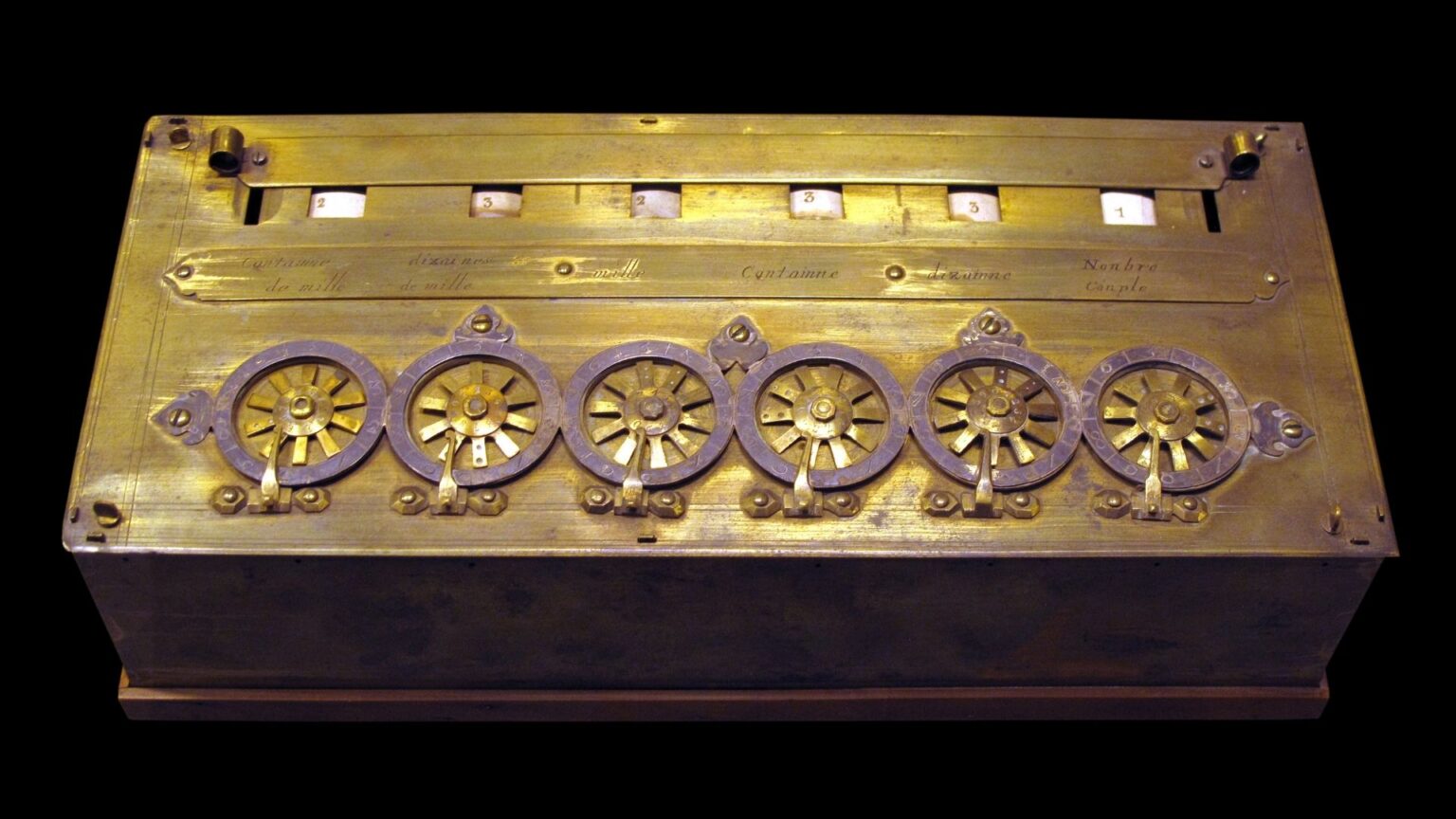
Art and luxury auction house Christie’s has withdrawn the world’s first calculating machine, designed by French mathematician Blaise Pascal in 1642. The decision was announced on Wednesday, after a Paris court suspended the object’s authorization for export, blocking buyers from taking it abroad.
Known as “La Pascaline”, the calculator’s auction was scheduled for Wednesday afternoon.
A group of leading scientists and researchers, including 2021 Nobel physics laureate Giorgio Parisi, asked the administrative court to block La Pascaline’s export, arguing it should be declared a “national treasure” and kept in France.
“Given the provisional nature of this decision and in accordance with the instructions of its client, Christie’s is suspending the sale of La Pascaline,” a Christie’ spokesperson said in a statement to the AFP news agency.
“Given its historical and scientific value, La Pascaline is likely to be classified as a ‘national treasure’… which prevents the issuance of an export certificate,” the court said, halting a sale that would have potentially fetched a sum between €2-€3 million (US$2.3 million to US$3.5 million).
A history of La Pascaline
Pascal created the device as an early attempt to “mechanise mental calculation” to help his father, who oversaw efforts to fix tax revenue collection in northern France, according to Christie’s.
The French mathematician designed each version of this machine for a different type of calculation – decimals, trade, or taxes. This particular model, made for surveyors, measures in feet, inches, and fathoms. The calculator is enclosed in a wooden box decorated with ebony sticks and features eight wheels on top.
Blaise Pascal had planned to produce this machine on a large scale, but the complexity of its manufacturing led to the failure of the idea. As a result, only eight of these machines were designed. Five of them are in French public collections, while two are housed in Germany.
The calculator in question is the eighth of the lot and has been part of a private collection since 1942.
Apart from the Pascaline, Pascal also achieved recognition for other inventions and theories, including Pascal’s Triangle, the theory of probability, and Pascal’s Law. The SI unit of pressure, the pascal (Pa), is named after him.
What did the scientists say
Scientists and researchers in France accused the state of committing a blunder, authorizing Christie’s to hold an auction rather than allowing French institutions the time to lodge a bid.
“What a sad admission of disinterest in our scientific heritage,” the scientists wrote in an op-ed published in Le Monde.
“What a misunderstanding of Pascal, engineer, mathematician, philosopher, writer, a personality like no other, whose 400th birth anniversary we celebrated in 2023,” they continued.
The culture ministry said an export certificate for the calculator had been issued in May 2024, following standard procedures, and that the decision was approved by the National Center of Arts and Crafts and the Louvre museum.
The court’s decision is provisional and valid only until the final judgment is passed.