
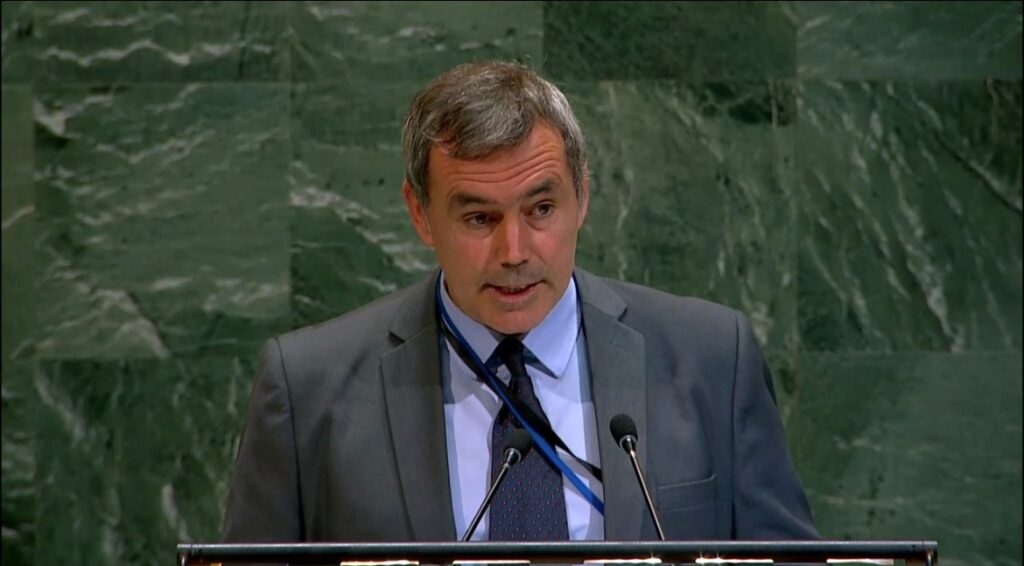
Madam President,
Thank you for organizing this debate on the use of the veto. I am speaking on behalf of Mexico and my own country, France.
In 2015, France and Mexico presented a joint declaration in favor of regulating the veto. Our observation was simple: we could not, we should not, resign ourselves to the paralysis of the Security Council when mass atrocities are committed, in other words, genocide, crimes against humanity, or large-scale war crimes. That same year, France announced that it would unilaterally refrain from using its veto in such situations. Our view is that the veto of permanent members is not a privilege but a special responsibility, creating more obligations than rights.
Where do we stand 10 years later? On the one hand, there is growing support for the principle of limiting the veto in cases of atrocities. Its importance was recognized in last year’s Pact for the Future and reaffirmed in early September in the framework of the resolution on revitalizing of the work of the General Assembly. With Armenia joining in March 2025, our initiative is now supported by 107 States from all regions of the world.
Madame President,
And yet, repeated stalemates in the Security Council on major crises continue. 2024 was marked by two sad records: first of all, the number of resolutions adopted by the Security Council in a single year, 46, was the lowest since 1991; and secondly, never since 1986 have so many resolutions been blocked by the use of veto, seven in total. And this is not an isolated phenomenon: 17 resolutions were not adopted for this same reason since 2022, representing more than a quarter of all cases recorded in the 21st century in just three years. These vetoes have sometimes endangered the lives of thousands of people, sometimes even leading to their deaths.
Like the vast majority of Member States, we deplore this abusive use of the veto, which undermines the effectiveness of the Security Council and the full exercise of the mandate entrusted to it by the United Nations Charter: namely, bear the primary responsibility for maintaining international peace and security.
But this is not fatality. What we propose is simple: this is not a question of abolishing the veto, even partially. This is not a question of amending the United Nations Charter or of removing from anyone the prerogatives conferred on them by that text. It is about improving the Council’s working methods and reaching a political, collective, and voluntary agreement among the permanent members of the Security Council to refrain from using the veto in cases of mass atrocities. This agreement will have to specify the modalities for its activation in order to prevent any instrumentalization.
Madam President,
France and Mexico reiterate their commitment to this initiative. This year as we mark the 80th anniversary of the United Nations, we remain determined to continue, with all those who wish to do so, our efforts to achieve a more responsible use of the veto. A large number of Member States have defended the idea of regulating the veto in cases of mass atrocities during the high-level week last September, and they did so again during the negotiations on revitalizing the work of the General Assembly. That is why we call on those who have not yet done so to join the Franco-Mexican initiative.
We are also ready to engage in discussions with the other permanent members of the Security Council to negotiate this agreement that we want to see. Because a more responsible Security Council is a more effective Security Council. And because people who are victims of atrocities cannot wait.
Thank you.