
If you had to take the environment ministry’s word for it, you would probably think Malta and Gozo are just about bursting at the seams with an abundance of large public parks around every corner.
Throughout the past couple of months, environment minister Miriam Dalli rolled out a no expenses spared social media campaign to promote the government’s efforts to increase the number of public parks, complete with its own cartoon mascot and depictions of idyllic scenes in “the many open spaces spread around Malta.”
Dalli also launched a website called Parks in Malta, which provides information on the location of these parks, the amenities available at each site, and photos of each park, listing over 200 sites in its database.
Using Google Earth Pro’s measuring tools and the ministry’s own website as a definitive guide for which public parks are to be included in the analysis, The Shift’s latest investigation shows that the majority of these “parks” can hardly be described as such.
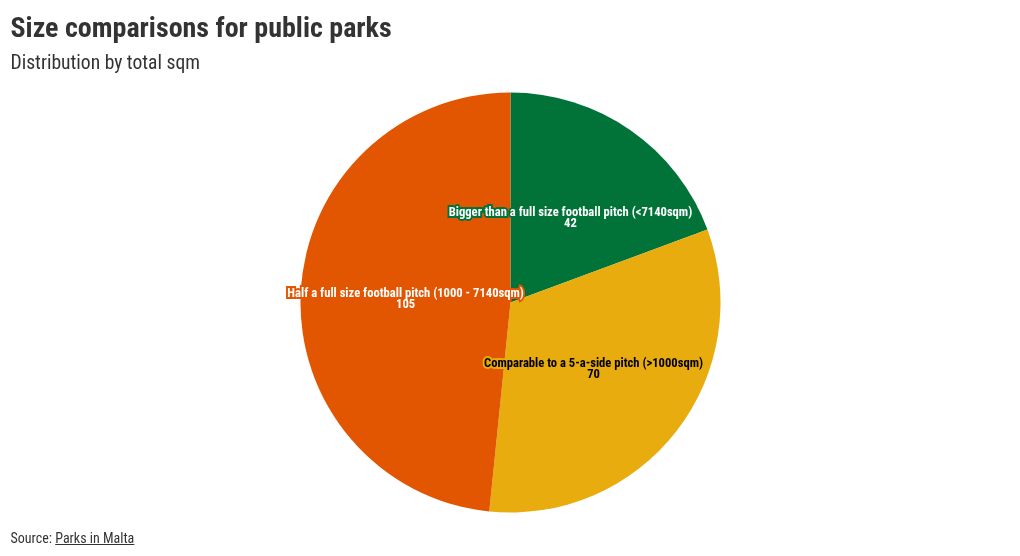
For starters, 80% of the 217 parks scanned for this analysis cover less ground than a full size football pitch.
32% are comparable to a 5-a-side football pitch in size.
A handful of them are so small that they can be compared to the surface area of an average three bedroom apartment.
All in all, the public parks listed on this website cover just 13.9% of the Maltese islands’ total surface area.
For the sake of clarifying the scope of this analysis, it is worth noting that sites which can be described as open green spaces, like Miżieb and L-Aħrax tal-Mellieħa, were excluded from the ministry’s database.
While there are no clear legal criteria that define what the Maltese state considers to be “a public park”, the Establishment of the Majjistral, Nature and History Park Regulations do give an indication of why the law designates additional protections for a site like the Majjistral park in Mellieħa:
“The designation of the National Park aims to protect the ecological processes as well as the species, natural habitats, features and characteristics of the area, and in this regard, the competent authority may from time to time determine additional levels of protection within the Park as may be required.”
The overwhelming majority of the parks listed on the ministry’s website do not fit those parameters, and would be more aptly described as small playgrounds with a variety of public amenities.
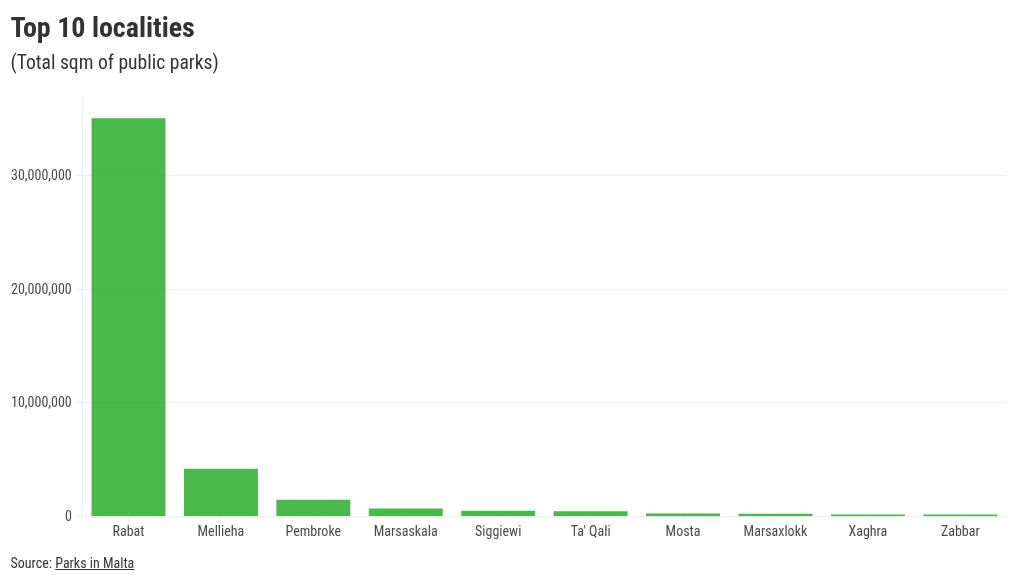
Chadwick Lakes is the largest site in the database, amounting to a total of around 3.5 square kilometres of parkland. Since it falls within Rabat’s borders, it is by far the locality with the largest concentration of public parks in Malta.
Mellieħa, Pembroke, Marsaskala, Siġġiewi, Ta’ Qali, Mosta, Marsaxlokk, Xagħra, and Żabbar round out the rest of the top 10 localities with the largest amount of public parks within their borders.
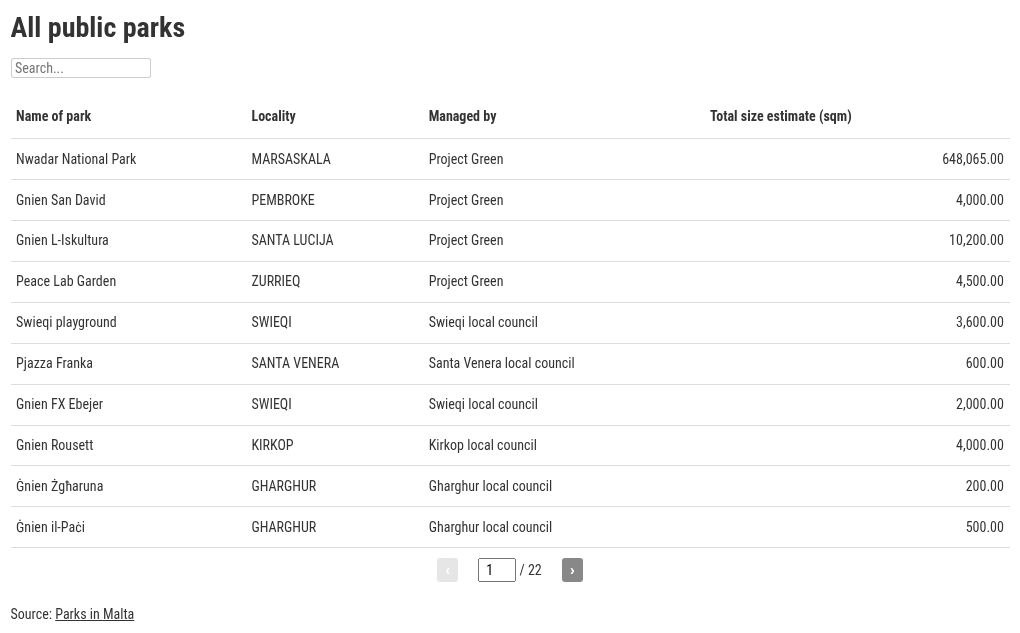
The searchable database below contains every public park listed on the environment ministry’s website. You can input the name of your locality to find a list of the parks in your town and an estimate of the size of the site.
The majority of these public parks are managed by local councils, with government entities like Project Green, Ambjent Malta, and WasteServ managing the larger, more resource-intensive sites like Buskett and Xrobb l-Għaġin.
Miriam Dalli’s efforts to convince the electorate that the government is committed to delivering more public green spaces occur in the context of the government’s years long failure to protect the natural environment.
After years of rampant over-development during disgraced former prime minister Joseph Muscat’s tenure, prime minister Robert Abela pledged to invest €700 million in urban greening projects during the last general elections.
Instead of tightening the same planning regulations that were enabling a relentless construction boom at the cost of already existent public spaces, Abela outdid his predecessor by proposing the broadest planning deregulation exercise in Malta’s history.
While any public investment in decent green spaces is long overdue, the general public remains unconvinced, mounting an overwhelming opposition against proposed legal changes which would effectively neuter the legal mechanisms which environmental groups use to stop contentious developments.
Since we last reported on the government’s position on these bills, no further changes have been announced, indicating that Abela’s administration has adopted a wait and see approach with its deregulation drive.