They should have used England, Scotland, Ireland as reference values.
Also the ratings from Germany confuses me. It’s easier to find someone that speaks English in Czechia than in Germany.
AlexMTBDude on
While I don’t doubt the source there is no way that Germans (and Austrians) are more proficient in English, in practice, than the Nordic countries. Just try travelling through the countries and speaking English with a random person.
FIR3W0RKS on
England is probably in the 300’s on this map judging off the idiots I went to school with lol
lousy-site-3456 on
From the ‘even if correct still useless’ department
porgy_tirebiter on
Switzerland surprisingly low. Romania and Portugal carrying the Romance countries.
learner1314 on
They should include England, the scores would be under 600 surely.
Troelski on
This map runs counter to all my experiences living and travelling in Europe. Romania, Poland and Portugal having similar profeciency to Scandinavia feels kinda ludicrous.
tristepin222 on
It’s quite interesting that English proficiency is low in Switzerland
English is taught at school, and there are many English speaking foreigners
I am not sure why it is that low, ig the french and Italian part have the lowest score?
Troelski on
Wait is this data just based on the people who have taken this EF test? Not general populations?
hoopyhat on
Portugal can into Nordics now!
MojoVersion8 on
No data for England, hrmm
xynaxia on
I would say germany is closer to France…
ShinyGrezz on
Over the summer I went to stay with a friend in Italy, he lives in an area that sees much more local tourism than international. And yeah, we did not meet anybody else the entire week outside of my friend and his parents who spoke a lick of English. Friendly people, to be sure. But no English. So, this tracks.
turb0_encapsulator on
From what I’ve seen, it seems like the average Scandinavian can read and write English better than the average American. Half this country is borderline illiterate.
japetusgr on
How come Cyprus gets such a low score?
elleasar on
It hurts that everyone here complains about the unrealistic findings but no one bothered to check the sources: In the report it says that those are test scores – not an evaluation of the whole population. The sampling bias is even mentioned: Only people interested in learning English would take this online test. It skews towards young, educated people with internet access.
itsjustameme on
Clearly this does not take into account the goofy accents we have.
AlpineEsel on
I never understand how people can upvote that nonsense. Do they not have any critical thinking at all?
FrancisCStuyvesant on
Germanies value is way too high compares to Benelux and the nordic countries.
Kn0wnSoul on
France should be a little above 0
stygger on
Countries that dub their media should realistically be lower than those that don’t. The number for Germany seems outright incorrect, unless this is something specific like reading comprehension.
The results are based on people voluntary taking a language test. This is NOT a random sample from the population. For example 85% of respondents are younger than 35. From the report:
Although the sample of test takers for
the EF EPI is biased toward respondents
who are interested in pursuing language
study and younger adults, the sample is
roughly balanced between male and female
respondents and represents adult language
learners from a broad range of ages.
• Female respondents comprised 46% of
the overall sample, male respondents
40% and respondents who did not
provide gender information 14%.
• The average age of respondents who
provided age information was 26, with
85% of those respondents under the age
of 35, and 99.5% under the age of 60.
10% of respondents did not provide their
birth year.
dirufa on
As an Italian, living abroad, I disagree.
J_FM01 on
Yeah mo way English proficiency is higher in Germany than in Sweden.
nebulnaskigxulo on
I like how there’s no data to tell how proficient the English are at speaking English.
zeefox79 on
in my experience Sweden and the Netherlands have better English proficiency than we do ourselves🥲
SeongHyeon on
I wonder how high is it in the UK
Zanian19 on
Yeah no way. As a Dane who grew up right on the border, I knew that whenever I had to cross it, I had to get used to speaking my broken German, because their English was pure gobbledygook.
ElendX on
Reading through the comments, the data is coming from the education first website, and it is based on the test results of the people actually using the website.
So, countries like Cyprus, Germany and all the Nordics, where either English is part of the school curriculum or they have other tests that make this one redundant (like the English O Levels or IELTS).
This data has such narrow usage, they might as well not be reported as representative to the public.
mirvge on
I’ve met 0 people that doesn’t know English in Sweden. Probably 100+ / every other person in Portugal. So this is clearly incorrect…
TheKaney on
I mean, I’ve been to Budapest last year and only about 20% of people could actually utter something in English.
adc1369 on
So, how many of the countries are more proficient than the UK?
/s
uruiamme on
Moving to Italy to teach English!
Adventurous_Air_7762 on
There is nooo way Portugal is higher then Sweden and Finland, literally 0% chance
SuperSonicToaster on
We all know the french absolutely do not speak english at large
Training_Advantage21 on
Greece with higher proficiency in English than Cyprus… right. There are some Greeks who know good English, but as a national index this is hard to believe.
Chogolatine on
I’ve been to Sarajevo, city center, and the waiter couldn’t even count to 12 in English, we had to show with our hands. Basically ditto for Portugal. And those aren’t just a “you talked to the one guy who did not speak English” situation, I legit had trouble having a simple convo in English with a regular person.
I have no idea where those data come from but they contradict my experience very hardly.
YetAnotherGuy2 on
This map must be using school data as basis. As others have remarked, this map feels off compared to every day experience.
First off, anyone in East Europe will have had Russian instead of English as foreign language 35 years ago. Anyone who is ca 45+ will have had at least some years of Russian instead of English. Trying to speak to anyone over 50 in English is certainly going to be an exercise in futility unless you are very, very lucky.
Secondly, it’s a question if how much English people are confronted with in their daily lives. Some countries – for example Germany – dub everything on TV fairly well (let’s not open that can of worms), so the need to use English after school is low. Other countries don’t have that extensive (or good) dubbing, so they tend to watch English movies with subtitles. That exposure helps in learning English to a certain degree.
Thirdly, YouTube and the Internet has driven the use of English, so anyone who uses it a bit more extensively will be fairly good at passively understanding primarily American English. I’ve seen a while genre of German which (more or less sarcastic depending on either) uses germanized English words. For example the German sub for stock bets is called “Mauerstraßewetten” which is literally “Wall street bets”. It only makes sense if you know the English version, because Mauerstraße has no specific meaning in German.
So yeah, this number might represent the level of English education you *could* have not heavily depends on your circumstances you are living in.
robgod50 on
Shame there’s no data for my home country. I’ve been to Norway & Denmark and they speak English way better than us.
amora_obscura on
Germany is absolutely not higher than Nordic/Scandinavian countries. One of the big reasons is that English-language movies are dubbed into German.
awildencounter on
France being rated moderate is so strange, they’re actively trying to get young French people to speak more French because English is slowly overtaking it as most popular language.
PolicyOne9022 on
What is this american scale?
Special-Association1 on
Finde die Portugiesen sprechen viel besser Englisch, als die deutschen
Pjoernrachzarck on
Yeah no way is Germany accurate.
saltexx on
I’m very surprised to see Germany have a higher score than Scandinavia. I guess the world has really changed (or something is a bit off with this data).
blasharga on
These numbers tell me nothing? On a scale of what to what ?
Also, no way germany is on level with nordic countries
dcwt2010 on
if you go by written English, I’m fairly confident my neighbourhood in England would rank quite low. These would be all locals though, it’s a indictment of our poor education system and how those in lower income often don’t see the value of education.
Sam-Starxin on
Italy be like: My ahhh, name aahhh, iz ahhh, Gucci.

![English Proficiency in Europe 2025 [OC]](https://www.byteseu.com/wp-content/uploads/2025/11/gx1nys2wak2g1-1024x1024.jpeg "English Proficiency in Europe 2025 [OC]")
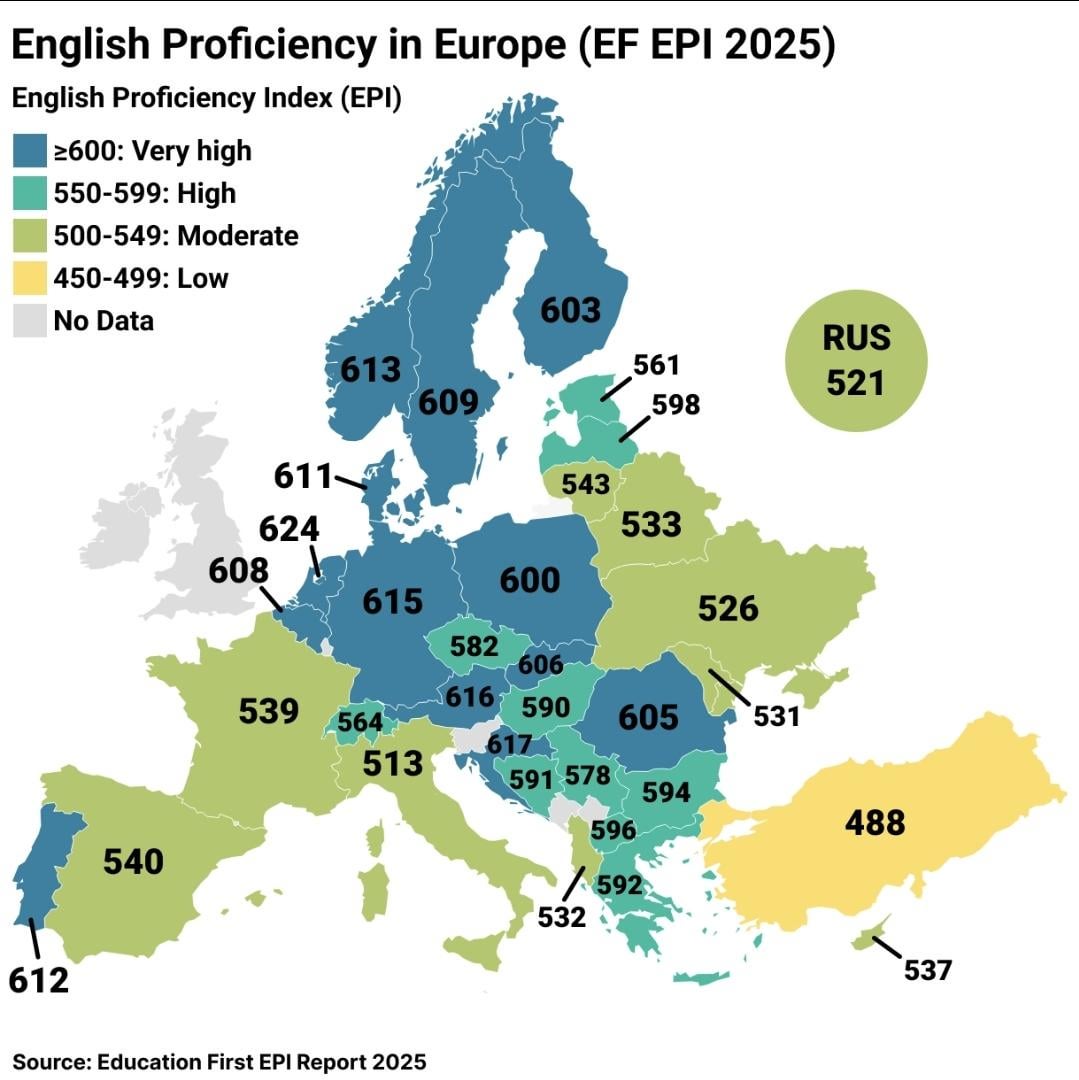
48 Comments
They should have used England, Scotland, Ireland as reference values.
Also the ratings from Germany confuses me. It’s easier to find someone that speaks English in Czechia than in Germany.
While I don’t doubt the source there is no way that Germans (and Austrians) are more proficient in English, in practice, than the Nordic countries. Just try travelling through the countries and speaking English with a random person.
England is probably in the 300’s on this map judging off the idiots I went to school with lol
From the ‘even if correct still useless’ department
Switzerland surprisingly low. Romania and Portugal carrying the Romance countries.
They should include England, the scores would be under 600 surely.
This map runs counter to all my experiences living and travelling in Europe. Romania, Poland and Portugal having similar profeciency to Scandinavia feels kinda ludicrous.
It’s quite interesting that English proficiency is low in Switzerland
English is taught at school, and there are many English speaking foreigners
I am not sure why it is that low, ig the french and Italian part have the lowest score?
Wait is this data just based on the people who have taken this EF test? Not general populations?
Portugal can into Nordics now!
No data for England, hrmm
I would say germany is closer to France…
Over the summer I went to stay with a friend in Italy, he lives in an area that sees much more local tourism than international. And yeah, we did not meet anybody else the entire week outside of my friend and his parents who spoke a lick of English. Friendly people, to be sure. But no English. So, this tracks.
From what I’ve seen, it seems like the average Scandinavian can read and write English better than the average American. Half this country is borderline illiterate.
How come Cyprus gets such a low score?
It hurts that everyone here complains about the unrealistic findings but no one bothered to check the sources: In the report it says that those are test scores – not an evaluation of the whole population. The sampling bias is even mentioned: Only people interested in learning English would take this online test. It skews towards young, educated people with internet access.
Clearly this does not take into account the goofy accents we have.
I never understand how people can upvote that nonsense. Do they not have any critical thinking at all?
Germanies value is way too high compares to Benelux and the nordic countries.
France should be a little above 0
Countries that dub their media should realistically be lower than those that don’t. The number for Germany seems outright incorrect, unless this is something specific like reading comprehension.
There are a lot of comments about how this can’t be right for country X. The data is from https://www.ef.com/assetscdn/WIBIwq6RdJvcD9bc8RMd/cefcom-epi-site/reports/2025/ef-epi-2025-english.pdf.
The results are based on people voluntary taking a language test. This is NOT a random sample from the population. For example 85% of respondents are younger than 35. From the report:
Although the sample of test takers for
the EF EPI is biased toward respondents
who are interested in pursuing language
study and younger adults, the sample is
roughly balanced between male and female
respondents and represents adult language
learners from a broad range of ages.
• Female respondents comprised 46% of
the overall sample, male respondents
40% and respondents who did not
provide gender information 14%.
• The average age of respondents who
provided age information was 26, with
85% of those respondents under the age
of 35, and 99.5% under the age of 60.
10% of respondents did not provide their
birth year.
As an Italian, living abroad, I disagree.
Yeah mo way English proficiency is higher in Germany than in Sweden.
I like how there’s no data to tell how proficient the English are at speaking English.
in my experience Sweden and the Netherlands have better English proficiency than we do ourselves🥲
I wonder how high is it in the UK
Yeah no way. As a Dane who grew up right on the border, I knew that whenever I had to cross it, I had to get used to speaking my broken German, because their English was pure gobbledygook.
Reading through the comments, the data is coming from the education first website, and it is based on the test results of the people actually using the website.
So, countries like Cyprus, Germany and all the Nordics, where either English is part of the school curriculum or they have other tests that make this one redundant (like the English O Levels or IELTS).
This data has such narrow usage, they might as well not be reported as representative to the public.
I’ve met 0 people that doesn’t know English in Sweden. Probably 100+ / every other person in Portugal. So this is clearly incorrect…
I mean, I’ve been to Budapest last year and only about 20% of people could actually utter something in English.
So, how many of the countries are more proficient than the UK?
/s
Moving to Italy to teach English!
There is nooo way Portugal is higher then Sweden and Finland, literally 0% chance
We all know the french absolutely do not speak english at large
Greece with higher proficiency in English than Cyprus… right. There are some Greeks who know good English, but as a national index this is hard to believe.
I’ve been to Sarajevo, city center, and the waiter couldn’t even count to 12 in English, we had to show with our hands. Basically ditto for Portugal. And those aren’t just a “you talked to the one guy who did not speak English” situation, I legit had trouble having a simple convo in English with a regular person.
I have no idea where those data come from but they contradict my experience very hardly.
This map must be using school data as basis. As others have remarked, this map feels off compared to every day experience.
First off, anyone in East Europe will have had Russian instead of English as foreign language 35 years ago. Anyone who is ca 45+ will have had at least some years of Russian instead of English. Trying to speak to anyone over 50 in English is certainly going to be an exercise in futility unless you are very, very lucky.
Secondly, it’s a question if how much English people are confronted with in their daily lives. Some countries – for example Germany – dub everything on TV fairly well (let’s not open that can of worms), so the need to use English after school is low. Other countries don’t have that extensive (or good) dubbing, so they tend to watch English movies with subtitles. That exposure helps in learning English to a certain degree.
Thirdly, YouTube and the Internet has driven the use of English, so anyone who uses it a bit more extensively will be fairly good at passively understanding primarily American English. I’ve seen a while genre of German which (more or less sarcastic depending on either) uses germanized English words. For example the German sub for stock bets is called “Mauerstraßewetten” which is literally “Wall street bets”. It only makes sense if you know the English version, because Mauerstraße has no specific meaning in German.
So yeah, this number might represent the level of English education you *could* have not heavily depends on your circumstances you are living in.
Shame there’s no data for my home country. I’ve been to Norway & Denmark and they speak English way better than us.
Germany is absolutely not higher than Nordic/Scandinavian countries. One of the big reasons is that English-language movies are dubbed into German.
France being rated moderate is so strange, they’re actively trying to get young French people to speak more French because English is slowly overtaking it as most popular language.
What is this american scale?
Finde die Portugiesen sprechen viel besser Englisch, als die deutschen
Yeah no way is Germany accurate.
I’m very surprised to see Germany have a higher score than Scandinavia. I guess the world has really changed (or something is a bit off with this data).
These numbers tell me nothing? On a scale of what to what ?
Also, no way germany is on level with nordic countries
if you go by written English, I’m fairly confident my neighbourhood in England would rank quite low. These would be all locals though, it’s a indictment of our poor education system and how those in lower income often don’t see the value of education.
Italy be like: My ahhh, name aahhh, iz ahhh, Gucci.