
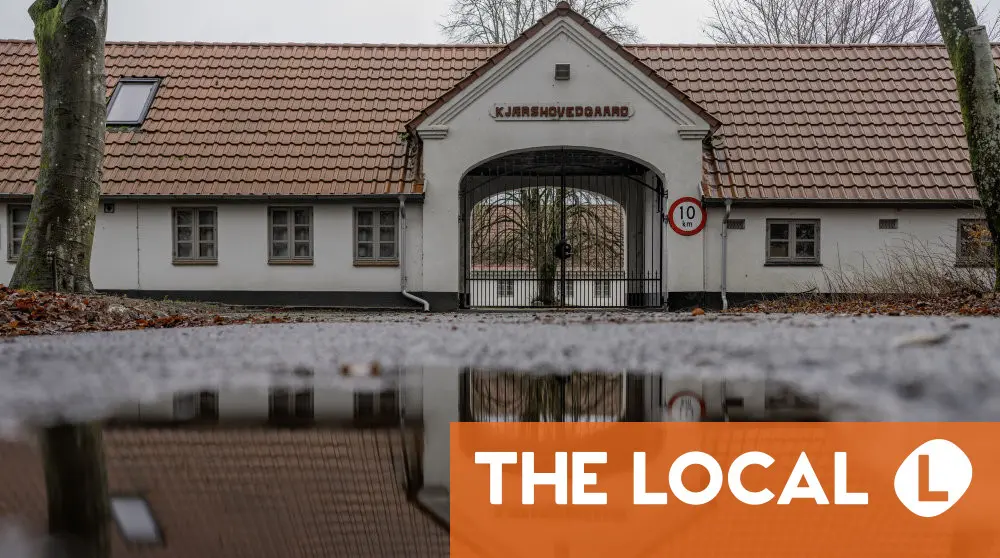
People accommodated at the Danish deportation facility Kærshovedgård will be banned from driving from next year after parliament adopted new restrictions.
Parliament has adopted a government bill placing new restrictions on Kærshovedgård residents, the Ministry of Immigration and Integration said in a statement.
The changes take effect in January 2026.
The new rules apply to all residents at Kærshovedgård as well as Sjælsmark, Denmark’s other udrejsecenter, which translates to deportation or expulsion facility.
This type of facility is used to accommodate persons who do not have legal residence in Denmark for reasons including criminal convictions and rejected asylum claims.
Kærshovedgård houses people who have not committed crimes but have no legal right to stay in Denmark, for example due to a rejected asylum claim; as well as foreign nationals with criminal records who have served their sentences but are awaiting deportation.
In some cases, people in these positions do not agree to be deported because they fear persecution if they return home, and Denmark cannot forcibly deport them if it has no reciprocal agreement with the source country.
The new rules include a ban on driving for persons at the centres, as well as an obligation to register daily at the centre where they live. This previously only applied to a limited number of residents.
Advertisement
Failure to comply with registration requirements can result in a fine or prison sentence.
It will be illegal for residents to drive under the tightened restrictions.
The new measures are designed to make life at the centres less tolerable for residents, with the overall objective of forcing them to agree to leave the country, the ministry said.
READ ALSO: Danish watchdog slams ‘deteriorating’ conditions at Kærshovedgård asylum facility
“No foreigner should be able to live illegally in Denmark. They must leave the country,” Immigration and Integration Minister Rasmus Stoklund said in the statement.
“Until they do, their life should be as bleak and monotonous as possible, and we must know where they are every single day,” he said.
Advertisement
Located 13 kilometres from Ikast in Jutland, the Kærshovedgård facility is one of two deportation centres in Denmark used to house rejected male and female asylum seekers who have not agreed to voluntary return, as well as persons with so-called ‘tolerated stay’ (tålt ophold) status.
It first became prominent in the mid-2010s, when it received criticism for imposing conditions that could lead to mental illnesses in residents.
Kærshovedgård has also become a source of tension in the local community, with politicians from the local Ikast-Brande Municipality last year directly contacting Bek to raise alarm over the situation, saying residents from the centre frequently committed crimes in the area.
In 2023, a visit to the centre by the parliamentary ombudsman concluded that conditions had deteriorated, crime was rife and many residents were suffering with addiction problems.
Earlier in November, police arrested a resident of the centre on suspicion of arson after a fire caused some of the residents to be evacuated to a different part of the facility.
The 33-year-old man who was arrested admitted to police that he started the fire but denied his intention was to hurt anyone. At preliminary court hearings, it emerged he had set fire to napkins and clothing in a section of the centre for residents with special care needs. He was accommodated at the section himself due to PTSD.
No-one was injured in the fire.