
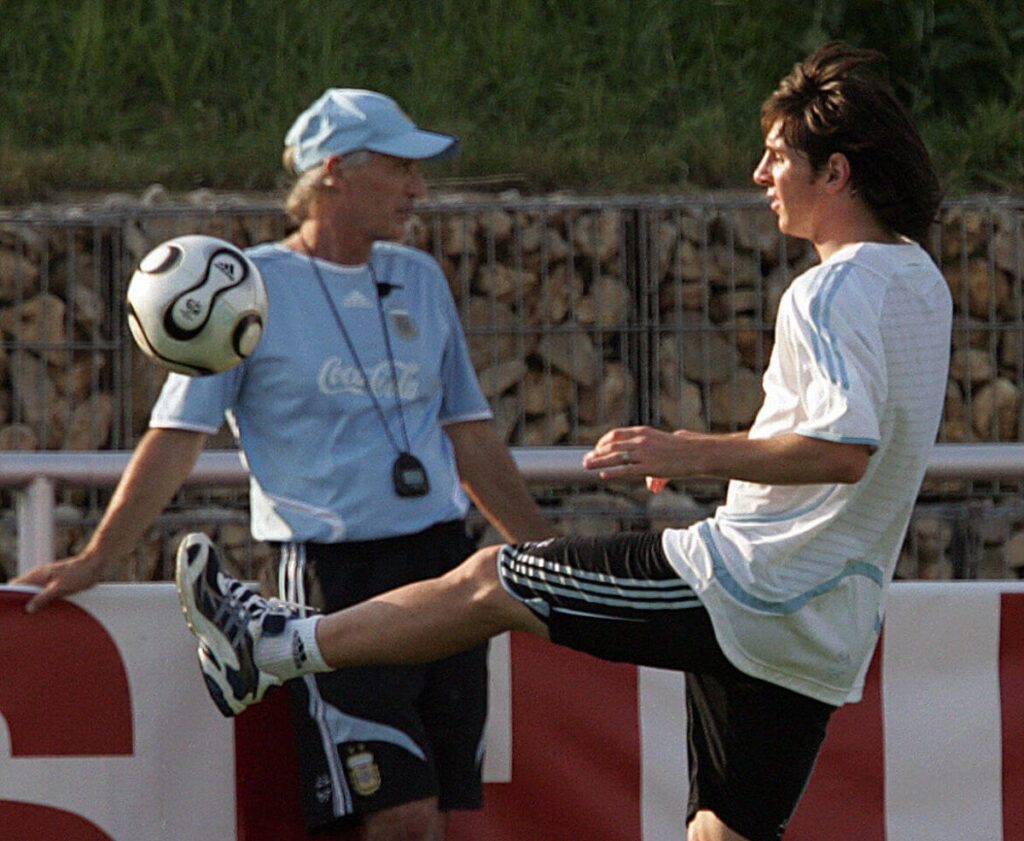
José Pékerman, the former coach who shaped generations of Argentine footballers, still commands enormous respect within the sport. He is also the man who opened the door for a young Lionel Messi to make his debut with the Argentina national team.
During his appearance at an event hosted by the Argentine newspaper Diario Olé, Pékerman revisited a key moment from 2004, recounting how he became involved in a quiet but urgent effort to ensure Messi wouldn’t end up playing for Spain at the Under-20 World Cup — a move that could have changed football history entirely.
Pékerman, a three-time U-20 world champion and manager of the senior team between 2004 and 2006, spoke of an “operation” that he and his staff put into motion to prevent the Spanish national team from incorporating a still-teenaged Messi.
Pékerman recalled that once his spell in charge of the senior national team had ended, he continued traveling through Europe to expand his coaching knowledge. On one of those visits, he heard members of Spain’s technical staff casually mention they were thrilled with a 17-year-old attacker. That prodigy, he soon realized, was Lionel Messi — and the Spanish federation was planning to take him to the 2004 U-20 World Cup. At 13, Messi had moved to Spain to join Barcelona’s famed La Masia academy, beginning the rigorous training that would shape his career.
PEKERMAN: “LO VI A MARADONA DE CHIQUITO. CUANDO LO VI A MESSI DIJE: ‘VA A SER IGUAL'” 🇦🇷🔝
▶️ El exentrenador de la Selección Argentina, multicampeón con los equipos juveniles, recordó en el Olé Summit cuando lo descubrió a Leo jugando en Barcelona
🗣️ “Hugo, no me puedo… pic.twitter.com/xTQnXayAr5
— Diario Olé (@DiarioOle) November 19, 2025
Pékerman recounted that the Spanish coaching staff had already noticed Messi following a U-17 tournament in Finland, even admitting they regretted not having him on their side. “Spanish coaches told us that if they had that kid, they would have won,” Pékerman remembered.
Had that happened, under FIFA regulations, his participation with another country would have been practically annulled.
Upon returning to Buenos Aires, Pékerman passed the news along to his colleague Hugo Tocalli, who at that point had nearly finalized Argentina’s U-20 roster for the upcoming South American Championship.
According to Pékerman, Tocalli was bewildered by the idea of adding Messi because the roster was set. Tocalli responded, “How can you tell me there’s a kid now?”
Pékerman explained that his objective was not to include Messi in the tournament, but to complete a key move. “I told him I didn’t want him to play unless necessary, just that he play in a friendly, sign the match sheet and send it to FIFA. And that’s it, Spain no more.”
Pékerman detailed the reason for his urgency, that Messi “was the player of the future. I couldn’t be wrong; he was the new emergence of Argentine football, a blessing. But since the paperwork was already prepared for him to play the U-20 World Cup for Spain, which would have locked him in, we had to hurry.”
Messi didn’t actually have to play in the South American Championship. All that was required was for him to appear in a single friendly, enough for FIFA to officially tie him to Argentina. Even a brief moment on the pitch would block any chance of him switching to Spain.
Next, Julio Grondona, then president of the Argentine Football Association, had to quickly set up an official match in Buenos Aires, and Pékerman insisted it be held at Argentinos Juniors, the stadium where Diego Maradona began his football career.
The operation materialized into a U-20 friendly against Paraguay that Argentina dominated in an 8-0 win. Messi replaced Ezequiel Lavezzi at halftime, scored Argentina’s seventh goal and assisted on another. With his appearance, Spain was officially out of the race.
That maneuver allowed Argentina to keep the player who, years later, would become the face of its national team. Messi went on to make nearly 200 appearances, score 115 goals, and lift the World Cup trophy in 2022.
In a conversation with the show “Pasión por el Fútbol”, in 2018, Messi reflected on the possibility of representing Spain. “The other day I was talking to a friend and he told me, ‘Imagine if you had stayed with Spain, you’d already be a world champion.’ But it wouldn’t have been the same. Obviously, it never crossed my mind. Being champion with Argentina would be something unique.”
In 2017, Spain’s former national team coach Vicente del Bosque made clear that the decision was all Messi’s. “I know there was an attempt by the Spanish Football Federation to include him in their youth squads. The player didn’t want to, which is also understandable because he loves his country,” he said in an interview broadcast by Superdeportivo.
Del Bosque admitted how much having Messi under his guidance would have enriched his team. “Messi would have been an added value to what we had in Spain,” he said.
And he ended with a personal confession: “If we’re talking about dreams, I would have liked to coach Lionel Messi in Spain.”