
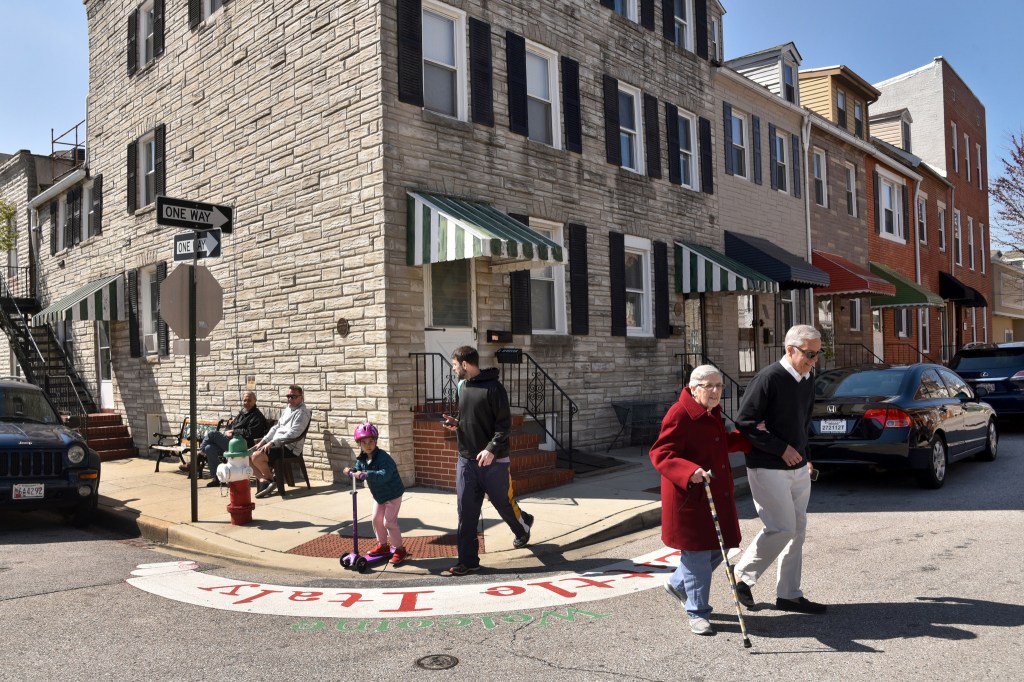
When my husband and I moved to Columbia, Maryland, in 1971, we were excited to be so close to Washington, D.C., anticipating exploring new restaurants, theater, music, museums and monuments. But after a couple of disastrous forays, we found that most often scarce parking, heavy traffic, high costs, snobby restaurants and long lines marred the experience. So, when we were offered free tickets to the Baltimore Symphony, we were willing to explore a different, albeit lesser, new city. We expected a small, working-class steel town. But our first trip to the heart of Baltimore turned out to be pure magic.
We had decided to have dinner before the concert in a neighborhood the locals called Little Italy, known for its small, family-run restaurants. We found ourselves on a tiny street barely wide enough for our car, lined with old, narrow brick rowhouses. It felt more like a residential neighborhood than a commercial one. We were delighted to find street parking right in front of the restaurant.
We walked up the three marble steps into what looked more like a home than a restaurant. The small dining room was clean, the tables had clean white tablecloths, plain China plates and solid silverware. Since it was early, the restaurant was empty, save for a very elderly woman sitting alone near the back. She was dressed in the traditional black clothing of a widow. She sat quietly, back rounded, looking down at the table, and appeared to possibly be napping. The waiter, wearing a white shirt and black pants, quickly brought out two enormous menus. Nothing about the menu was “trendy.” After the server took our order, he brought us a basket of newly sliced bread and on his way back to the kitchen, stopped to whisper something to the old woman. To my surprise, she immediately stood up and walked through a small doorway next to her table, presumably to the kitchen.
We started nibbling on the bread and found it to be fresh, warm and crusty. While gobbling down the bread, we began to pick up the glorious scents of butter, olive oil, garlic, freshly grated cheese, oregano and basil. Shortly before our dinners arrived, the old woman returned to her seat in the back of the restaurant and resumed her previous posture.
After a few bites, we realized that this was the best Italian meal we had ever eaten. While the Italian place we had tried in Washington had a magnificent setting and a showy presentation, the food turned out to be bland and tasteless. Here, everything served was fresh, huge and delicious. I looked over and caught the eye of the old woman for a brief second. Assuming she was the “nonna” responsible for the amazing meal, I smiled. She responded with the slightest nod of her head. I immediately felt welcome — to her home and kitchen, and even to Baltimore itself.
After dinner, we headed over to the symphony, already feeling quite differently about Baltimore. As we drove north on Charles Street, we passed through an old, grimy downtown. But when I looked up from the map I was using to navigate, I was completely disoriented. Where are we? I was surprised to see beautiful old parks with fountains and flowers and a huge obelisk I later learned was a monument to George Washington, built before the famous one in D.C. These parks were surrounded by gorgeous townhomes. It felt more like Paris than anything I expected to see in Baltimore.
We arrived at the Lyric theater for the symphony, and again, we were surprised and delighted to find ourselves in a magnificent old theater in traditional classical style. We were again happy to find easy nearby parking, no lines. After being seated, I noticed the sculpted heads of the major classical composers on the walls, like some theaters in Europe. Soon Sergiu Comissiona, the Romanian conductor, came out and gave a very warm and enthusiastic introduction. We relaxed, sat back and listened to a first-rate orchestra.
Heading home after this wonderful evening, we couldn’t wait to begin planning future trips to our new favorite city. Over the next 50 years, we came to love this Baltimore — its ethnic neighborhoods, the old and new harbor areas, wonderful parks, museums, theaters and restaurants. Before long, we were loving steamed crabs and rooting for the Orioles. But — don’t tell anybody! Let this magical city stay humble, welcoming and undiscovered!
Julianne Oktay, a retired faculty member at the University of Maryland School of Social Work, is a member of the Johns Hopkins Osher Lifelong Learning Institute, where she participates in a seminar on memoir writing taught by Diane Scharper.