
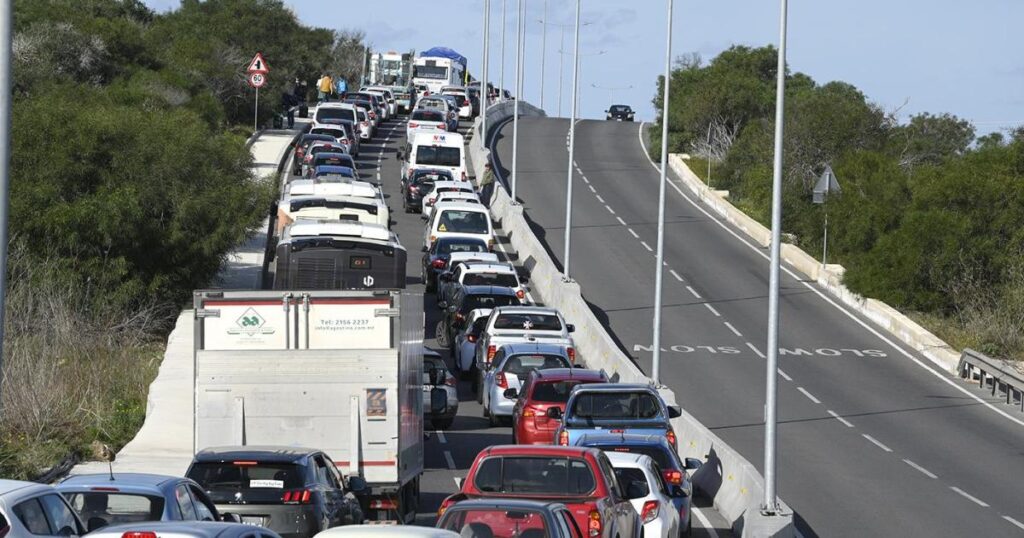
Traffic congestion is set to cost Malta €770 million this year, rising to €917 million by 2030, a new transport master plan warns.
According to the National Transport Master Plan 2030, issued for public consultation earlier this month, travel times will increase over the coming years unless drastic action is taken.
RELATED STORIES
Rising fuel and maintenance costs mean Malta will lose even more money to traffic congestion in the coming years.
“By 2030, the economic cost of traffic congestion – driven by longer journey times for passengers and freight, higher vehicle operating costs (fuel, maintenance, drivers), and related impacts – is projected to reach €917 million per year, up from €770 million in 2025,” the master plan says.
These figures do not include the economic cost of carbon dioxide emissions and other air pollutants generated by vehicles, which add a further €195 million a year to the bill, the master plan adds.
The report forecasts that unless drastic policy changes are introduced, drivers and passengers in Malta will lose over 8.5 million hours to congestion by 2030, with public transport users losing a further 2.5 million hours.
In practice, Malta is currently losing around 3.3% of its GDP to traffic congestion, before environmental costs are factored in.
A previous transport strategy had warned that the cost of congestion could be as high as €1.28 billion each year by 2050, with a 2022 European Commission report estimating the cost of traffic at €400 million that year.
RELATED STORIES
In setting out the economic cost of Malta’s congestion, the master plan lists a litany of factors that have led to Malta’s traffic woes.
Malta has the highest road density and urbanisation level in the EU, the report says, making road widening difficult and leading to bottlenecks in areas such as Qormi, Sliema and Msida.
And Malta’s love affair with cars has been fuelled by policies, such as the ever-increasing provision of parking spaces, which can “encourage, rather than restrain, car use, further increasing urban congestion”. Commercial vehicles are also singled out as “a significant contributor to the country’s traffic congestion,” with the report highlighting the increasing popularity of delivery services.
Ultimately, though, the report points to Malta’s “heavy reliance on cars, even for short distances,” with private cars accounting for 84% of all road traffic and around three-quarters of all mobility movements.
Long-promised plans for a mass transit system which could alleviate congestion are in the works, although a much-discussed metro is conspicuously absent from the master plan.
Instead, the master plan says authorities are looking into the feasibility of several types of mass transport, listing a bus rapid transit system as one possibility.
The report also points to active mobility, such as cycling and walking, as one solution to ease congestion, admitting Malta’s cycling network remains “fragmented” and “does not penetrate urban areas,” often with “poorly designed or maintained” infrastructure, despite some recent improvements.