
Security officials say negotiators from Turkey, Qatar and Egypt presented Hamas with terms the group “could not refuse” as part of a broader effort to push it to accept Trump’s ultimatum and avoid rejecting the plan outright.
2 View gallery
(Photo: AP Photo/Alex Brandon, REUTERS/Amir Cohen, AP Photo/Khalil Hamra, REUTERS/Nathan Howard)
That arrangement would allow Hamas to survive in Gaza as a behind-the-scenes power even if it relinquished formal control.
Israeli officials are alarmed that dismantling Hamas’ weapons and demilitarizing Gaza could take place through consent rather than force, based on terms negotiated by the mediators — particularly Egypt — with the terrorist organization.
A proposed multinational stabilization force, known as ISF, would play a role in disarmament but would not be authorized to use force. Under such conditions, Hamas could insist on surrendering only “offensive” weapons such as rockets, drones and explosives, while retaining “defensive” arms including rifles, machine guns and RPGs. Officials warn this would enable Hamas and Islamic Jihad to maintain a guerrilla capability under the banner of “resistance” against Israel.
Hamas also floated a separate idea in recent days to “deposit” its weapons with the Palestinian Authority for safekeeping. The PA rejected the idea, but Hamas is expected to continue pushing for arrangements that allow it to wage guerrilla warfare inside Gaza and potentially later against Israeli civilians.
After the secret understandings were reached with the mediators, Hamas demanded direct guarantees from Trump. In a Qatar-brokered meeting, presidential envoy Steve Witkoff and Jared Kushner assured senior Hamas figure Khalil al-Hayya that Trump was committed to implementing both the 20-point plan and the unwritten promises delivered by the mediators. Israeli officials say this was the breakthrough that led Hamas to accept the hostage release.
But the suspected guarantees also gave Hamas an opening to preserve political and military influence in Gaza, even if it eventually stepped aside from formal rule. The group is expected to maintain a sizable armed wing that could rebuild tunnels, workshops and other infrastructure and continue paying the 20,000 to 25,000 fighters it recently recruited.
Prime Minister Benjamin Netanyahu’s government can point to progress on one war goal set after Oct. 7: the return of most surviving hostages. But security officials warn that if the secret guarantees are implemented, Israel may have to forfeit its core wartime objective of dismantling Hamas’ civilian and military rule in Gaza.
Officials say that as long as Hamas remains capable of rebuilding its arsenal, the atrocities of Oct. 7 could be repeated.
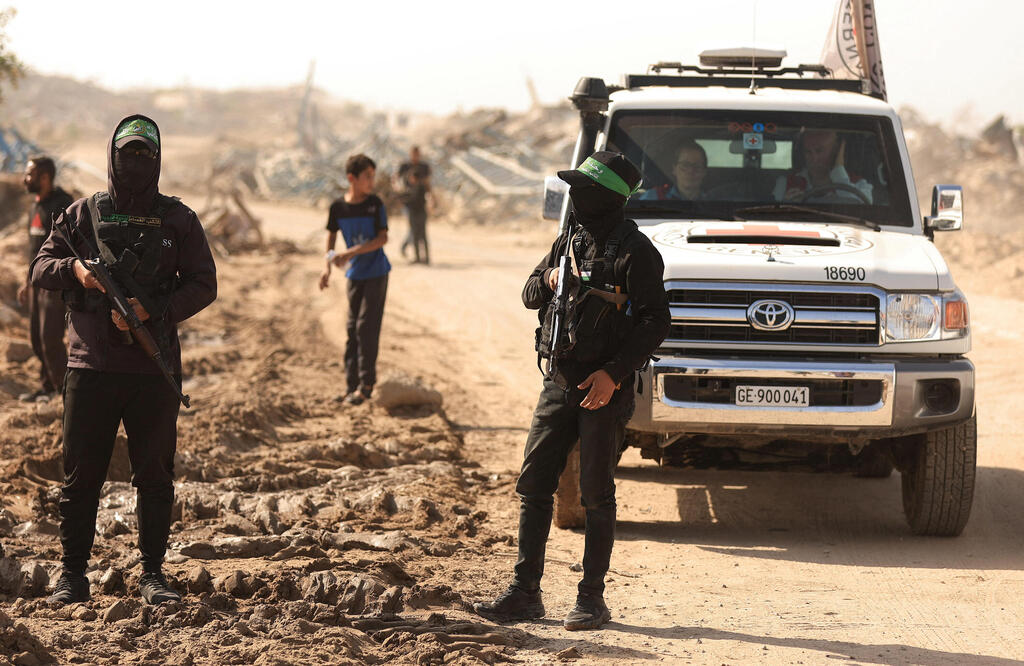
From an Israeli security standpoint, the picture is troubling. There is no working timeline — even for the coming year — to fully disarm Hamas or demilitarize Gaza. Hamas has told mediators it will not disarm, offering only to “reorganize” its arsenal, a term Israeli officials say is a euphemism for retaining quick access to weapons. They note Hamas would not have set such conditions without believing it already secured firm commitments from mediators and from Witkoff.
The ISF has yet to be established. Meanwhile, humanitarian aid is flowing into areas controlled by Hamas, and early planning for reconstruction has begun solely in the Israel-controlled eastern part of the Strip.
According to assessments based on work at the American-Israeli coordination hub in Kiryat Gat, the U.S. intends to keep Gaza divided for an extended period between a Hamas-controlled “red zone,” home to roughly 2 million Palestinians, and an Israel-controlled “green zone” with 200,000 to 300,000 residents.
U.S. Central Command is focused on delivering humanitarian aid to the red zone — despite Hamas’ ongoing seizures of supplies — and on aerial intelligence. It is not planning reconstruction, disarmament or removal of Hamas infrastructure inside Hamas-controlled areas for the foreseeable future.
In the green zone, American planners are working with Israel on “temporary communities” that would host displaced Palestinians and provide services such as food, medical care, schooling and employment. Longer-term plans call for a new city on the ruins of Rafah and additional towns in the Khan Younis area, financed by Gulf states and built mainly by Egypt.
U.S. officials hope that improved living conditions will motivate more than 1.5 million Palestinians to relocate from the Hamas-run red zone to the Israeli-controlled green zone, potentially isolating Hamas operatives and pressuring them to disarm. Israeli officials doubt the strategy, noting that many Gaza residents are unwilling to abandon their land even under harsh conditions.
If Hamas continues controlling significant parts of Gaza and most of its population, Israeli officials warn, Israel may eventually have to act alone — either by ordering the Israel Defense Forces to seize the red zone and impose military rule, or by enabling an alternate Palestinian civilian authority not influenced by Hamas. The Palestinian Authority, despite its shortcomings, is seen as the most realistic option from Israel’s perspective.