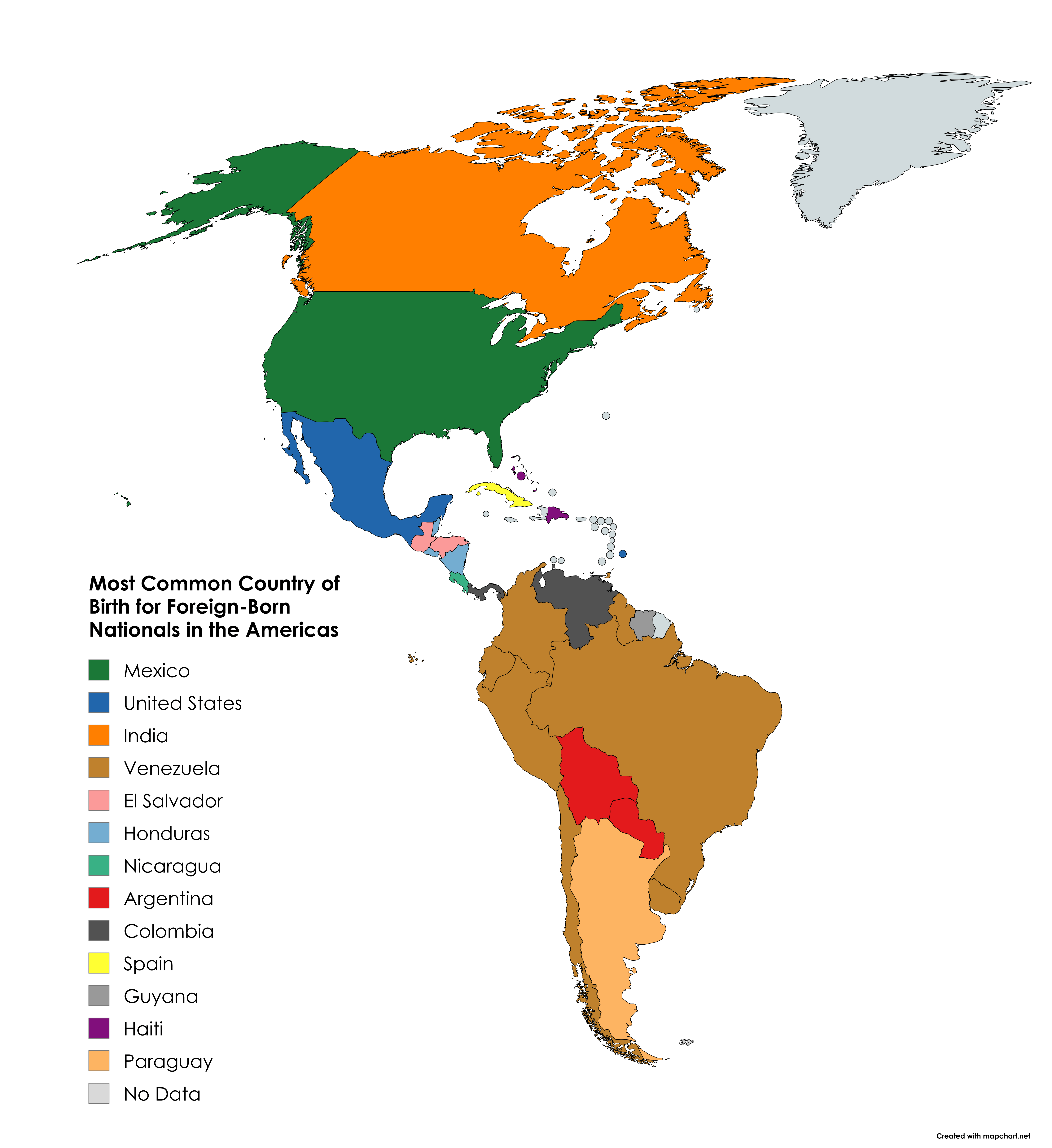
I’m guessing the fact that Cuba is the only spanish-speaking country to have Spain as the most common foreign country of birth, is a legacy of the Cuban government making it difficult (until somewhat recently, iirc) to actually leave the country? I know they were also one of the last colonies that Spain gave up too, but no other latin american country in this map has a European country as their most common place of birth for citizens born elsewhere.
GeneralMe21 on
Greenland being sneaky with its statistics yet again.
ClaroStar on
Spain for Cuba is surprising to me.
DataSittingAlone on
Kind of surprised about the amount of US born folks living in Mexico. I wonder if it’s more kids deported with their parents or more of those people with remote jobs that prefer living somewhere cheaper.
Reasonable_Fold6492 on
Yeah unfortunately Chile has a rising far right because of Venezuela immigrants. The country doesnt have the infrastructure to support those immigrants so many of them turn to gang life style which worsen there image.
Remarkable-Ad-4973 on
China continues to be the most common country of birth for foreign nationals in Canada. The Canadian Census counts Hong Kong and Macau separate from China, which skews the results.
China (715,835) + Hong Kong (213,855) + Macau (5,320) = 935,010
Paraguayans got the first place in Argentina after 1995. Before that, Italians got the title for decades.
Also, most of the Argies in Bolivia and Paraguay are somehow related to immigrants from those countries.
DrDMango on
What’s with all the Argentines moving to Bolivia and Paraguay?
MmmIceCreamSoBAD on
All of these make logical sense except for Canada, why on earth is it India of all places?
Lucky-Substance23 on
Very interesting that Brazil does not show up in this list anywhere in spite of it being the second largest country in this hemisphere population wise.
Key-Village-8203 on
What is the meaning of each colour?
Replevin4ACow on
I was curious about the details of the US->Mexico immigration. Here is what wiki has to say:
Before the COVID-19 pandemic, people from the USA were by and large retirees, students, religious workers (missionaries of the Church of Jesus Christ of Latter-day Saints, Protestant missionaries, etc.), Mexican-Americans, and spouses of Mexican citizens. A few are professors who come employed by Mexican companies to teach English, university professors and corporate employees and executives. With the advent of remote work after the COVID-19 pandemic and the soaring cost of living in the United States, many “digital nomads” have migrated to Mexico, roughly doubling the number of immigrants since 2010.

![Most Common Country of Birth for Foreign-Born Nationals in the Americas [OC]](https://www.byteseu.com/wp-content/uploads/2025/11/h2a57y8pw83g1-1408x1536.png "Most Common Country of Birth for Foreign-Born Nationals in the Americas [OC]")
13 Comments
Sources from each countries latest census:
[https://en.wikipedia.org/wiki/Demographics_of_the_United_States](https://en.wikipedia.org/wiki/Demographics_of_the_United_States); [https://en.wikipedia.org/wiki/Demographics_of_Canada](https://en.wikipedia.org/wiki/Demographics_of_Canada); [https://en.wikipedia.org/wiki/Demographics_of_Mexico](https://en.wikipedia.org/wiki/Demographics_of_Mexico); [https://en.wikipedia.org/wiki/Demographics_of_Guatemala](https://en.wikipedia.org/wiki/Demographics_of_Guatemala); [https://en.wikipedia.org/wiki/Demographics_of_Honduras](https://en.wikipedia.org/wiki/Demographics_of_Honduras); [https://en.wikipedia.org/wiki/Demographics_of_El_Salvador](https://en.wikipedia.org/wiki/Demographics_of_El_Salvador); [https://en.wikipedia.org/wiki/Demographics_of_Nicaragua](https://en.wikipedia.org/wiki/Demographics_of_Nicaragua); [https://en.wikipedia.org/wiki/Demographics_of_Belize](https://en.wikipedia.org/wiki/Demographics_of_Belize); [https://en.wikipedia.org/wiki/Demographics_of_Costa_Rica](https://en.wikipedia.org/wiki/Demographics_of_Costa_Rica); [https://en.wikipedia.org/wiki/Demographics_of_Panama](https://en.wikipedia.org/wiki/Demographics_of_Panama); [https://en.wikipedia.org/wiki/Demographics_of_Colombia](https://en.wikipedia.org/wiki/Demographics_of_Colombia); [https://en.wikipedia.org/wiki/Demographics_of_Peru](https://en.wikipedia.org/wiki/Demographics_of_Peru); [https://en.wikipedia.org/wiki/Demographics_of_Ecuador](https://en.wikipedia.org/wiki/Demographics_of_Ecuador); [https://en.wikipedia.org/wiki/Demographics_of_Brazil](https://en.wikipedia.org/wiki/Demographics_of_Brazil); [https://en.wikipedia.org/wiki/Demographics_of_Bolivia](https://en.wikipedia.org/wiki/Demographics_of_Bolivia); [https://en.wikipedia.org/wiki/Demographics_of_Chile](https://en.wikipedia.org/wiki/Demographics_of_Chile); [https://en.wikipedia.org/wiki/Demographics_of_Argentina](https://en.wikipedia.org/wiki/Demographics_of_Argentina); [https://en.wikipedia.org/wiki/Demographics_of_Uruguay](https://en.wikipedia.org/wiki/Demographics_of_Uruguay); [https://en.wikipedia.org/wiki/Demographics_of_Paraguay](https://en.wikipedia.org/wiki/Demographics_of_Paraguay); [https://en.wikipedia.org/wiki/Demographics_of_Venezuela](https://en.wikipedia.org/wiki/Demographics_of_Venezuela); [https://en.wikipedia.org/wiki/Demographics_of_Cuba](https://en.wikipedia.org/wiki/Demographics_of_Cuba); [https://en.wikipedia.org/wiki/Demographics_of_the_Dominican_Republic](https://en.wikipedia.org/wiki/Demographics_of_the_Dominican_Republic); [https://en.wikipedia.org/wiki/Demographics_of_the_Bahamas](https://en.wikipedia.org/wiki/Demographics_of_the_Bahamas); [https://en.wikipedia.org/wiki/Demographics_of_Guyana](https://en.wikipedia.org/wiki/Demographics_of_Guyana); [https://en.wikipedia.org/wiki/Demographics_of_Trinidad_and_Tobago](https://en.wikipedia.org/wiki/Demographics_of_Trinidad_and_Tobago); [https://en.wikipedia.org/wiki/Demographics_of_Suriname](https://en.wikipedia.org/wiki/Demographics_of_Suriname); [https://en.wikipedia.org/wiki/Demographics_of_Barbados](https://en.wikipedia.org/wiki/Demographics_of_Barbados)
I’m guessing the fact that Cuba is the only spanish-speaking country to have Spain as the most common foreign country of birth, is a legacy of the Cuban government making it difficult (until somewhat recently, iirc) to actually leave the country? I know they were also one of the last colonies that Spain gave up too, but no other latin american country in this map has a European country as their most common place of birth for citizens born elsewhere.
Greenland being sneaky with its statistics yet again.
Spain for Cuba is surprising to me.
Kind of surprised about the amount of US born folks living in Mexico. I wonder if it’s more kids deported with their parents or more of those people with remote jobs that prefer living somewhere cheaper.
Yeah unfortunately Chile has a rising far right because of Venezuela immigrants. The country doesnt have the infrastructure to support those immigrants so many of them turn to gang life style which worsen there image.
China continues to be the most common country of birth for foreign nationals in Canada. The Canadian Census counts Hong Kong and Macau separate from China, which skews the results.
China (715,835) + Hong Kong (213,855) + Macau (5,320) = 935,010
India = 898,050
Source = 2021 Census (https://www12.statcan.gc.ca/census-recensement/2021/dp-pd/dv-vd/imm/index-en.cfm)
Paraguayans got the first place in Argentina after 1995. Before that, Italians got the title for decades.
Also, most of the Argies in Bolivia and Paraguay are somehow related to immigrants from those countries.
What’s with all the Argentines moving to Bolivia and Paraguay?
All of these make logical sense except for Canada, why on earth is it India of all places?
Very interesting that Brazil does not show up in this list anywhere in spite of it being the second largest country in this hemisphere population wise.
What is the meaning of each colour?
I was curious about the details of the US->Mexico immigration. Here is what wiki has to say:
Before the COVID-19 pandemic, people from the USA were by and large retirees, students, religious workers (missionaries of the Church of Jesus Christ of Latter-day Saints, Protestant missionaries, etc.), Mexican-Americans, and spouses of Mexican citizens. A few are professors who come employed by Mexican companies to teach English, university professors and corporate employees and executives. With the advent of remote work after the COVID-19 pandemic and the soaring cost of living in the United States, many “digital nomads” have migrated to Mexico, roughly doubling the number of immigrants since 2010.
Source: [https://en.wikipedia.org/wiki/Immigration_to_Mexico](https://en.wikipedia.org/wiki/Immigration_to_Mexico)