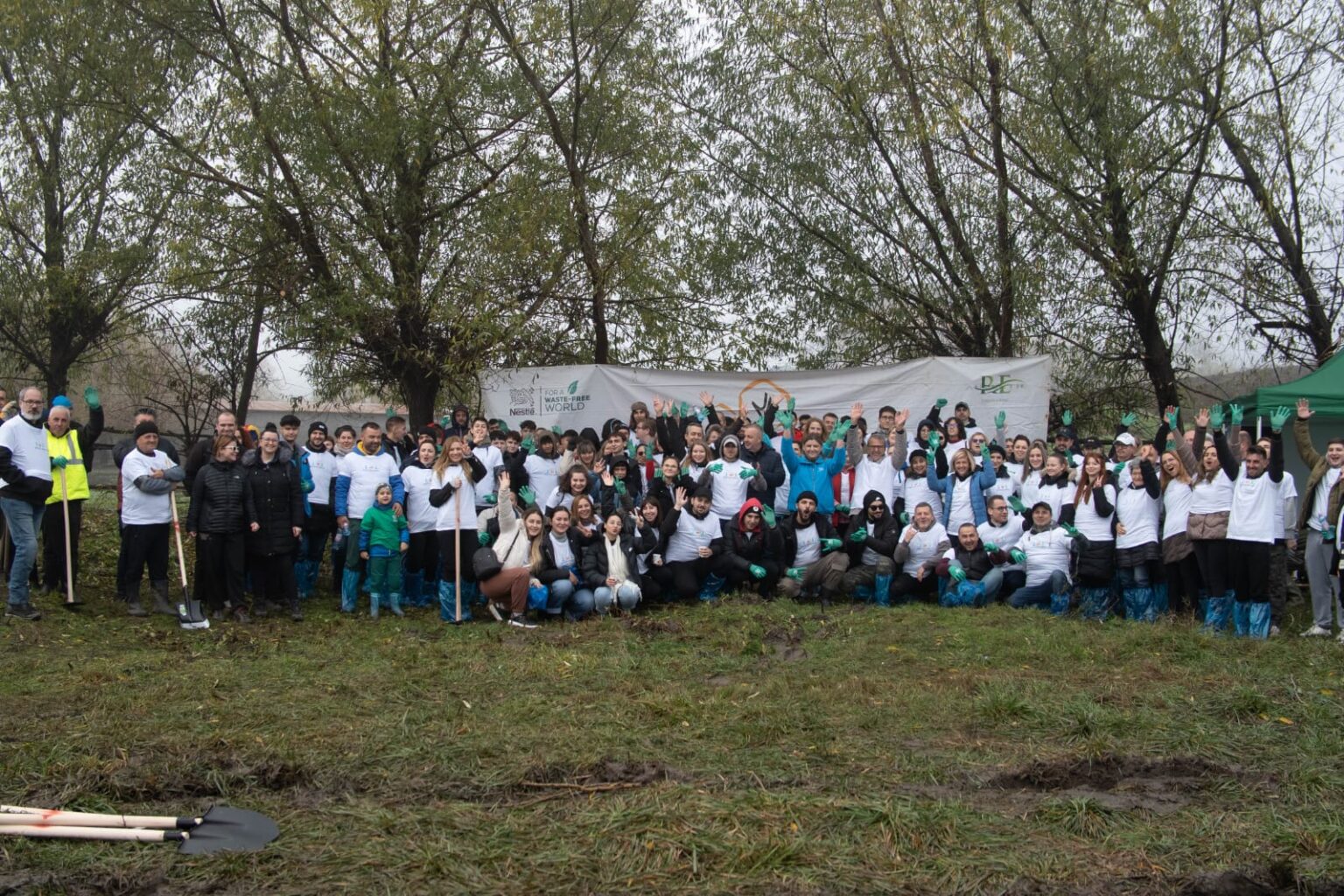
Nestlé Romania continued its “Honey Forest” project for the fifth consecutive year, part of the company’s commitment to the environment, planting another 10,000 acacia trees on an area of two hectares in the municipality of Oltenița, Călărași County, approximately 70 km southeast of Bucharest.
The Nestlé Honey Forest is an innovative concept launched by the company in Romania, combining both forest regeneration for better absorption of carbon dioxide (CO2) from the atmosphere and the creation of an ecosystem attractive to beekeeping in our country, as the acacia is the main honey-producing forest species in Romania.
This year, nearly 200 volunteers, Nestlé employees and partners, as well as members of the Re-Autentic Association, volunteered to plant 10,000 acacia seedlings in Oltenița, near the Danube, continuing the reforestation campaign in the Muntenia plain, where a total of 95,000 acacia trees have already been planted. From 2020 to date, Nestlé has planted 120,000 trees in Romania.
“We are delighted to have found openness in Oltenița for this sustainability project, which will bring economic and environmental benefits to the entire local community. The acacia forest we have started to plant here will contribute significantly to reducing the carbon dioxide footprint through photosynthesis, because a 6-hectare plantation can absorb over 90 tons of CO2 annually, provided that the planting density is higher. Through the “Honey Forest,” the Nestlé Romania team and their partners are creating a positive impact on the local ecosystem, supporting land restoration and biodiversity stabilization,” says Cătălin Nechifor, Re-Autentic Association.
This project specifically aims to restore affected soils, support biodiversity, and create a harmonious environment for both people and bees. In general, acacia honey production per hectare ranges between 800 and 2,000 kg, which means that up to 8-10 tons of honey can be obtained from the entire acacia plantation, provided that local beekeepers are encouraged and promoted accordingly by both local and county authorities.
“Honey is one of nature’s miracles, but now bees need human support to create new areas conducive to bees and the beekeeping community in our country. We are delighted to be able to contribute, for the fifth consecutive year, to the regeneration of Romania’s forest heritage. We are pleased to have partners in the Re-Autentic Association and the Oltenița Town Hall with whom we can contribute to concrete measures to preserve the environment and protect biodiversity in Romania,” says Irina Siminenco, Corporate Affairs Manager, Nestlé Romania.
Through this effort, Nestlé, the world’s largest food and beverage company, is supporting its commitment to sustainable development, which includes achieving net-zero emissions by 2050, transitioning to 100% renewable energy, developing alternative packaging, increasing biodiversity, and reducing CO2 emissions by planting trees.