
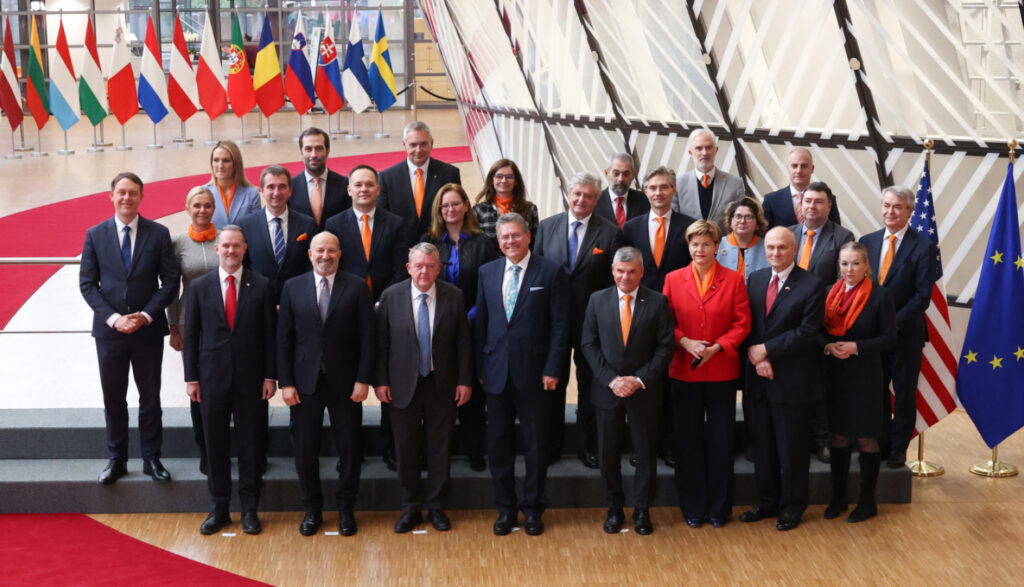
BAKU, Azerbaijan, November 25. Latvian Foreign
Minister Baiba Braže joined her EU counterparts at the EU Foreign
Affairs Council on Trade in Brussels to discuss EU–U.S. and
EU–China trade relations, as well as ongoing EU bilateral
negotiations, with a particular focus on talks with India, Trend reports via Latvian
MFA.
Minister Braže highlighted that EU ministers recently met with
U.S. Secretary of Commerce Howard Lutnik and U.S. Trade
Representative Jameson Greer to review the state of transatlantic
trade, bilateral investment flows, commercial opportunities, and
cooperation in defense, energy, and technology.
“The U.S. is and will remain our strategic partner and close
ally. Strengthening transatlantic trade relations and cooperation
with the U.S. is essential for the EU,” Braže stated.
Several EU member states, Estonia, Finland, Germany, Latvia,
Lithuania, Poland, and Sweden — urged the European Commission to
propose additional tariff increases on products originating from
Russia and Belarus.
Braže stressed that in international trade, it is vital for
public funds and national resources to support partners who respect
international law and the core principles of the UN Charter. She
emphasized the need for the EU to leverage all available tools to
reduce dependence on trade with unreliable and hostile actors,
underlining that this is a matter of European security.
In discussions on other EU agreements and ongoing bilateral
negotiations, Braže underscored the importance of using every
available EU instrument, from trade agreements and new partnerships
to trade-defense tools, to ensure that European companies can
successfully expand into new markets and contribute to economic
growth.
“It is equally important to ensure that EU businesses are not
subjected to unfair competition,” she added.
Ministers welcomed the European Commission’s progress in
negotiations with India, Indonesia, and Thailand. Braže highlighted
that the expansion of the EU’s global trade agreement network over
the past two decades has delivered clear benefits. For example,
after the entry into force of EU free trade agreements, exports to
South Korea increased nearly tenfold (since 2011), to Canada by 166
percent (since 2017), and to Japan by 49 percent (since 2019).
Addressing the EU–Mercosur Free Trade Agreement, Braže called it
a strategic partnership with major Latin American economies that
will open new markets for Europe and Latvia while supporting job
creation. Once concluded, the agreement would form the world’s
largest free trade area, covering nearly one-quarter of global GDP
and creating a market of more than 700 million consumers. It is
expected to save EU businesses up to 4 billion euros annually in
export duties, supported by lower or fully eliminated tariffs and
streamlined customs procedures. For example, the agreement foresees
significant tariff reductions in the EU — up to 20 percent for
machinery, vehicles, and ICT products, and around 30 percent for
dairy products, wine, and chocolate.
On EU–China trade relations, ministers discussed the ongoing
need to advance the EU’s risk-reduction strategy, particularly by
diversifying trade partners and suppliers of critical raw
materials.