
(Bagnolet: November 25, 2025) Today, November 25, the International Day for the Elimination of Violence against Women, in a context marked by multiple crises—climate, food, economic, political, migration, and care crises—that threaten progress toward equality, we join the global call and mobilization to demand rights, an end to impunity, and justice for women in rural areas, forests, waterways, and cities. Check out our action wall here.
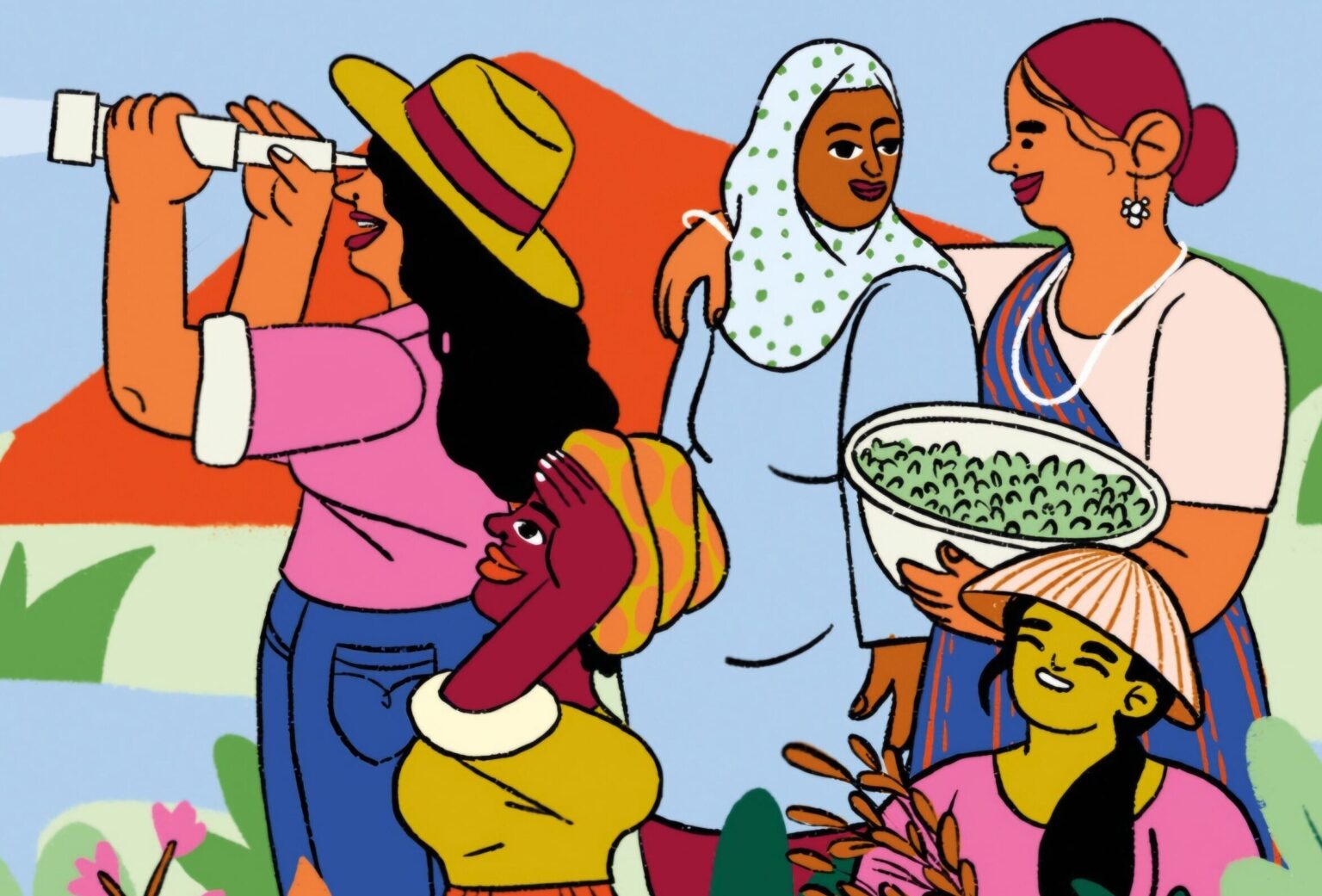
Likewise, a few days after the recent People’s Summit held in Belém, Brazil, where organized communities from around the world resolved to confront false market solutions and demanded that communities participate and assume a leading role in building climate solutions, recognizing our ancestral knowledge, we are officially launching our new graphic publication “Climate Justice: Insights from Peasant and Popular Feminism” coordinated by the Women Articulation of La Vía Campesina and illustrated by the FemGarabat Feminist Collective.
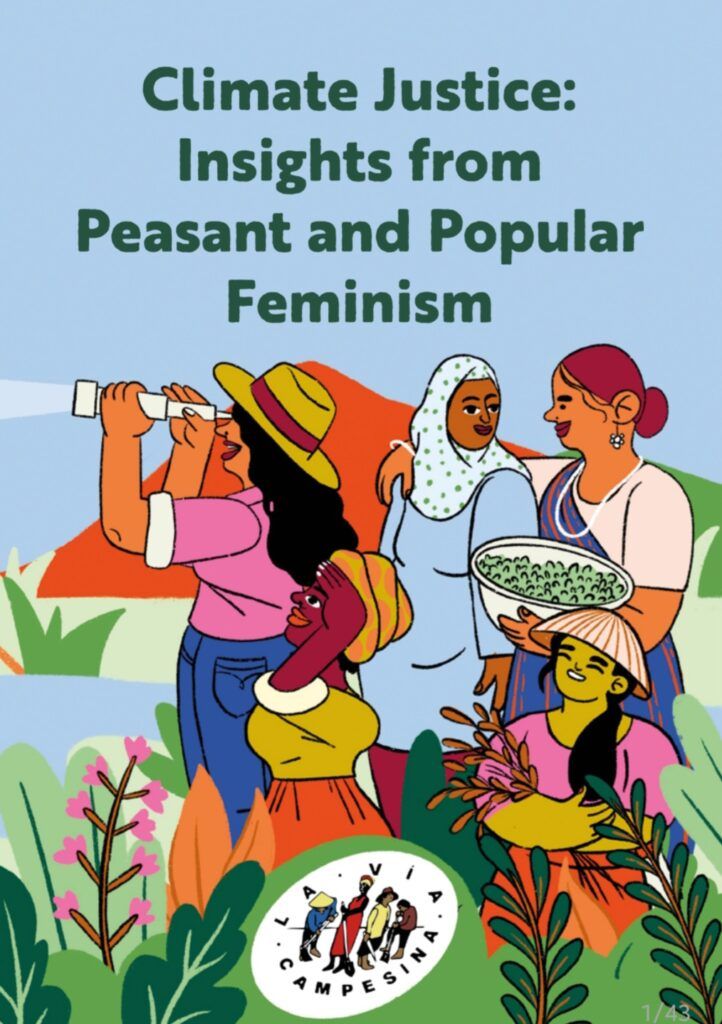
This booklet is a living tool for education, mobilization and collective action in the countryside and the city. Our goal is to strengthen grassroots organizing and converge on a unified agenda: one that is socio-environmental, anti-patriarchal, anti-capitalist, anti-colonialist, anti-racist and rights-based, all while respecting diversities and specificities, united for a future based on Buen Vivir (good living).
For our movement, Peasant and Popular Feminism offers a transformative vision that highlights the role of peasant, Indigenous, fisherfolk, pastoralist, gatherer, seasonal, migrant and working women in food systems, caring for territories and nurturing life itself. Based on this collective reflection, we offer tangible proposals emerging from the territories to face different crises. We resist the advance of capital with our bodies, our ancestral practices and knowledge; we are defenders of our territories and of life itself. We play a strategic role in the climate struggle. Within our rural and Indigenous communities, we practice diverse, poison-free farming, and also, we protect our water sources, the land and the oceans. This is precisely what is now cooling the planet.
We, peasant, Indigenous women and diversities in the countryside, are guardians of seeds, transmitters of ancestral knowledge, while we lead processes in our communities and territories. This fight has been tough, requiring strong organization and, above all, education.
Currently, we are key protagonists in the construction of concrete proposals to achieve climate justice through Food Sovereignty, Peasant Agroecology, and demanding Peasant Rights.
In this regard, the booklet “Climate Justice: Insights from Peasant and Popular Feminism” is a tool to strengthen training processes within the movement and to engage with society. It is composed of five chapters that critically address the main challenges and paths towards a just climate transition:
- The First Chapter analyzes how agribusiness—through land grabbing, the use of agrotoxics, deforestation and other extractivist practices—contributes to the global climate crisis. It also explains how the “false solutions” promoted by agribusiness undermine Food Sovereignty.
- The Second Chapter introduces Food Sovereignty, grounded in Peasant Agroecology, as a true solution to “Cool the Planet,” highlighting the critical need for Popular Agrarian Reforms. Through essential steps, it illustrates how peasant knowledge, agroecological practices and local economies can sustain a just, resilient and sustainable food system.
- The Third Chapter delves into the relationship between climate justice and Peasant and Popular Feminism, making visible the impacts of the climate crisis on communities and territories, especially on women and diversities in the countryside. Meanwhile, it also acknowledges their central role in resistance, resilience and transformation. Public policies needed to tackle these inequalities from the ground up are also discussed.
- The Chapter Four outlines campaigns and strategies driven by La Via Campesina and allies, including the Campaign to Stop Violence Against Women, the Fight for Agrarian Reform, Defense of Peasant Seeds, the Struggle against Agrotoxics and Global Organizing to resist Corporate Power.
- The Fifth Chapter collects experiences of resilience and territorial resistances from organized peasant communities in various regions worldwide. It demonstrates that viable and sustainable alternatives already exist for mitigating and adapting ecosystems, highlighting the role of women in this process.
Finally, we offer a glossary of key climate-related terms for our organizations and communities, designed to improve understanding of this material. Additionally, bibliography is included for further learning and training.
Now, more than ever, we must promote collective efforts to defend democracy and international solidarity, standing against the far right, fascism, fundamentalist movements, warfare and the financialization of nature alongside the environmental crisis.