
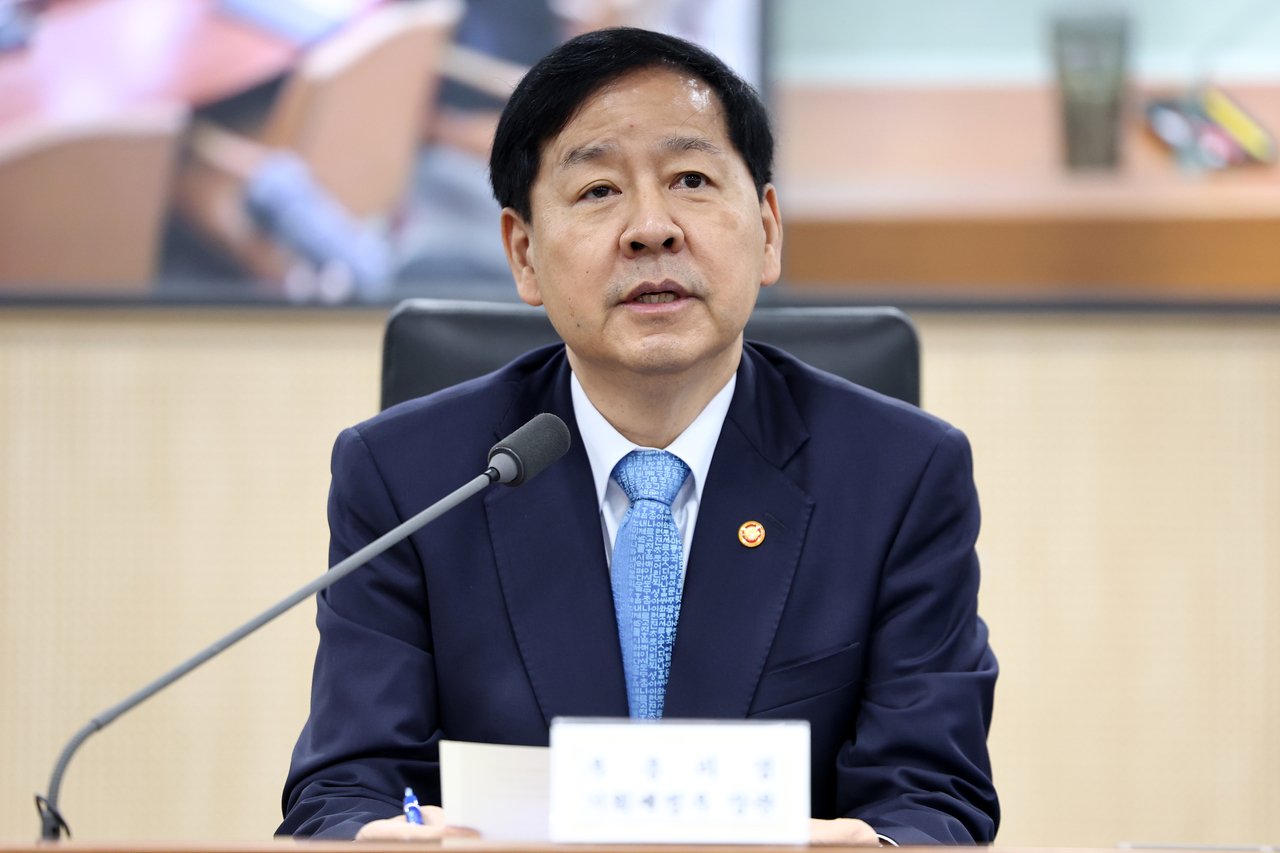
 Finance Minister Koo Yun-cheol speaks during an economy-related ministers’ meeting at the government complex in Sejong on Wednesday. (Yonhap)
 Finance Minister Koo Yun-cheol said Wednesday that South Korea’s economy is at a “turning point” that will shape its growth trajectory for decades, vowing to push ahead with projects aimed at creating new growth engines.
The government earlier announced 15 flagship projects under President Lee Jae Myung’s five-year economic development blueprint to build what it calls a “super-innovation economy.” The government views the next five years as the nation’s final window to secure long-term, sustainable growth and aims to deliver tangible results by 2030.
“(South Korea) must strengthen its competitiveness in advanced industries, including artificial intelligence, to stay ahead in the global race for technological dominance,” Koo said while presiding over an economy-related ministers’ meeting to discuss the projects.
To do so, the government will accelerate establishing task forces for six initiatives in three energy-related fields — next-generation solar power, power grids and green hydrogen.
It is also planning to make large-scale fiscal investments and push for aggressive regulatory reforms.
In addition, the government will focus on nurturing autonomous vehicles, a core industry for physical AI, with a goal of achieving full commercialization of fully autonomous cars by 2027, according to the finance ministry.
Koo stressed that the country should seize the opportunities created by recently resolved tariff issues, emphasizing increased investment in the US as a strategic move to lead and secure global value chains.
Later Wednesday, the ruling Democratic Party is set to submit a special bill to the National Assembly to promote investment in the US, following an agreement between Seoul and Washington on the details of South Korea’s $350 billion investment package tied to a trade deal.
The agreement was finalized during President Lee’s meeting with US President Donald Trump on the sidelines of the Asia-Pacific Economic Cooperation summit in Gyeongju last month. (Yonhap)