
![[OC] US Cities by Population](https://www.byteseu.com/wp-content/uploads/2025/11/qhv95zcotm3g1-1536x1220.png "[OC] US Cities by Population")
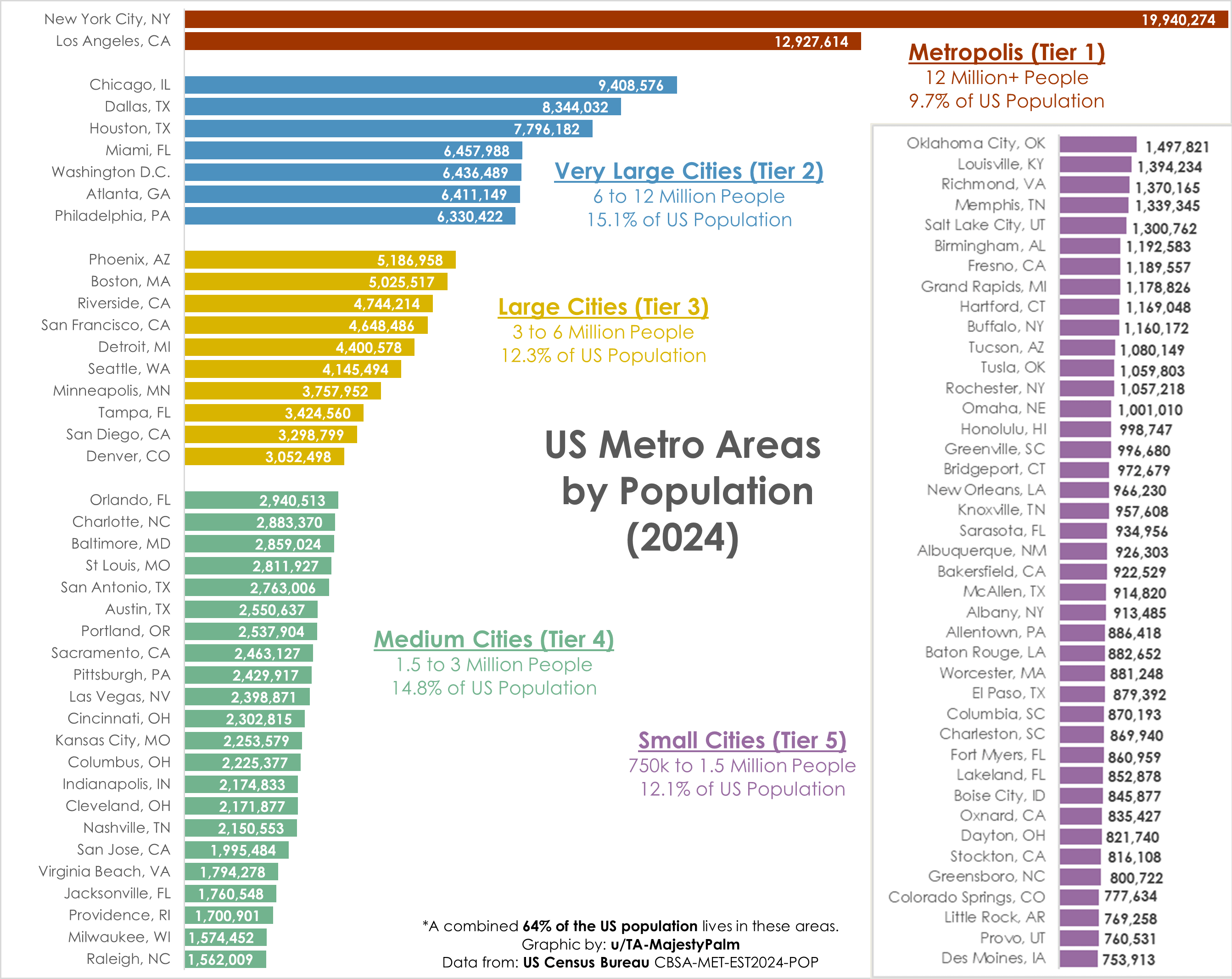
Graphic by me, created in excel. Source dataset here: https://www.census.gov/data/tables/time-series/demo/popest/2020s-total-metro-and-micro-statistical-areas.html
I thought it would be interesting to compare metro area populations of US cities, and try and group them into "Tiers" (large, medium, small etc). People often talk about living in a "small" or "large" city.
For each population tier I simply divided the population threshold by 2, starting from 12 million.
Posted by TA-MajestyPalm
28 Comments
Graphic by me, created in excel. Source dataset here: https://www.census.gov/data/tables/time-series/demo/popest/2020s-total-metro-and-micro-statistical-areas.html
I thought it would be interesting to compare metro area populations of US cities, and try and group them into “Tiers” (large, medium, small etc). People often talk about living in a “small” or “large” city.
For each population tier I simply divided the population threshold by 2, starting from 12 million. Obviously the cutoff points are subjective. The bars are scaled to population.
I think it’s funny that Providence, RI has over 500k more people than the state of Rhode Island. The ‘metro area’ calulation might be a little over tuned lol
Riverside, CA…. wow… the Inland Empire population growth is massive
lmao so we’re just redefining “small” and “medium” cities now? Small is generally anything over 5-10k (depending on source) and over 100k is usually medium
Maybe using “metros” instead of cities would work better.
Interesting. My city has about 160k and I always said I live in a small city.
Apparently the metro area is about 450k and still doesn’t make the list.
These arent cities, this is by metro area.
Orlando, Lakeland, and Tampa all showing up here is fascinating. Increasingly this is just a single huge urban area stretching from coast-to-coast in central
Florida.
Atlanta being considered bigger than SF requires some interesting definitions
Dallas is a city, the metro area is Dallas Fort Worth or DFW.
I’d love to see it by Population Density as well
It continues to blow my mind that anyone uses MSAs for anything other than mocking the federal government’s statisticians.
Virginia Beach is about 450k. The Hampton Roads metro area has the 1.8 million that is mentioned.
This is a much better metric for the ‘city’ feel than raw city population. Very cool!
Love this graphic.
I would say that some ‘Large’ cities like Boston and SF and Seattle, feel more like ‘Very Large’ cities. Tampa probably feels more like a ‘Medium’ city as well.
A lot of people are pointing out the weirdness of things like SF and San Jose being separate metro areas (or LA and Riverside), but the Census does have Combined Statistical Areas (CSAs) for those ‘larger’ definitions. The issue with using CSAs instead is they are *extremely* broad in some cases and would just piss people off even more – things like NYC including Trenton, Boston including Providence, Portland including Salem, etc. There is no happy medium unfortunately, at least one thats officially defined and measured.
Greenville metro area is surprising. I had no idea it was that big.
Every city here has more people than some whole states.
As someone who lives in southern California, riverside is not that big. Are they including all of riverside and orange counties or something like that?
That’s not the population of Fresno though 🤨 I think we’re considerably smaller.
LA feels like a fake big city – you have to drive everywhere. Chicago and NYC are the only true “big cities” in my opinion.
Bring back the Super Sonics!
Interesting, Honolulu “feels” like it has a higher population due to the geography and how crammed in everyone is. Tons of giant condo tower blocks and houses stacked up right next to each other. Also the H1 has way more lanes than many larger cities I’ve been in.
So now I can feel like a Korean Gen Z from a Manwa living in a Tier 2 city.
I’d think Riverside would be part of LA metro
The Data is wrong. “Dallas” is 1.3 million, but DFW (Dallas – Fort Worth) is 8.3 million. So they have counted a metroplex/twin city as just “Dallas”.
Why do the metro and not just the city?
Crazy, I’ve lived in all 5 tiers
they separated Riverside from Los Angeles and San Francisco from San Jose. Those areas are. bigger if you combine them.
if you want to update it I’d recommend doing tiers based on density
And of course the suburbs shouldnt count