
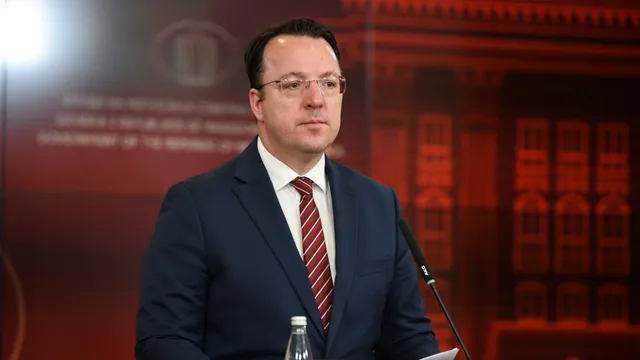
Just a few weeks ago, Nikoloski refused to apologize for the insult “Bulgarians are beggars.”
North Macedonia’s Deputy Prime Minister Aleksandar Nikoloski has once again used Bulgaria to justify the Skopje government’s unwillingness to implement the Negotiating Framework with the European Union, a BGNES reporter said.
Nikoloski stressed that his party, VMRO-DPMNE, remains “firm in its position not to accept constitutional changes under Bulgarian dictate.” He also said that Bulgaria is not complying with the rulings (not rulings, but decisions – ed.) of the European Court of Human Rights in Strasbourg and that Skopje expects their implementation and recognition of a “Macedonian minority” in Bulgaria.
BGNES recalls that just a few weeks ago, Nikoloski refused to apologize for the insult “Bulgarians are beggars.”
“We do not accept constitutional changes under Bulgarian dictates and we have clearly stated our expectations, whether they are related to the historical and political continuity of the Macedonian people, whether they are related to the distinctiveness of the Macedonian language, we have made it very clear that Bulgaria is not implementing the judgments (decisions) of the European Court of Human Rights in Strasbourg, that we want them to be implemented. We have clearly stated that we want Macedonian minorities to be recognised and to be part of the Council of National Minorities that Bulgaria has. Our positions are clear,” Nikolovski said in an interview with Channel 5.
He claims that there is a new wave of optimism in the European Union about enlargement, and that several larger member states are prepared to support the process.
“I hope that there is now a new wave of optimism spreading with regard to enlargement, that several larger and stronger EU countries will agree to enlargement, and if they agree to enlargement, they will put pressure on Bulgaria not to block us,” Nikolovski said.
He emphasized that he is the only minister in this government who has signed an intergovernmental agreement with Bulgaria, such as the agreement for the construction of the joint tunnel at Gyueshevo.
“We are trying to speed up the second phase, although unfortunately we inherited a very poor contractor from the previous government. We are trying to speed it up, I expect the first of the three documents to be released early next week — this is the information for conducting a tender, because we are following the rules of the European Investment Bank. I hope that with the start of the new construction season, it will be able to be put into operation,” Nikolovski emphasized. | BGNES